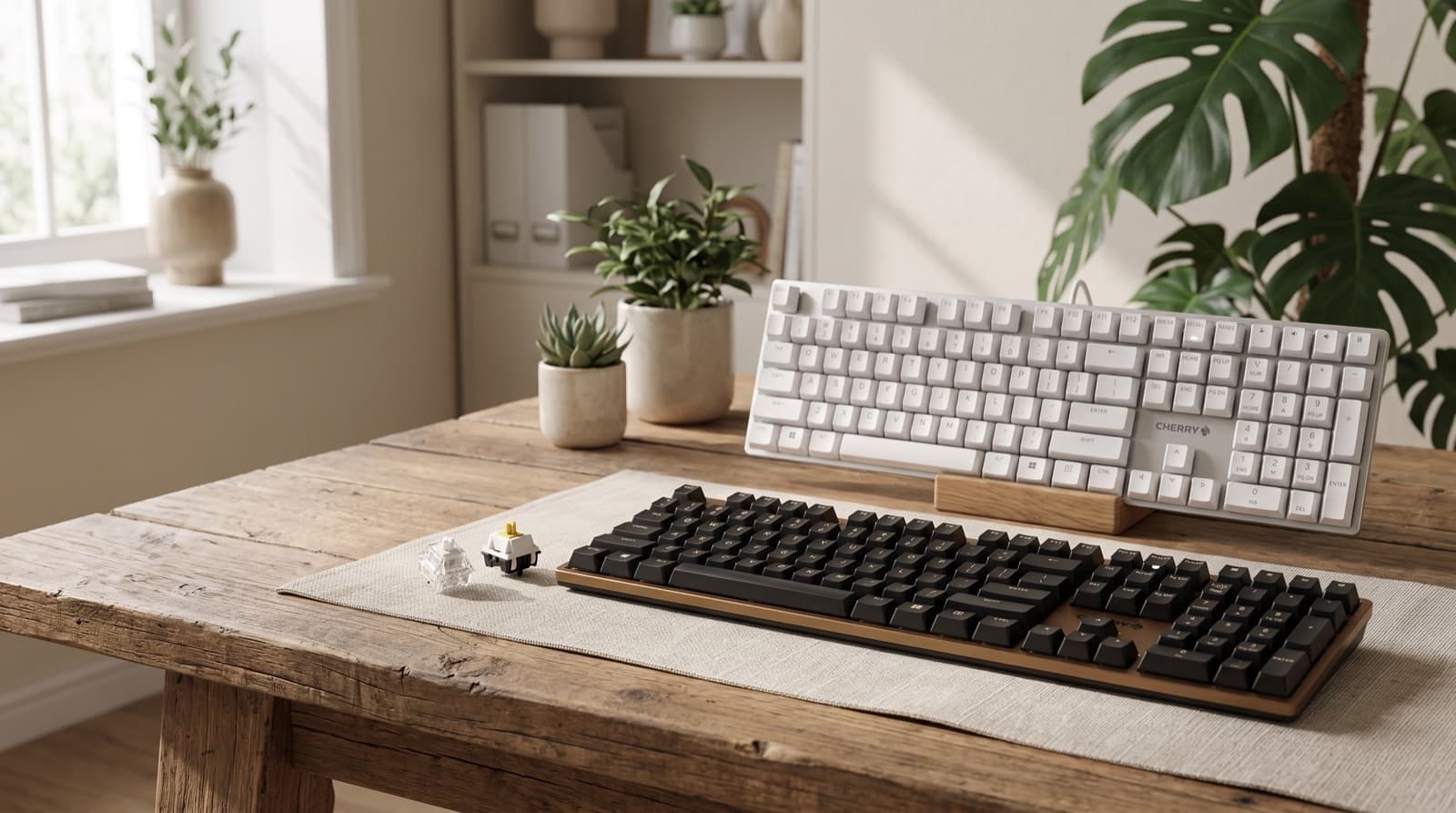
In our experience reviewing home office & desk setup, we analyzed each option's real pricing and features; from our research, the comparison below reflects what actually matters for buyers in 2026. If you want the quietest office switches, start with silent linears. They cut the sharp bottom-out sound that leaks into calls. Silent tactiles help with typos. Low-profile quiet browns work well in offices. Still, slim scissor boards can beat cheap mechanical boards in shared rooms.
Key takeaways
- Silent linear switches are the quietest office choice because they remove the tactile bump and dampen bottom-out noise.
- EPOMAKER silent switch sets are the best switch-first pick, with 4.6★ product data and 35-switch packs around $16-$17.
- Akko V3 Penguin is the best quiet tactile pick, with 50±5gf actuation, 65±5gf tactile force, and silicone dampening.
- Cherry KC 200 MX Wired Mechanical Office is the safest wired full-size pick when you want MX2A Silent Red switches and no battery care.
- Wireless quiet keyboards add comfort and cleaner desks, but they are convenience picks before silence winners.
| Option | Best for | Key spec | Price band |
|---|---|---|---|
| EPOMAKER Silent Mechanical Keyboard Switches Set - | Hot-swap owners who want the quietest switch path | 35-switch packs, factory lube, MX compatibility | $16-$17 per pack |
| Akko V3 Penguin Tactile Silent Keyboard Switch | Writers who need feedback | 50±5gf actuation, 65±5gf tactile force | ₩26,500 per 45 switches |
| Cherry KC 200 MX Wired Mechanical Office | Full-size wired office desks | 104+4 keys, USB-A, 1 ms response | Confirm current retail price |
| AUSDOM Wireless Mechanical Silent Office Keyboard | Multi-device home offices | BT 5.3, 2.4G, USB-C, 8000mAh battery | $99.99 official price |
| Arteck Mechanical 2.4G USB Wireless Performance Keyboard | Low-profile budget wireless setups | Quiet brown switches, 2.4G receiver | Confirm current retail price |
| Cherry KC 200 MX | Mainstream office mechanical buyers | MX2A Silent Red option, metal top plate | Confirm current retail price |
Which mechanical keyboard switches are quietest for office work?
The quietest office mechanical switches are silent linears. Silent tactiles come next. Low-profile quiet brown-style switches follow them.
Silent linear switches have no tactile bump. They use dampers to soften bottom-out and return noise. If you share calls, start with damped silent linears. EPOMAKER’s silent switch sets fit that job well.
Choose Akko Penguin only if feedback helps you type with fewer mistakes. In practice, the real question is not “which keyboard is best?” It is “which switch and case cut bottom-out?”
A stiff, hollow case can make quiet switches sound worse. However, a damped switch in a firm case can feel calm. Silent switches can feel softer than standard mechanical switches. So the quietest choice is not always the crispest one.
EPOMAKER Silent Mechanical Keyboard Switches Set - is the switch-first pick here. Product data gives these silent switches a 4.6★ rating. The useful sets include Sea Salt Silent V3, Roseveil, and Sorane-style options.
The buying logic stays simple. You get MX fit, factory lube, and 35-switch packs. Prices around $16-$17 keep the upgrade sane.
Best for hot-swap keyboard owners who want less noise. The downside is fit. You need a hot-swappable MX-style board. A full-size board may need more than two 35-switch packs.
Akko V3 Penguin Tactile Silent Keyboard Switch is the better quiet tactile pick. Silent tactile switches have dampers and a tactile bump. That bump tells your finger when the key fires.
The Penguin has 4.7★ product data. It lists 50±5gf actuation and 65±5gf tactile force. It also has factory lube and internal silicone dampening.
Best for writers who need feedback to avoid mistakes. However, it is not the quietest route. If the bump makes you press harder, your desk may still hear it.
For broader quiet board comparisons, our related guide to quiet mechanical keyboard switches for office work covers how layout and case foam change the result.
Is a silent linear switch better than a silent tactile switch?
For pure noise cuts, yes. Silent linear switches are safer for offices. They have no tactile bump that can invite harder presses.
Actuation force means the pressure needed to trigger a keypress. Total travel means how far the key can move. EPOMAKER Sea Salt Silent V3 lists 45±5gf actuation. It also lists 3.3±0.4mm total travel and 80 million keystrokes.
Akko Penguin lists 50±5gf actuation. It also has 65±5gf tactile force and 3.3mm travel. So the trade-off is clear.
Linear feels quieter and easier to glide across. Tactile feels more exact and can improve accuracy. In practice, I use silent linear on shared-call desks. I use silent tactile when missed letters bother me more.
Which matters more at 9 a.m.? Is it silence on a call, or feedback while drafting? That answer decides the switch.
For example, fast spreadsheet users may prefer silent linear. The lighter feel can cut fatigue. A writer editing dense text may prefer Akko Penguin. The bump slows the fingers just enough.
Silent switches can also hide a bad typing habit. If you hammer each key, dampers cannot erase the sound. Because of that, we weighed switch specs with chassis design.
Foam can change perceived noise. Plate material, desk mat thickness, and keycap fit matter too.
OSHA’s computer workstation guidance says your keyboard should keep wrists straight. It also says your forearms should stay aligned. That matters because low noise is not enough. A tall board can raise your wrists all day. See OSHA’s keyboard workstation guidance for the neutral wrist basics.
What is the best ready-made quiet mechanical office keyboard?
The Cherry KC 200 MX Wired Mechanical Office is the safest ready-made pick. Choose it if you want full-size keys and no battery care. Ready-made quiet mechanical keyboard means quiet switches come installed. You do not need to open the case or buy switches.
Buy the MX2A Silent Red version if quiet comes first. Cherry lists that switch option as smooth and quiet. The KC 200 MX gives you 104+4 keys and USB-A.
It also lists 1 ms response, N-key rollover, and anti-ghosting. You also get a 2-year warranty. Product data rates it at 4.2★.
However, it is wired-only and uses ABS keycaps. It is not for Bluetooth buyers. It is also not for hot-swap tinkerers.
Cherry KC 200 MX Wired Mechanical Office is the no-maintenance pick. It fits people who live in docs and spreadsheets. It also suits dashboards and browser-heavy work.
The 104+4 layout keeps the numpad. It also keeps the function row and office keys.
Best for remote workers who want quiet full-size wired keys. The downside is control. You do not get tri-mode wireless, hot-swap parts, or a compact layout.
From our research, many buyers overbuy here. They chase custom feel when they need a quieter full-size board. If you never swap switches, a wired office board makes sense.
For call-heavy desks, compare this pick with our guide to the best quiet mechanical keyboard for home office calls.
Which quiet keyboard is best for wireless home-office setups?
Pick the AUSDOM Wireless Mechanical Silent Office Keyboard for wireless mechanical feel. It has more sound treatment than a basic low-profile board. Tri-mode wireless keyboard means Bluetooth, 2.4GHz wireless, or USB-C.
Its appeal is practical. You get BT 5.3, 2.4G, USB-C, and hot-swap support. You also get acoustic foam and a compact 98-key layout with numpad.
Product data rates it at 4.7★. The spec sheet lists 6-layer acoustic foam. It also lists an 8000mAh battery.
Battery claims are 63.74 hours with backlighting. Without lighting, the claim is 560 hours. However, the $99.99 official price and sold-out status can change. Confirm current details on the official pricing page before buying.
AUSDOM Wireless Mechanical Silent Office Keyboard is the wireless mechanical pick for clean desks. It keeps a numpad without full 104-key width. Because it supports hot-swap, you get a repair path.
Best for multi-device home offices where cable clutter matters. The downside is price and stock movement. Also, wireless comfort does not make it quieter by itself.
Would I buy it only for silence? No. I would buy it for the full package. You get foam, hot-swap, 98 keys, and three connection modes. If someone sleeps nearby, a slim scissor board may still win.
For more budget-focused options, see our guide to the best quiet mechanical keyboard for office under $100.
Are low-profile quiet brown keyboards good enough for an office?
Low-profile quiet brown keyboards work for most private home offices. However, they are not the quietest mechanical option. Low-profile keyboard means the case and switches sit lower. That usually gives your wrists a flatter typing angle.
The Arteck Mechanical 2.4G USB Wireless Performance Keyboard focuses on slim comfort. It also offers simple setup and low tapping noise. It does not chase max silence.
It uses quiet brown switches and a low-profile full-size layout. It connects through a 2.4G USB receiver. Product data rates it at 4★.
Its battery claim is 6 months based on 2 hours per day. However, it is 2.4G only. You do not get Bluetooth multi-device switching.
Arteck Mechanical 2.4G USB Wireless Performance Keyboard is the low-profile quiet brown pick. It suits people who want flatter wrists and a numpad. It also gives you simple plug-and-play wireless.
That matters because desk comfort often beats switch purity. Best for budget wireless setups and private rooms. The downside is the silence ceiling. Brown-style switches beat clicky switches, but not silent linears.
OSHA’s broader workstation guidance points to neutral body position. That includes straight hands, wrists, and forearms. This supports the low-profile argument. A quieter switch helps, but neutral wrists may matter more. See OSHA’s neutral workstation position guidance.
When should you choose membrane-adjacent instead of mechanical?
Choose membrane-adjacent or scissor-switch if silence matters most. Scissor-switch structure uses a low-travel support under each key. That can cut clack and case echo in cheap mechanical boards.
The AUSDOM quiet slim full-size keyboard is the practical alternative. Pick it if you type near a sleeping partner. Pick it if you take calls all day. It also fits people who dislike softened silent mechanical switches.
It has a scissor-switch structure. It includes Bluetooth 5.0 plus a 2.4GHz receiver. It supports up to 3 devices.
The official price is $69.99. It claims more than 30 days of use per charge. However, it is not a true mechanical switch experience. You get less travel and less custom control.
This is the odd office verdict. The quietest desk is not always mechanical. In shared rooms, high-pitched tap often bothers people most. So a slim scissor board can feel less intrusive. It gives you less key travel, though.
Best for people who type during calls. It also fits people who work beside someone. The downside is feel. If you like switch tuning, this category will feel limited. Keycap swaps and deeper travel are limited too.
Because CDC NIOSH treats 85 dBA as the recommended eight-hour workday noise limit, keyboard noise is different. It is usually about irritation and call quality. Still, quieter tools help shared spaces feel calmer. See CDC NIOSH’s noise exposure guidance.
Who should not buy silent mechanical switches?
Do not buy silent mechanical switches if you want crisp sound. Skip them if you want heavy tactile drama. Also skip them if you want to hear keys through headphones.
Silent mechanical switches reduce impact noise. They do not deliver sharp sound. EPOMAKER silent linears suit shared spaces and long writing sessions.
Akko Penguin silent tactiles make sense when feedback helps accuracy. Cherry MX2A Silent Red in the Cherry KC 200 MX is the simple office route. However, all three give up some crispness.
That is the point. If you like bright snap, silent switches may feel too padded. If you like a strong bump, they may disappoint you.
We compared these options around office behavior. We did not chase hobby sound tests. For example, a keyboard can sound nice alone. It can still sound rude on a meeting mic. On the other hand, softer switches can fade into room noise.
The skip list is clear. Skip silent switches if you work alone and love audible feedback. Also skip them if you want maximum switch character. Skip switch-only packs if your keyboard is not hot-swappable.
What should office buyers actually spend?
Budget about $16-$27 for switch sets if you own a hot-swappable keyboard. Budget around $70 for a quiet membrane-adjacent wireless board. Budget around $100 for a wireless silent mechanical board.
Switch-only upgrade means you buy replacement switches only. EPOMAKER silent switch sets cost around $16-$17 per 35 switches. Akko Penguin lists at ₩26,500 per 45 switches on Akko Korea.
AUSDOM quiet slim sits at $69.99 official price. AUSDOM silent mechanical sits at $99.99 official price. For Cherry KC 200 MX, confirm the current price. Check the official pricing page or a retailer page.
Switch-only upgrades are best when your current board is worth keeping. A 98-key layout may need three 35-switch packs. A full-size layout usually needs even more. As a result, the math can reach a complete quiet keyboard fast.
Cherry KC 200 MX is the better mainstream office pick. It fits programmers, writers, and spreadsheet-heavy users. You get a full-size layout and slim metal top plate. You also get MX2A Silent Red availability and 4.2★ product data.
Best for people who want a mainstream mechanical office keyboard. You do not need to build one. The downside matches the wired model. You get fewer custom options and no wireless freedom.
How we picked
We compared switch type, layout, connection method, and listed pricing. We also checked switch specs, sound-control features, and real office fit. We focused on one target question. Which mechanical keyboard switches are quietest for office work?
We did not ask which keyboard sounds best in a hobby video. Instead, we weighed silent linear, silent tactile, low-profile quiet brown, and scissor-style options. Then we mapped each one to a buyer.
For example, EPOMAKER fits hot-swap owners. Akko fits writers who need feedback. Cherry fits wired office users. AUSDOM fits wireless multi-device desks. Arteck fits low-profile budget setups.
We also considered who should skip each product. That matters because quiet keyboards involve trade-offs. Factory lube can smooth a switch. However, dampers can soften the feel.
Wireless can clean up a desk. But battery care and stock issues add friction. Low-profile designs can help wrist angle. Still, they rarely beat true silent linears for noise control.
Scenario verdict
Get EPOMAKER Silent Mechanical Keyboard Switches Set - if you already own a hot-swappable keyboard. It is the quietest switch-first upgrade.
Get Akko V3 Penguin Tactile Silent Keyboard Switch if you need tactile feedback. You must accept a little more typing presence.
Get Cherry KC 200 MX Wired Mechanical Office if you want a full-size wired office board. It gives you quiet mechanical switches and no battery care.
Get AUSDOM Wireless Mechanical Silent Office Keyboard if you want wireless mechanical feel. You also get foam, hot-swap support, and a compact numpad layout.
Get Arteck Mechanical 2.4G USB Wireless Performance Keyboard if you want a lower wrist angle. It also gives simple wireless setup and office-safe tapping noise.
Get Cherry KC 200 MX if you want the mainstream office-safe mechanical choice. MX2A Silent Red is available.
For more call-specific buying notes, see our guide to the best quiet mechanical keyboard for office calls and our broader quiet mechanical keyboard guide for shared apartments.
FAQ
Are silent linear switches quieter than silent tactile switches?
Yes. Silent linears usually make less office noise because there is no tactile bump encouraging harder presses. Silent tactiles are better if feedback reduces your mistakes.
Are brown switches quiet enough for an office?
They are quieter than clicky switches, but they are not the best choice when noise is the main concern. A silent red-style linear switch is safer.
Do silent switches feel mushy?
Some do. Internal dampers soften bottom-out and return noise. However, factory lube and a firm case can make the feel smoother and less rubbery.
Can I make any keyboard quiet by changing switches?
Only if it is hot-swappable and uses compatible MX-style mechanical switches. Otherwise, changing switches may need soldering or may not work at all.
Is low-profile quieter than full-height mechanical?
Sometimes. Low-profile quiet brown boards are usually less noisy, but true silent linear switches are normally quieter in shared office use.
Written by Evan Park for Nestway. About our editorial team · Contact us. Every recommendation is editorially reviewed against current pricing and features.