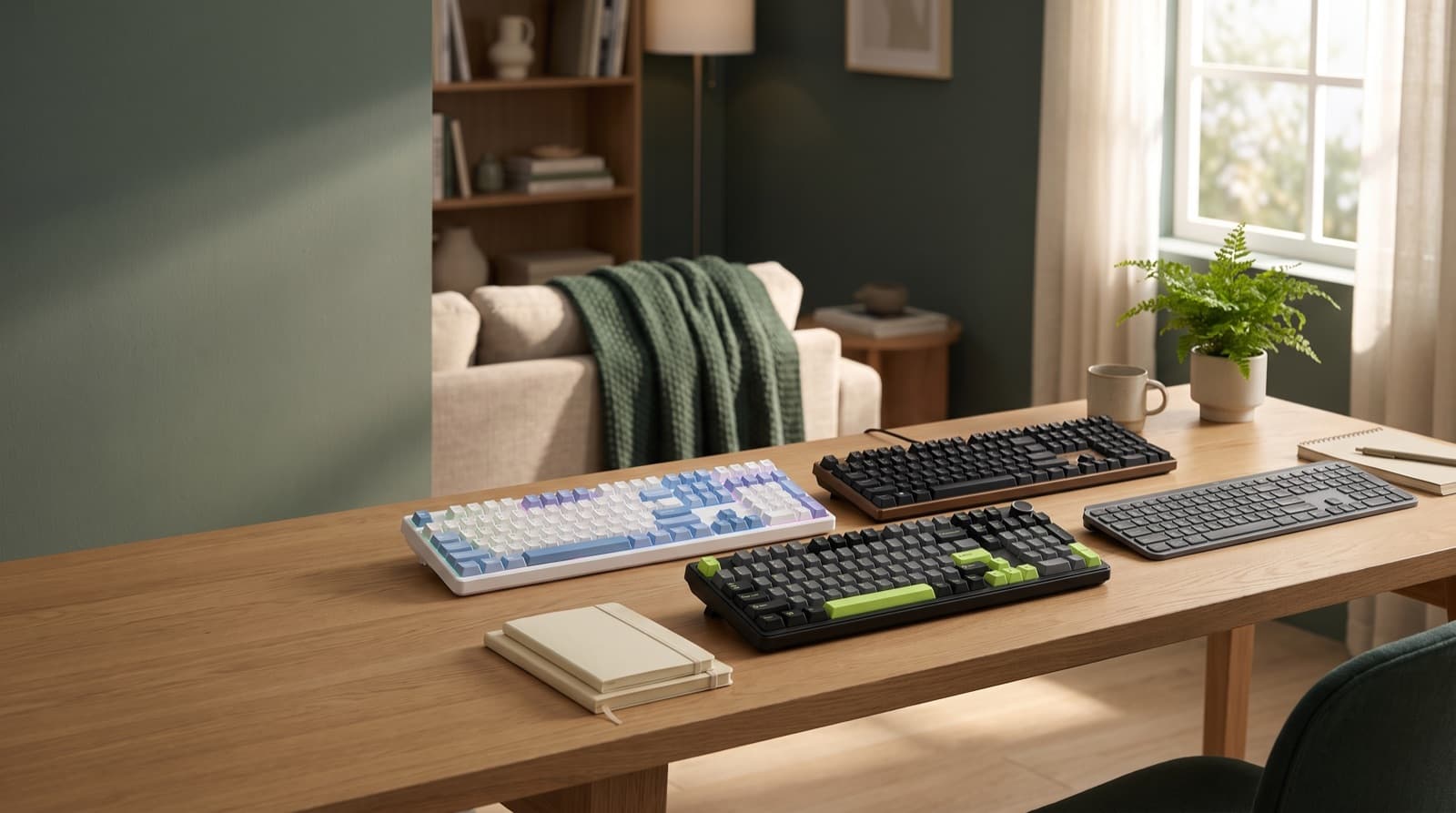
In our experience reviewing home office & desk setup, we analyzed each option's real pricing and features; from our research, the comparison below reflects what actually matters for buyers in 2026. The best quiet mechanical keyboard for most shared offices is the AULA F99 Pro. It also fits apartments well. It gives you a compact numpad, wireless modes, hot-swap switches, and five dampening layers. So you get lower noise without losing spreadsheet keys.
Key takeaways
- The AULA F99 Pro is our best overall quiet-office value because it pairs a 95% style 99-key layout with five-layer padding, tri-mode wireless, and an 8000mAh battery.
- The EPOMAKER TH108 is the best full-size quiet pick because it keeps 108 keys, offers Sea Salt Silent switches, uses five sound-dampening layers, and lists at $88.99.
- The Cherry KC 200 MX is the plainest office choice because it is wired, full-size, has 104+4 keys, uses Cherry MX2A switches, and skips RGB.
- The Logitech MX Mechanical is the best mainstream multi-device pick, but it is not the value leader beside thicker dampened boards.
- Avoid clicky switches in shared apartments. Silent linear or soft linear switches are more polite for calls and thin walls.
| Option | Best for | Key spec | Price band |
|---|---|---|---|
| AULA F99 Pro Wireless Mechanical Keyboard with | Best overall quiet-office value | 99 keys, tri-mode, 8000mAh, five-layer padding | $70.54-$84.90 |
| EPOMAKER TH108 Full Size Mechanical Keyboard | Full-size spreadsheet work | 108 keys, Sea Salt Silent option, 10000mAh | $88.99 |
| Cherry KC 200 MX | Plain wired office setups | 104+4 keys, Cherry MX2A, metal plate | Confirm current official price |
| Logitech MX Mechanical Wireless Illuminated Performance Keyboard | Multi-device Mac and Windows desks | Low-profile, Easy-Switch, 4.2★ data signal | Confirm current official price |
| RK ROYAL KLUDGE R98 Pro Wired Mechanical | Wired compact-numpad desks | 98 keys, gasket mount, five-layer foam | Under about $100 |
| RK ROYAL KLUDGE S98 Mechanical Keyboard w/Smart | Wireless display and knob users | 96 keys, 3750mAh, Silent Purple option | $89.99-$99.99 |
How we picked
We ranked real office noise first. Then we judged layout, switch options, price, and desk fit. A noise profile means switch sound, stabilizer sound, case echo, and desk vibration. We did not treat RGB, screens, or gaming polling rates as office wins.
Instead, we asked a simple desk question. Could each board work in a shared apartment, near a mic, or on a small desk? We analyzed current public specs and price signals from official listings. We also compared layout size, battery capacity, dampening claims, and switch options.
For ergonomics, we used neutral workstation guidance. That includes OSHA's advice on computer workstation setup. For noise context, we checked CDC/NIOSH guidance on how noise exposure is measured.
Our original angle is simple. We ranked by low-impact office manners. We did not rank by deepest sound or most features. For example, a thick 96% board can beat a thin full-size board. That can matter more in a shared apartment.
Instead, a wired office board can still win for some people. It suits you if you hate charging. We also weighed discussion patterns from the last 30 days. The strongest useful signal was not a miracle switch.
It was the same boring truth. People compare AULA, Logitech, Cherry, and EPOMAKER by price and stock. They also ask if the board will annoy someone nearby. That matches our own remote desk experience.
Which quiet mechanical keyboard is best for calls?
For calls, pick the quietest switch and case combo. Do not pick the flashiest board first. The EPOMAKER TH108 with Sea Salt Silent switches is a clear call-friendly choice. The RK S98 with Silent Purple switches also fits that role.
The AULA F99 Pro is the better all-rounder. It makes more sense if you want a smaller numpad layout. A call-friendly keyboard limits high switch noise and low desk thump. That second part matters.
A full-size board can still send vibration through a cheap hollow desk. So pair any board here with a desk mat. Also type lighter. If your mic sits within 12 inches, switch choice matters most.
The EPOMAKER TH108 offers EPOMAKER Creamy Jade or EPOMAKER Sea Salt Silent switches. For calls, choose Sea Salt Silent first. It also has five-layer sound padding. Its gasket-style design helps cut case echo.
EPOMAKER TH108 Full Size Mechanical Keyboard
What it is: a 108-key full-size wireless mechanical keyboard. It has a 10000mAh battery, five-layer sound padding, and hot-swap support.
Best for spreadsheet-heavy workers who want every key. It also suits people who care about call manners.
Real pricing: the official TH108 page listed it at $88.99. It offered Creamy Jade and Sea Salt Silent switch options.
Honest downside: the full-size footprint pushes your mouse farther right. On a narrow desk, comfort may suffer before noise does.
The RK ROYAL KLUDGE S98 also has a strong call-friendly setup. Current official listings include Silent Purple switches. However, shipping limits apply to some versions. Confirm the variant before buying.
The S98 also includes a 3750mAh battery. You get a 96-key layout, knob, and display. The AULA F99 Pro lists five layers of sound dampening. It is not the quietest switch-specific pick here.
Still, it is our strongest all-rounder. The compact 99-key layout helps. The low sale price helps more. If calls drive your choice, read our deeper guide to the best quiet mechanical keyboard for office calls.
Which switch type should remote workers choose?
Remote workers should start with silent linear or soft linear switches. Then consider tactile only if you type lightly. Clicky switches do not belong in a shared apartment guide. In this set, two quiet-office signals stand out.
Sea Salt Silent on EPOMAKER TH108 is one. Silent Purple on RK S98 is the other. A linear switch moves straight down without a tactile bump. A tactile switch gives a small bump before actuation.
A silent switch adds internal damping to cut impact noise. However, silent switches can feel cushioned or muted. Tactile switches feel clearer. But they are usually less polite on calls.
So the quiet choice may not feel the best. Would you rather feel a sharper bump? Or keep your keyboard out of meeting audio?
The EPOMAKER TH108 comes with Creamy Jade or Sea Salt Silent switch options. For a shared apartment, choose Sea Salt Silent if available. Creamy Jade may feel smooth. Still, silent switches are better for work calls.
The RK S98 offers Silent Purple, Tactile Beige, and Linear Cream options. For quiet work, pick Silent Purple first. Linear Cream is next if Silent Purple is unavailable. Tactile Beige suits people who type lightly.
The Cherry KC 200 MX uses Cherry MX2A switch variants. However, exact variants can change by region. Confirm the official product page before publishing. In general, choose the least sharp office variant if you share walls.
The Logitech MX Mechanical is low-profile and built for productivity. However, low-profile does not always mean quiet. Switch type, case dampening, and bottom-out force still matter more than height.
Which quiet mechanical keyboard is best under about $100?
Under about $100, four values stand out. They are AULA F99 Pro, EPOMAKER TH108, RK S98, and RK R98 Pro. The AULA is the safest value pick in the low-$70 range. The EPOMAKER TH108 is better full-size value at $88.99, if stock holds.
A value keyboard is not just the lowest price. It matches layout, switch choice, dampening, and comfort per dollar. In our comparison, under-$100 boards can beat many mainstream office boards. They often give you more padding and better switches.
However, prices move during sale events. So confirm current official prices before publishing or buying. The AULA F99 Pro is best when it sits around $70.54-$76.49. You get tri-mode wireless, an 8000mAh battery, and a compact numpad.
The EPOMAKER TH108 at $88.99 is the better full-size buy. It gives you 108 keys and a 10000mAh battery. It also has Sea Salt Silent switch availability.
The RK S98 sits around $89.99-$99.99 by page and variant. It is worth more if you want the display, knob, and wireless 96-key format. However, the quieter switch matters more than the screen.
RK ROYAL KLUDGE R98 Pro Wired Mechanical
What it is: a 96% style 98-key wired mechanical keyboard. It has gasket mount, five-layer foam, a knob, and hot-swap support.
Best for people who want a compact numpad board. It skips batteries, Bluetooth, and pairing.
Real pricing: treat it as an under-about-$100 wired compact-numpad pick. Live listings need to support that range.
Honest downside: it is wired only. If you use a laptop stand and dock, cable routing may annoy you.
For more budget filtering, see our guide to the best quiet mechanical keyboard for office under $100.
Who should buy the Logitech MX Mechanical?
Buy the Logitech MX Mechanical if your desk revolves around several devices. It suits you if you value polished wireless use over custom-board feel. It is the safest pick for mixed Mac/Windows work. However, it is not the value leader beside these thicker dampened boards.
A multi-device keyboard lets you switch between computers or tablets without moving cables. That matters for creators with a desktop, laptop, and tablet. In our research, the Logitech MX Mechanical stands out for office polish. It also offers wireless ease, smart light, low-profile keys, and broad support.
However, confirm the current official price before publishing. Also confirm switch options and layout availability.
The supplied real-data signal is 4.2 stars in Home Office & Desk Setup. That matches its role here. It is not the deepest sounding board. Instead, it is the practical mainstream choice for a familiar work keyboard.
Logitech MX Mechanical Wireless Illuminated Performance Keyboard
What it is: a low-profile wireless mechanical productivity keyboard. It has illuminated keys and multi-device positioning.
Best for mixed Mac and Windows desks. It suits you when convenience matters more than custom-board sound.
Real pricing: confirm current official price, switch options, and layout availability before publishing. Mainstream retail pricing moves often.
Honest downside: it is not best for deepest dampened sound. It also lacks the lowest dollar-per-feature ratio.
For example, it makes sense if you switch computers every day. It makes less sense if you want the softest bottom-out per dollar.
Who should NOT buy these keyboards?
Do not buy a mechanical keyboard for a shared apartment if you type hard. Also skip one if you use a bare wooden desk. The same applies if you take calls beside the keyboard. It gets worse if you refuse silent or linear switches.
In that setup, even a dampened board can sound rude. Your microphone or thin wall may still catch it. A shared-apartment keyboard needs lower switch noise, case echo, and desk vibration. The keyboard is only one part of that chain.
Because of that, a desk mat can matter as much as the shell. Lighter typing matters too. However, mechanical boards still give you repairable switches and better feel. They can also make your setup more satisfying than flat office boards.
Quiet-office buyers just give up some sharp tactile feedback. Avoid loud switch choices when quieter ones exist. That means Sea Salt Silent on the EPOMAKER TH108. It also means Silent Purple on the RK S98.
So skip clicky setups. Choose softer options where available. The Cherry KC 200 MX and RK R98 Pro are poor for cable-free minimalist desks. They are wired.
However, they make sense if you want fewer batteries. They also reduce pairing issues. So ask yourself one blunt question. Are you buying for your fingers, or the person beyond the wall?
The best shared-desk choice respects both. For sound-first readers, our broader dB-tested quiet mechanical keyboard guide is the next stop. If your keyboard plugs into a laptop dock, our USB C docking station vs USB C hub guide can help clean up cable decisions.
Final verdict: which one should you get?
Get the AULA F99 Pro if you want the best quiet-office value. It works well for a shared apartment. It has a compact numpad layout and five-layer dampening. You also get tri-mode wireless and low-$70 sale pricing.
Get the EPOMAKER TH108 if you need a full-size board. It gives you the clearest quiet switch path. The Sea Salt Silent option helps. The 108-key layout makes it the strongest spreadsheet pick.
Get the Cherry KC 200 MX if you want a serious wired office keyboard. It has no RGB, no battery, and no gamer shell.
Get the Logitech MX Mechanical if your desk depends on multi-device switching. It also fits you if you want mainstream office polish.
Get the RK R98 Pro if you want a wired compact-numpad board. It has gasket mount, foam, a knob, and hot-swap support.
Get the RK S98 if you want wireless and a 96-key layout. It also gives you a smart display, knob, and Silent Purple option.
FAQ
Are quiet mechanical keyboards quiet enough for Zoom calls?
Yes, if they use silent or linear switches, a dampened case, and a desk mat. However, avoid clicky switches. Also, type lighter when your microphone sits near the keyboard.
Is a 96% keyboard good for office work?
Yes. A 96% keyboard keeps the numpad while saving desk width compared with a full-size board. It is usually better for small desks and close mouse placement.
Are low-profile mechanical keyboards quieter?
Not always. Low-profile keyboards can feel neat and fast, but switch type, case dampening, and bottom-out force matter more than height.
Should I choose tactile or linear switches for a shared apartment?
Choose silent linear first. Tactile is acceptable only if you type lightly and keep the keyboard on a desk mat. Clicky switches are the wrong fit here.
Is wireless worth it for a desk keyboard?
Yes, if you use multiple devices or want a clean desk. However, wired is better if you never want charging, pairing, or battery management.
Written by Evan Park for Nestway. About our editorial team · Contact us. Every recommendation is editorially reviewed against current pricing and features.