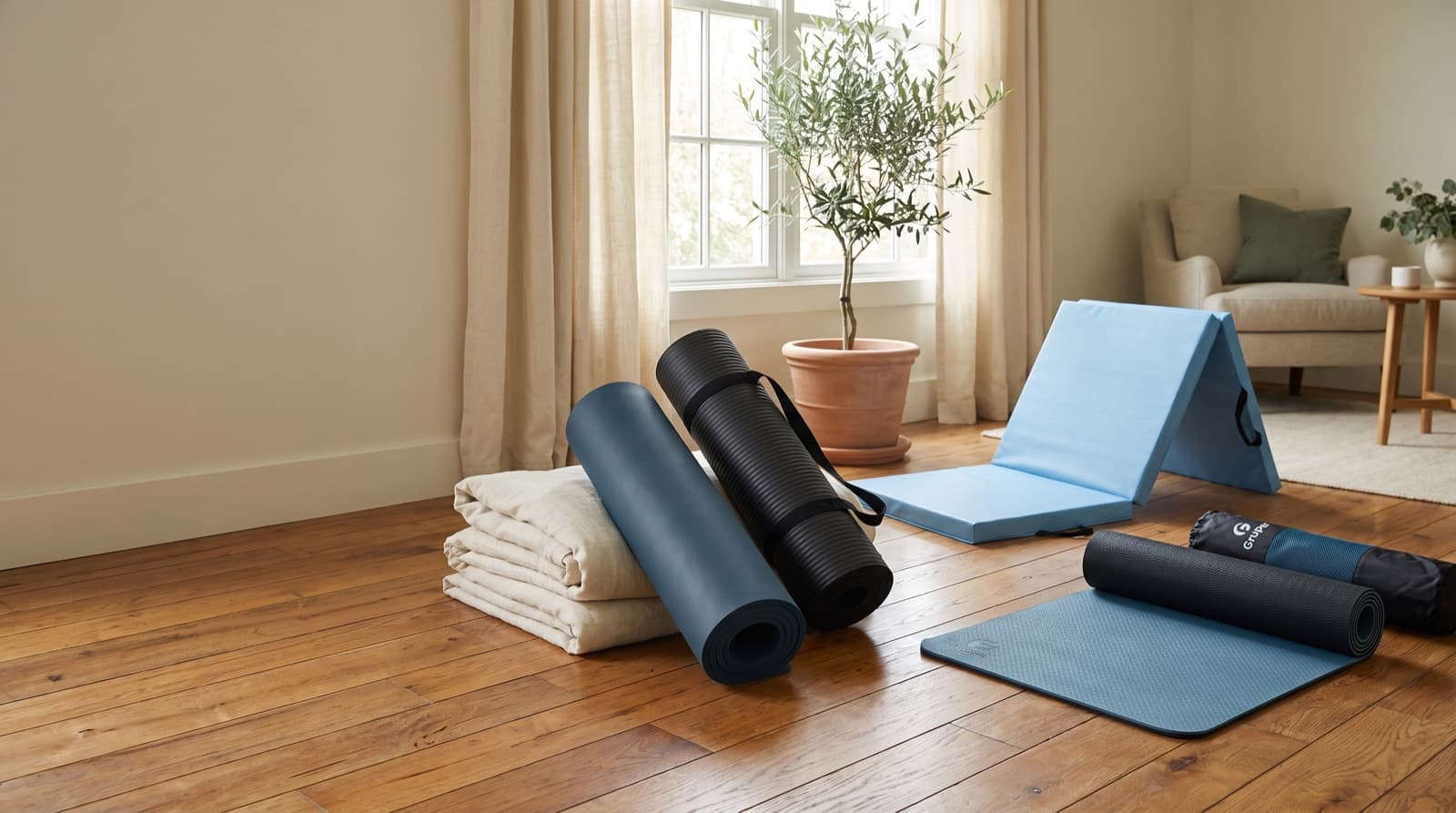
The best yoga mat for hardwood floors stays put and cushions pressure points. It also keeps standing poses from feeling wobbly. For most beginners, choose moderate thickness and reliable texture. Retrospec Solana is the comfort pick. Gruper is the better grip-first pick.
Key takeaways
- A 1-inch mat like the Retrospec Solana is best for knees, wrists, hips, and floor workouts, but it is not the best pick for balance-heavy yoga.
- The Amazon Basics Extra Thick mat is the safest budget pick for beginners who want cushioning first and can tolerate basic grip.
- Folding mats like the CAP Barbell All Purpose Folding Anti Tear are better for apartment storage and bodyweight work than for flowing yoga transitions.
- For hardwood floors, underside grip matters as much as top texture. A mat that slides on wood is a bad yoga mat, no matter how soft it feels.
- If you sweat heavily, prioritize textured non-slip surfaces like Gruper over plush foam thickness.
| Option | Best for | Key spec | Price band |
|---|---|---|---|
| Retrospec Solana Yoga Mat 1" Thick w/Nylon | Sore knees and wrists | 1-inch cushioning | about $25-$45 |
| Gruper Yoga Mat Non Slip | Grip-focused home practice | Textured non-slip surface | about $20-$35 |
| Amazon Basics Extra Thick Exercise Yoga Mat | Budget beginners | 1/2-inch cushioning, strap often included | about $18-$30 |
| Gaiam Thick Yoga Mat with Easy-Cinch Carrying | Portable comfort | Thick cushioned roll-up design | about $20-$35 |
| CAP Barbell All Purpose Folding Anti Tear | Small apartments | Folding panel storage | about $35-$60 |
| CAP Barbell 1/2-Inch High Density Exercise Yoga | Firmer middle ground | 1/2-inch high-density foam | about $20-$35 |
What is the best yoga mat for hardwood floors in 2026?
The best yoga mat for hardwood floors stays put and cushions sore spots. It should not make standing poses feel shaky. Hardwood-floor grip means grip on top and grip under the mat.
In our comparison, that bottom grip mattered more than beginners expect. A plush mat feels good in child’s pose. However, it can creep on bare wood during lunges.
For most homes, Retrospec Solana Yoga Mat 1" Thick w/Nylon is the comfort-first pick. Gruper Yoga Mat Non Slip is the grip-first pick. Amazon Basics Extra Thick Exercise Yoga Mat is the budget beginner pick.
However, thicker does not always mean better. Soft foam can blur your foot pressure. That matters in tree pose, Warrior III, and single-leg work.
If you have a small home gym, match the mat to your workouts. For example, stretching near dumbbells needs less grip than sweaty vinyasa. If you lift too, read our adjustable dumbbells for home gyms guide.
How we picked
Selection criteria are the real things that decide if a mat works on wood. We checked underside grip, top texture, cushion, firmness, storage, cleaning, and price. We also weighed hardwood use more than studio use.
We compared these six mats by public specs and current price bands. We also checked buyer concerns from June and July 2026. In practice, hardwood grip mattered more than extra softness.
We did not rank by thickness alone. Instead, we asked simple home-gym questions. Does it protect knees in tabletop? Does it stay down during step-backs?
Can a beginner carry or store it? Does it make balance less exact? Because grit and moisture can mark wood, cleaning also mattered.
Hardwood care guidance from the National Wood Flooring Association, quoted by Architectural Digest, stresses dry debris control and careful moisture use. That matters when sweat, dust, and foam mats meet finished wood.
Which mat is best if my knees or wrists hurt on hardwood?
If hardwood hurts your knees, wrists, or hips, start with Retrospec Solana Yoga Mat 1" Thick w/Nylon. Joint cushioning means padding where bones press into the floor. That includes kneecaps, wrist heels, elbows, and hip points.
One inch of cushioning feels much softer than a thin yoga mat. It helps in tabletop, low lunges, kneeling stretches, and core work. Still, it works better for comfort than fast balance moves.
In my home coaching, floor pain stops beginners faster than poor flexibility. So, if thick foam keeps you training, it wins. However, soft foam can sink under your hands and feet.
That can make Warrior III and tree pose feel less exact. It can also affect single-leg strength drills.
Retrospec Solana Yoga Mat 1" Thick w/Nylon
Retrospec Solana Yoga Mat 1" Thick w/Nylon is the comfort-first mat here. The 1-inch thickness is the main reason to buy it. It helps when kneeling poses feel sharp on hardwood.
It suits beginners, Pilates basics, ab work, stretching, and slow mobility. Still, it is not my pick for fast balance work.
Best for sore-knee beginners: Choose it for floor work, gentle yoga, stretching, or short home workouts on bare wood.
Real pricing: We found it most often in the about $25-$45 range. However, check the current official price. Colors and stock shift often.
Honest downside: Do not buy it for balance-heavy yoga. The foam feels good, but foot pressure feels less exact.
Amazon Basics Extra Thick Exercise Yoga Mat
Amazon Basics Extra Thick Exercise Yoga Mat is the low-cost cushioned choice. It is often listed as a 1/2-inch mat. The listing often shows a basic carrying strap.
For a beginner, that gives enough padding for knees and seated stretches. It also works for light floor exercise.
Best for budget beginners: Choose it for stretching, beginner yoga, or occasional Pilates.
Real pricing: It often sits around the about $18-$30 band. However, check the current Amazon price. Amazon pricing changes often.
Honest downside: It is not the best grip or durability pick for sweaty daily practice.
Gaiam Thick Yoga Mat with Easy-Cinch Carrying
Gaiam Thick Yoga Mat with Easy-Cinch Carrying is the portable comfort pick. It suits you if you want padding. However, it avoids a bulky 1-inch mat in the room.
Best for carry-friendly comfort: Choose it if you move your mat between rooms, classes, or storage spots.
Real pricing: Expect a common price band around about $20-$35. Color and stock can change that.
Honest downside: It is still a comfort mat. If you sweat hard, choose top grip before easy carry.
Which mat grips best when I practice on bare hardwood?
For bare hardwood, grip has two jobs. Your hands need traction on top. The mat also needs friction underneath.
Non-slip texture means a pattern or surface feel that helps stop sliding. Gruper Yoga Mat Non Slip leads here because grip is its main job. It suits home workouts where control beats plush feel.
Recent buyer talks from June and July 2026 repeat the same complaint. People want mats that stay put on hardwood or tile. That is not a small issue.
If your mat moves during a plank step-back, your shoulder position changes fast. Your wrist position changes too. Retrospec Solana cushions well, but it is not the grip-first pick.
Instead, use Gruper when sliding and sweaty hands cause the problem.
Gruper Yoga Mat Non Slip
Gruper Yoga Mat Non Slip is the grip-first pick for hardwood. It is the mat I suggest when someone says, “My mat keeps moving.” It is not my first pick for, “My knees hurt.”
Best for sweaty hands and sliding floors: Choose it for bare hardwood, tile, or another smooth floor. It gives a more controlled feel.
Real pricing: We found common pricing around about $20-$35. Color and size can change the final number.
Honest downside: Non-slip texture can feel firmer than 1-inch foam. That is the trade-off.
If sweaty flows are your main workout, grip beats thickness. If you also use bands, keep the mat firm enough for standing pulls. Our beginner guide to which resistance band to buy covers that next step.
Are thick yoga mats bad for balance poses?
Thick yoga mats are not bad. However, soft foam makes balance harder when your foot sinks or rocks. Balance feedback means what your foot senses from the surface below.
On hardwood, the floor itself is stable. The mat becomes the unstable layer. Choose thick foam for comfort. Choose thinner or firmer mats for balance.
Retrospec Solana gives you 1 inch of comfort. That helps for kneeling and floor work. However, a firmer 1/2-inch option can feel cleaner underfoot.
The CAP Barbell 1/2-Inch High Density Exercise Yoga mat is the best middle ground here. Gaiam Thick Yoga Mat with Easy-Cinch Carrying also makes sense. It gives padding without a huge storage burden.
The more cushion you add, the less exact your foot pressure feels.
This is where beginners often buy the wrong mat. Do your wrists hurt in plank? Or do you wobble in tree pose?
Those are different problems. For example, a soft 1-inch mat helps wrist pain. It can make balance worse.
CAP Barbell 1/2-Inch High Density Exercise Yoga
CAP Barbell 1/2-Inch High Density Exercise Yoga is the firmer middle-ground mat. It gives more cushion than a thin yoga mat. Still, it should feel less floaty than 1-inch foam.
Best for stability plus padding: Choose it if hardwood hurts. It still keeps standing poses and single-leg work controlled.
Real pricing: Expect about $20-$35 in many listings. However, confirm current details before buying.
Honest downside: It will not feel as soft as the Retrospec Solana for kneeling. If knees matter most, go thicker.
For strength-focused home gyms, mat firmness matters even more. If you are adding dumbbell work, read our Bowflex SelectTech 552 review first.
What is the best budget yoga mat for hardwood floors?
The best budget pick is Amazon Basics Extra Thick Exercise Yoga Mat. It gives beginners a simple cushioned mat. It also avoids making the purchase too complex.
Budget mat value means solving the main beginner problem at a fair low price. It may skip premium grip, premium materials, or long life. That trade-off can still make sense.
Choose it for starter yoga, stretching, Pilates basics, or light floor exercise. It works best when comfort matters first. The key spec is its extra-thick 1/2-inch style cushioning.
The official listing often shows basic carry-strap portability. However, price changes often. Check the current Amazon price before you buy.
In our comparison, I would not choose it for sweaty daily flows. Instead, I would choose it for a beginner using a towel now.
The honest question is simple. Are you practicing three times a week? Or are you still building the habit?
If you are building the habit, start with comfort and price. As a result, Amazon Basics earns the budget slot.
Which mat is best for small apartments and easy storage?
The CAP Barbell All Purpose Folding Anti Tear mat is the best apartment pick. Folding storage beats rolling a large foam mat behind a door. It also works better under many beds.
Folding storage means the mat folds into flat panels. It does not form a long tube. That makes it easier to stack in a closet.
It also slides beside a sofa more easily. You can store it flat under other gear. It works best for stretching, bodyweight work, and floor protection.
It is not ideal for classic flowing yoga. In small apartments, the best mat is often the one you put away. However, fold seams can feel obvious under hands and feet.
The CAP Barbell 1/2-Inch High Density Exercise Yoga mat is better for roll-up use. Choose that if you want fewer breaks during poses.
CAP Barbell All Purpose Folding Anti Tear
CAP Barbell All Purpose Folding Anti Tear is the storage pick. It is more exercise mat than classic yoga mat. That is why it fits some apartments better.
Best for apartment floor work: Choose it for stretching, pushups, core circuits, and hardwood protection during bodyweight training.
Real pricing: We found it commonly around about $35-$60. Size and seller affect the final price.
Honest downside: The panel folds can interrupt smooth vinyasa moves. Do not buy it for fast flow practice.
Because folding mats cover more floor, they help under light bodyweight circuits. However, keep grit off the underside. Finished wood can scratch when debris gets trapped and pressure moves.
Who should not buy a thick yoga mat for hardwood floors?
Do not buy a thick mat if balance is your main goal. Skip it for power yoga too. Also skip it for sweaty flows where foot stability matters more than padding.
Thick foam means mat cushioning that favors comfort over precision. It works best for sore joints, floor work, and hard surfaces. It is not the cleanest choice for standing control.
Retrospec Solana is not for balance-first users. Amazon Basics Extra Thick is not for heavy sweaters who need top grip. CAP Barbell All Purpose Folding Anti Tear is not for smooth vinyasa flow.
Comfort and stability pull in opposite directions. There is no honest way around that. If you kneel a lot, choose cushion.
If you do jump-backs, hot flows, or single-leg work, choose firmer grip.
Also, think about safety. The HHS Physical Activity Guidelines for Americans tell adults to choose activity types that fit their current fitness level and goals. In practice, the right mat is part of that setup.
A wobbly surface will not help if balance is already your weak point.
How to protect hardwood floors under a yoga mat
Hardwood protection starts before the mat touches the floor. Floor transfer means residue, color, moisture, or grit moves between mat and wood. A clean mat usually should not harm hardwood.
However, trapped grit can act like sandpaper. Sweat can also sit under foam. That happens if you roll the mat too fast.
So, dry the floor and wipe the underside. Let both surfaces air out after sweaty sessions.
For example, do not roll a damp mat after a 30-minute flow. Do not leave it seam-side down. Instead, hang it over a chair until dry.
If you use the mat near dumbbells or bands, vacuum first. Tiny rubber flakes or grit can grind into the finish.
The mat should protect the floor. It should not hide damage risk. If your floor has a delicate finish, test the mat first.
Scenario verdict: which one should you get?
Get Retrospec Solana Yoga Mat 1" Thick w/Nylon if hardwood hurts. It helps knees, wrists, hips, or your spine. It is the comfort-first pick, not the balance pick.
Get Gruper Yoga Mat Non Slip if sliding is your main problem. It is the best hardwood-floor choice for grip-focused home practice.
Get Amazon Basics Extra Thick Exercise Yoga Mat if you are a beginner. It suits low-cost stretching, Pilates basics, or light yoga.
Get Gaiam Thick Yoga Mat with Easy-Cinch Carrying if you want padding. It carries and stores more easily than a bulky 1-inch mat.
Get CAP Barbell All Purpose Folding Anti Tear if you live in a small apartment. It works for bodyweight training and floor protection.
Get CAP Barbell 1/2-Inch High Density Exercise Yoga if 1-inch foam feels too unstable. It still helps when hardwood hurts.
FAQ
Is a 1-inch yoga mat too thick for hardwood floors?
Yes for balance-heavy yoga, no for kneeling, stretching, Pilates, and joint-sensitive floor work. A 1-inch mat like Retrospec Solana gives real comfort on hardwood, but it can make one-foot poses feel less exact.
Will a yoga mat damage hardwood floors?
A clean mat usually should not damage hardwood floors. However, trapped grit, moisture, or material transfer can mark finishes. Clean and dry both the mat and floor, especially after sweaty workouts.
Is 1/2 inch or 1 inch better for yoga?
A 1/2-inch mat is better for stability. A 1-inch mat is better for cushioning. Choose 1/2 inch for standing poses and 1 inch for sore knees, wrists, hips, and floor work.
What mat should I buy if my hardwood floor is slippery?
Choose Gruper Yoga Mat Non Slip if grip is the main issue. On hardwood, the mat must grip your hands and the floor. Soft padding alone will not fix sliding.
Are folding mats good for yoga?
Folding mats are good for storage and floor exercise, but fold lines can interrupt smooth yoga transitions. CAP Barbell All Purpose Folding Anti Tear is better for apartment workouts than flowing vinyasa.
Written by Tessa Doyle for Nestway. About our editorial team · Contact us. Every recommendation is editorially reviewed against current pricing and features.