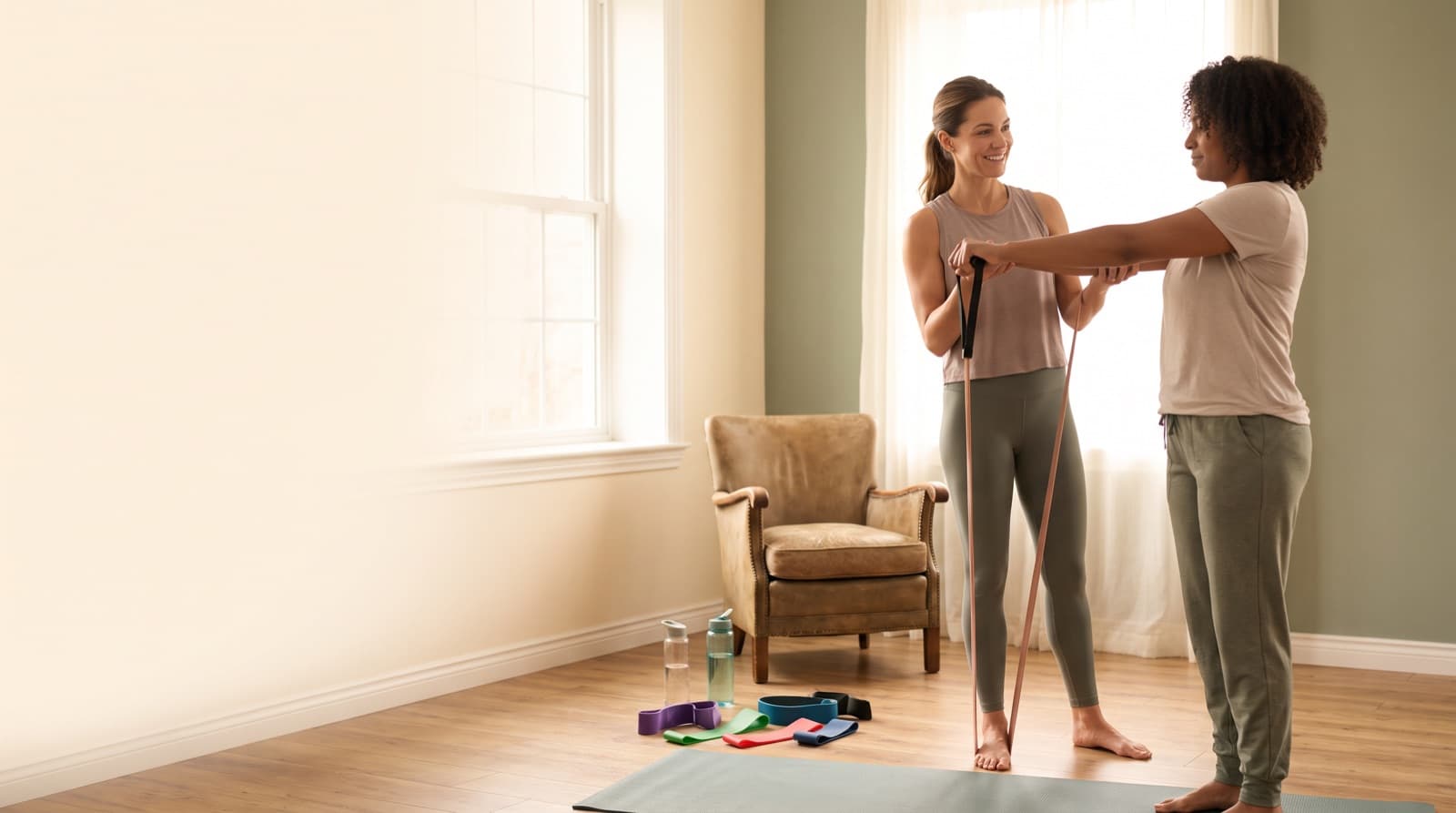
In our experience reviewing home fitness & gym gear, we analyzed each option's real pricing and features; from our research, the comparison below reflects what actually matters for buyers in 2026. The best resistance bands for beginner women use light-to-medium tension. They should let you finish 12-15 slow reps with clean form.
Start with one mini-band for glutes. Then add one long loop or tube set for rows, face pulls, presses, and mobility.
Key takeaways
- Beginners should not start with a heavy-only hip band set, because shoulders and back drills need light tension.
- Use the 12-15 rep test: the last reps should feel hard, but your joints should feel calm.
- Mini bands work best for glutes and hips; long loops and tube bands work better for rows and pulldowns.
- Better labeling, safe anchoring, and anti-roll comfort matter more than maximum resistance.
- In our comparison, the best first setup is a light loop set plus a handled tube kit.
| product name | Best for | Key spec | Price band |
|---|---|---|---|
| Fit Simplify Resistance Loop Exercise Bands | First mini-band set | 5 latex loops, 12 in x 2 in | $8-18 |
| RenoJ Resistance Bands for Legs and Butt | Anti-roll glute work | 3 fabric loops, light to heavy | $10-25 |
| WHATAFIT Resistance Bands Set with Handles | Door-anchor upper body | 5 tube bands, 10-50 lb each | $20-40 |
| Bodylastics Stackable Tube Resistance Bands | Safer tube training | Stackable tubes with inner safety cord | $45-80 |
| WODFitters Pull Up Assistance Band | Rows and assisted bodyweight work | 41 in latex power loop | $12-35 |
| Vergali Fabric Resistance Bands for Booty Hips and Legs | Comfortable lower-body circuits | 4 fabric loops, 13.6 in x 3.15 in | $18-35 |
What are the best resistance bands for beginners women in 2026?
The best resistance bands for beginner women use light-to-medium tension. They let you finish 12-15 slow reps with clean form.
Resistance bands are elastic training tools. They add tension as they stretch.
A good first kit should cover glute bridges, lateral walks, seated rows, face pulls, and mobility drills. It should not roll, snap back, or force sloppy form.
The CDC adult activity guidelines recommend strength work at least 2 days each week. Mayo Clinic also suggests resistance you can control for about 12-15 reps.
However, lighter bands can feel boring at first. They still help you learn shoulder position, rib control, and hip alignment.
In practice, I see beginners buy bands that are too heavy. Cheap bands can work. Bands that force bad form do not.
If a band makes you shrug during face pulls, it misses the point. If you arch during rows, it teaches a workaround.
For a wider buying map, see our guide to which resistance band beginners should buy first.
How we picked
We checked beginner bands by use, resistance range, comfort, anchors, labels, portability, and street price. We focused on first home-gym setups.
Because beginners need range, we asked six practical questions. Does the set include a truly light band?
Can you use it for 12-15 controlled reps? Does it work for glutes, back, and mobility?
Does it roll or pinch during lower-body moves? Does it label tension clearly? Does it include a safe anchor?
We also looked at common beginner complaints. Many people still ask about rows, face pulls, presses, and pulldowns.
So we ranked range above “burn” claims. Why buy a band that only fits one glute drill?
We did not invent lab tests. We did not claim durability cycles or tension data we lack.
Instead, we used public specs, current prices, trainer judgment, and exercise coverage. Prices change often, so check the checkout price.
Which type of resistance band should a beginner woman buy first?
Start with fabric mini bands plus one long loop. Choose tube bands with handles if upper-body work matters most.
Mini bands are short loops. You wear them around your thighs, ankles, or wrists.
They work well for lateral walks and glute bridges. Long loop bands are 41-inch power loops.
They fit rows, pulldowns, stretching, and assisted bodyweight work. Tube bands use handles, clips, anchors, or ankle straps.
Fabric bands resist rolling. However, latex loops stretch farther and work better for mobility.
If you only buy fabric hip bands, you may still struggle to train your back. For example, long-loop rows scale better than thick hip-circle rows.
On the other hand, thin latex mini bands can roll during lateral walks. That can ruin a short workout fast.
Fit Simplify Resistance Loop Exercise Bands
Fit Simplify Resistance Loop Exercise Bands are a basic 5-band latex mini-loop set. The set usually runs extra light through extra heavy.
Each loop measures about 12 inches long and 2 inches wide. Best for cheap warmups, shoulder activation, mobility, clamshells, and travel workouts.
The honest downside is roll-up. Thin latex loops can curl during squats, lateral walks, and sweaty leg sessions.
So skip this pick if skin pinching makes you quit. Comfort matters more than saving a few dollars.
RenoJ Resistance Bands for Legs and Butt
RenoJ Resistance Bands for Legs and Butt are fabric mini bands. They focus on lower-body work.
Best for glute bridges, lateral walks, squats, and hip-control drills. They do not slide into a cord as easily.
The downside is limited stretch. Fabric mini bands usually stretch less than latex loops.
So they work less well for upper-body mobility or long rows. Add a long band for full-body training.
How much resistance is enough for a first workout?
Enough resistance makes the last 2-3 reps feel hard. Your range of motion should still stay smooth.
Beginner resistance level means the lowest tension that trains the target muscle. It should not cause joint pain or cheating.
If you pass 15 reps easily, move up. If you shrug, arch, jerk, or cave your knees, go lighter.
Mayo Clinic says one set of 12-15 reps can support health and fitness. The resistance should feel challenging.
Also, rest one full day before training the same muscle group again. Your joints and tissue need time.
One band will not fit every move. Shoulders usually need less tension than glutes.
Because of that, I like sets with at least 3 clear levels. The best upgrade is not “extra heavy.”
Instead, buy a light band you will actually use. Pride does not build clean reps.
WHATAFIT Resistance Bands Set with Handles
WHATAFIT Resistance Bands Set with Handles is a tube-band kit. It includes handles, ankle straps, and a door anchor.
The common set uses 5 color-coded tubes. They rate around 10, 20, 30, 40, and 50 lb.
You can stack the tubes for more tension. Best for chest presses, rows, curls, triceps pressdowns, and face pulls.
The downside is setup time. Clips, handles, and anchors slow down quick workouts.
Also, door anchors need careful placement. Test the anchor slowly before you train hard.
Bodylastics Stackable Tube Resistance Bands
Bodylastics Stackable Tube Resistance Bands use handles and stackable tension. They also use an internal cord design.
Best for beginners who want a more serious tube system. They make sense for pressing and pulling.
The downside is cost. Bodylastics usually costs more than basic tube kits.
Also, tube bands can feel awkward under smaller stances. If you only want glute work, buy less kit.
Are mini bands or long loop bands better for glutes, back, and mobility?
Mini bands work better for glute activation and hip control. Long loop bands work better for back strength and mobility.
Glute activation means low-load drills. They help you feel and control your hips before harder work.
Mini bands fit glute bridges, clamshells, and lateral walks. Long loops fit rows, face pulls, pulldowns, assisted pull-ups, and mobility.
If you want one band style, choose long loop bands. However, lower-body beginners may use fabric mini bands more.
The recent beginner chatter around loop-band form makes sense. Long loops look simple, but anchor height changes everything.
A high-anchor face pull feels different from a rib-height row. So start light.
Then move the anchor before you blame your strength. The setup may be the issue.
For handled options, compare our best resistance bands for beginners with handles.
WODFitters Pull Up Assistance Band
WODFitters Pull Up Assistance Band is a 41-inch latex power loop. It comes in different widths.
Best for rows, pulldowns, assisted push-ups, assisted pull-ups, hamstring stretches, and mobility work.
The downside is sizing. A band that helps pull-ups may feel too strong for shoulder mobility.
So most beginners should start with a lighter width. Buy heavy support later if you need it.
Vergali Fabric Resistance Bands for Booty Hips and Legs
Vergali Fabric Resistance Bands for Booty Hips and Legs are fabric mini bands. They often come as a 4-band set.
The listed size is about 13.6 inches long and 3.15 inches wide. That gives more thigh coverage than narrow latex loops.
Best for beginners who dislike pinching during lower-body circuits. The downside is range.
These bands are not ideal for face pulls, rows, or pulldowns. Pair them with a long loop.
What should beginner women avoid when buying resistance bands?
Avoid unlabeled tension sets, heavy-only hip bands, strong odor, and kits without safe anchors. Beginners need clear levels.
Unlabeled tension means the band lacks clear light, medium, or heavy marking. It may also lack a resistance estimate.
That makes progress harder to track. Beginners should also skip bands that roll into a cord.
Because discomfort changes form, small problems matter. Check bands before each workout.
Look for cracks, tears, dry spots, worn stitching, and damaged clips. Mayo Clinic also warns against snapping bands back quickly.
Cheap sets can work for warmups. However, they often fail on comfort and clear progress.
If “medium” feels different each time, your training log becomes guesswork. You need repeatable tension.
Door anchors deserve respect. Use a solid door that closes toward you.
Place the anchor on the hinge side when possible. Then pull slowly before loading it.
What is the point of stronger tension if the anchor feels risky? Choose control first.
How much should beginners realistically spend on resistance bands?
Most beginners should budget for a full band setup. Do not chase the cheapest single band.
Price band means the normal street-price range before coupons, bundles, or seasonal changes.
In 2026, many latex mini-loop sets cost about $8-18. Fabric mini bands often cost $10-35.
Tube kits often cost $20-80. Single long loops often cost $12-35.
However, compare kit contents, not just price. Look for clear labels, a useful light band, and handles if needed.
If upper-body pulling matters, look for a door anchor. Also check the return policy.
Paying more only helps when it buys safer anchors. Better labels and bands that stay flat also matter.
A premium hip band can still feel too strong on day one. That is not a beginner win.
If you are shopping outside the U.S., our UK beginner resistance-band guide covers availability and naming differences.
Who should not buy resistance bands as their main home-gym tool?
Resistance bands are not the best main tool for everyone. Skip them if you hate variable tension.
Also skip them if you want exact load tracking. Dumbbells and barbells track load more clearly.
Variable resistance means the band gets harder as it stretches. That can feel smooth and joint-friendly.
However, exact load tracking gets harder. You cannot always compare band rows like 5 lb dumbbell jumps.
Bands work well for beginners, travel, mobility, warmups, and accessory work. They feel less satisfying for measured strength work.
From coaching, I think bands work best when the goal is consistency. They store under a bed or in a drawer.
As a result, beginners often use them more. Easy setup matters when motivation drops.
Still, bands are not magic. If you love measured strength work, add adjustable dumbbells later.
If your joints feel stiff before band work, try a simple recovery tool. A beginner foam roller may help your warmup routine.
How should a beginner use resistance bands in week one?
Use bands two non-consecutive days in week one. Do one set of 12-15 reps per move.
Week-one band training means short practice. It teaches form before fatigue.
Choose five basics. Use a glute bridge, lateral walk, seated row, face pull, and chest press.
Warm up for 5-10 minutes first. Walk, circle your arms, hinge your hips, and squat gently.
The CDC recommends strength training at least 2 days per week. Mayo Clinic supports 12-15 controlled reps as a starting point.
Stop if you feel sharp pain, pinching, dizziness, or joint discomfort. Pain is not a form cue.
Try this simple plan:
- Glute bridge with a mini band, 12-15 reps.
- Lateral walk with a mini band, 8-12 steps each way.
- Seated row with a long loop or tube band, 12-15 reps.
- Face pull with very light tension, 12-15 reps.
- Banded chest press or wall press, 12-15 reps.
The first week should feel controlled, not crushing. Can you repeat it in 2 days?
That signal beats four days of soreness. You want practice you can repeat.
Scenario verdict: which resistance band should you get?
Get Fit Simplify Resistance Loop Exercise Bands for the cheapest useful starter set. It works for mobility, warmups, and light activation.
Get RenoJ Resistance Bands for Legs and Butt if you want glute work. It avoids most latex rolling.
Get WHATAFIT Resistance Bands Set with Handles if you want budget full-body training. It suits anchored rows and presses.
Get Bodylastics Stackable Tube Resistance Bands if you want better safety features. It feels more refined than basic tube kits.
Get WODFitters Pull Up Assistance Band if you want one long loop. Use it for rows, pulldowns, mobility, and assisted bodyweight work.
Get Vergali Fabric Resistance Bands for Booty Hips and Legs if comfort matters most. It suits lower-body circuits.
FAQ
Are resistance bands enough for beginners?
Yes. Resistance bands are enough for beginners if they let you train major muscle groups 2 days per week with controlled 12-15 rep sets. The CDC adult activity overview recommends muscle-strengthening work on 2 or more days weekly.
Should beginners buy fabric or latex resistance bands?
Buy fabric bands for glutes, hips, and anti-roll comfort. Buy latex bands for longer stretch, mobility, and upper-body moves. In practice, many beginners do best with one fabric mini-band set plus one long latex loop.
What resistance level should women start with?
Start light enough to finish 12-15 reps without shrugging, arching, jerking, or losing range. According to Mayo Clinic strength training guidance, the resistance should feel tiring near 12-15 reps while form stays solid.
Can resistance bands build muscle?
Yes. Resistance bands can build muscle when tension is challenging near the end of the set and progresses over time. The ACSM 2026 resistance training update notes that elastic bands and home-based routines can improve strength and muscle size.
Are resistance bands safe for shoulders?
They can be safe for shoulders when beginners use light tension, slow tempo, and clean range of motion. Stop if you feel pinching, sharp pain, or joint discomfort. For face pulls and mobility, lighter bands usually beat heavier ones.
Written by Tessa Doyle for Nestway. About our editorial team · Contact us. Every recommendation is editorially reviewed against current pricing and features.