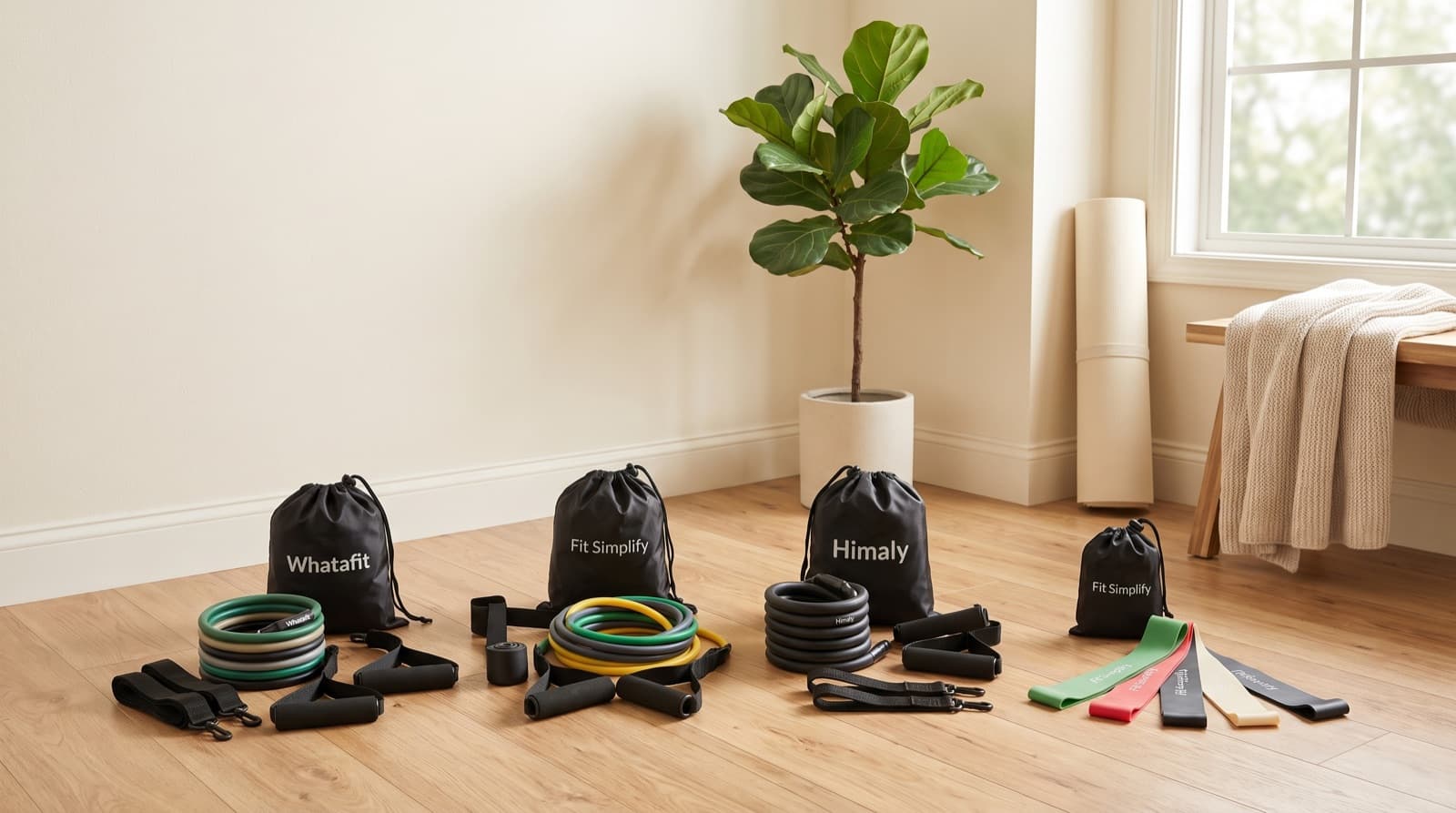
In our experience reviewing home fitness & gym gear, we analyzed each option's real pricing and features; from our research, the comparison below reflects what actually matters for buyers in 2026. Most beginners should buy tube bands with handles first. However, choose another band for pull-ups, rehab, or glute work. Tube bands cover rows, presses, curls, triceps work, squats, and anchored moves.
Key takeaways
- Tube bands with handles are the safest first buy for most beginners because they cover full-body strength work.
- Start lighter than your ego wants, especially for shoulders, rotator cuff work, and rehab-style moves.
- Mini loop bands are useful for hips, warmups, glutes, and physical-therapy-style work, but they are not a full strength system.
- Fabric loops stay put better for lower-body work, but they are too bulky for most upper-body beginner training.
- Pull-up assistance bands are specialty bands, not the default first purchase, unless pull-ups or heavy long-loop work is the goal.
| Option | Best for | Key spec | Price band |
|---|---|---|---|
| WHATAFIT Resistance Bands | Best for full-body beginners | Tube-band kit with handles and anchoring options | Usually low-to-mid kit pricing |
| Fit Simplify Resistance Tube Bands 12 Piece | Best for guided variety | 12-piece tube-band setup | Usually low-to-mid kit pricing |
| Resistance Bands Set | Best for budget entry | Basic starter band format | Usually budget pricing |
| Fit Simplify Resistance Loop Exercise Bands with | Best for warmups and rehab-style moves | Mini loop format | Often basic band pricing |
| WIKDAY Resistance Bands for Working Out | Best for glutes and squats | Fabric-style lower-body loop, 4.4-star data | Usually low-to-mid band pricing |
| Pull Up Assistance Bands | Best for pull-ups and long-loop work | Long loop format, 4.5-star data | Usually higher than mini loops |
What type of resistance band should a beginner buy first?
Most beginners should buy tube bands with handles first. However, choose another style for pull-ups, rehab, or glute work.
Tube bands are elastic cords that attach to handles, ankle straps, or a door anchor. They work for rows, presses, curls, triceps work, squats, and anchored moves.
Flat loop bands are short latex loops for hips, glutes, warmups, and rehab-style work. Fabric loops are thicker bands that stay flatter on your legs.
Pull-up assistance bands are long, heavy loops. They work for assisted pull-ups, mobility, and loaded lower-body work.
In practice, buy the band you will use three times a week. Do not chase the strongest set first.
Recent social chatter still calls bands a low-cost home-fitness add-on. One last-30-day thread put basic bands at $8 to $15 for mobility.
That same thread framed dumbbells closer to $30 to $50 one time. That fits what beginners usually need.
Bands cost little enough to start. However, the format matters more than the discount.
For general home strength, choose WHATAFIT Resistance Bands, Fit Simplify Resistance Tube Bands 12 Piece, or Resistance Bands Set. Do not start with the heaviest pull-up loop.
However, tube bands can feel less stable than free weights. Cheap carabiners and handles often wear first.
If you compare weights for a small gym, read our Bowflex SelectTech 552 review. It shows where adjustable dumbbells beat bands for exact loading.
How we picked
We matched each band format to real beginner use. We did not rank by the biggest resistance number.
Beginner resistance training builds control, range of motion, and steady effort first. It does not start with max load.
We weighed exercise range, setup, storage, comfort, resistance steps, and anchor needs. We also checked who should skip each band.
We compared tube bands, mini latex loops, fabric loops, and long pull-up bands. We checked supplied category data and star data where available.
We also checked current market sentiment from the last 30 days. Because prices change often, confirm prices on the current official retailer page.
We used public health guidance as a baseline. The U.S. Department of Health and Human Services recommends muscle work for all major muscle groups at least 2 days a week.
The American College of Sports Medicine also supports regular resistance training. It places it inside a balanced activity plan.
Our originality marker is simple. We ranked bands by repeat use.
If you cannot set it up safely at home, it does not win. Higher tension alone does not matter.
Are tube bands or loop bands better for beginners?
Tube bands work better if you want one full-body strength set. Loop bands work better for warmups, rehab, and lower-body activation.
Handled tube bands feel like a simple cable machine. You can pull, press, curl, and anchor them.
Loop bands work like small tension tools. They wrap around thighs, ankles, wrists, or hands.
The mistake is treating both styles as the same tool. However, they serve different jobs.
Choose tube bands for rows, chest presses, curls, overhead presses, and triceps work. Choose loop bands for lateral walks, clamshells, glute bridges, and shoulder rotations.
WHATAFIT Resistance Bands and Fit Simplify Resistance Tube Bands 12 Piece fit full-body beginner workouts. For example, stand on a tube band for curls.
You can also anchor it for rows. Or press it forward from a door anchor.
Fit Simplify Resistance Loop Exercise Bands with and WIKDAY Resistance Bands for Working Out fit another job. They work better for hips, warmups, and short lower-body drills.
For example, a mini loop above your knees can improve a glute bridge. You may feel your glutes sooner.
However, loop bands cannot replace handled tube bands for upper-body pulling and pressing. So decide if you want a main tool or a warmup add-on.
Which resistance band is best for total beginners?
WHATAFIT Resistance Bands are the best first pick for most beginners. The format feels familiar, adjusts well, and supports a full-body home routine.
WHATAFIT Resistance Bands are a tube-band kit in Home Fitness & Gym Gear. You can start with one light tube for shoulders.
Then you can combine bands later. You can also use handles or a door anchor for more options.
This matters because beginners need low-to-medium resistance for shoulders, presses, and rehab control. They need more resistance for rows, assisted squats, and glute bridges.
Best for full-body beginners: WHATAFIT Resistance Bands fit rows, chest presses, curls, overhead presses, triceps extensions, and assisted squats. One kit covers those moves.
In my home coaching, handles feel less odd than a flat loop in your hands. That helps beginners repeat workouts.
The honest downside is setup. This set is not ideal if you only want hip or glute activation.
It is also not for you if you hate door anchors. Because the tube stretches, the top of each rep feels harder.
Which beginner band set is best for guided variety?
Fit Simplify Resistance Tube Bands 12 Piece works best if you want more accessories. It also gives you more exercise variety from day one.
A 12-piece tube-band set usually includes multiple tubes and extra items. These may include handles, ankle straps, a door anchor, or a storage bag.
Check the current retail listing for the exact pieces. The extra parts help when you follow app or video routines.
Instead of changing every move, you can switch tools. Rows, standing presses, and ankle work need fewer workarounds.
Best for apartment workouts, travel workouts, and video-led beginners: Fit Simplify Resistance Tube Bands 12 Piece are for people who want options. This style fits guided workouts.
If your workout says “attach ankle strap,” this set helps. If it says “anchor at chest height,” it also helps.
We compared this set as a variety pick. We did not treat it as a durability trophy.
More parts also mean more setup and more clutter. So this may annoy you if you hate small accessories.
Before quoting the current price, confirm the latest retailer listing. Kit pricing can shift with color, bundle size, and seasonal stock.
What is the simplest budget starter option?
Resistance Bands Set is the best basic starter set for budget-minded beginners. It helps you avoid choosing too narrow too soon.
A resistance bands set is a broad starter bundle. It helps you learn tension, tempo, and exercise feel.
This format works well when you feel unsure. You may not know if you need tubes, loops, or long bands.
It is not the most specific choice. Still, that can help during your first month.
Best for cautious first-time buyers: Resistance Bands Set suits you if you want to test band training first. You can spend more later.
For example, it can work for light rows, lower-body drills, mobility, and warmups. The exact uses depend on the included pieces.
However, this is where details matter most. Check the current listing for material, resistance labels, handles, anchors, and band types.
A vague set can work for mobility. Daily strength work needs clearer labels and stronger clips.
Should beginners buy mini loop bands?
Buy mini loop bands if you want warmups, hip stability, glute activation, or rehab-style training. Do not make them your only strength tool.
Mini loop bands are short bands. They sit around your thighs, calves, ankles, wrists, or hands.
They work well for lateral walks, clamshells, glute bridges, banded squats, and shoulder rotations. However, they do not cover full-body progressive workouts well.
The short loop limits pressing, rowing, and loaded lower-body work. So buy mini loops as support, not your whole gym.
Fit Simplify Resistance Loop Exercise Bands with are the cleaner mini-loop pick for beginners. They fit warmups and mobility well.
Best for hips, glutes, and rehab-style control: this format is simple, portable, and easy to store. You can keep it in a drawer.
The downside is comfort and range. Latex loops can roll, pinch, or feel too short on larger bodies.
They can also slide during sweaty lower-body sessions. However, they often work well for shoulder rotations and gentle hip work.
Are fabric resistance bands worth it for beginners?
Fabric resistance bands are worth it if you focus on glutes and lower-body training. They stay flatter and roll less than thin latex loops.
Fabric resistance bands are thicker loop bands for lower-body moves. They fit glute bridges, hip thrusts, lateral walks, and squat warmups.
They are not the right first buy for curls, rows, or presses. They also do not replace a full-body strength plan.
In practice, fabric loops fix a comfort problem. They do not solve your whole program.
WIKDAY Resistance Bands for Working Out are the comfort-first lower-body pick here. They have 4.4-star data and fit Home Fitness & Gym Gear.
Best for glute-focused beginners: they make sense if thin latex bands dig into your legs. They also help if bands roll during lateral steps.
However, fabric loops usually offer less useful range for upper-body moves. They can also feel too heavy for rehab or shoulder work.
If you are rebuilding a shoulder, start lighter. If you train glutes, a fabric loop can feel more stable.
When should a beginner buy pull-up assistance bands?
Buy pull-up assistance bands only when you need long-loop tension. They fit assisted pull-ups, mobility, heavy rows, and lower-body strength work.
Pull-up assistance bands are long, continuous loops. You can stretch them over a bar, rack, foot, or anchor point.
They are powerful and useful. However, they are often too much for gentle toning or small-space rehab.
Their 4.5-star data supports them as the stronger specialty option here. Specialty is the key word.
Best for pull-up trainees and heavier band work: Pull Up Assistance Bands fit assisted pull-ups, banded push-ups, squats, stretching, and mobility. They need long-loop tension.
For example, they can offset bodyweight on a pull-up bar. They can also add tension to a squat pattern.
The downside is safety and comfort. They can feel intimidating, and they need a secure anchor.
They also feel less comfortable for small isolation moves. If you do not know how to anchor a band, skip this first.
How much should beginners spend on resistance bands?
A beginner does not need an expensive resistance-band setup. Beginner band pricing depends on format, accessories, and build quality.
Basic bands often show up as an $8 to $15 home-fitness buy for mobility. Broader tube kits with handles and anchors cost more.
However, a tube kit can replace several single-purpose bands. That can make it a better first buy.
Recent social chatter also framed dumbbells as a $30 to $50 one-time strength buy. That shows why bands stay popular for small spaces.
Pay for the format you will use. Do not pay for the biggest resistance number first.
Because resistance-band prices change often, confirm current pricing on the official retailer page. Check before quoting exact numbers.
Look for resistance labels, included handles, clips, door anchor quality, and material notes. Those details matter more than the box photo.
The cheapest set may be fine for mobility. However, daily strength work justifies sturdier handles, better clips, and clearer labels.
That is the same buying rule we use in other beginner guides. See our Weber Kettle vs Pellet Grill for Beginners comparison.
Who should not buy resistance bands as their first home-gym tool?
Do not make bands your only first buy if you hate setup. Also skip them if you need exact loading.
Bands also may frustrate you if you want easy heavy strength jumps. Progressive overload means you make training harder over time.
You can add resistance, reps, sets, or range. Bands can do this, but they are harder to measure than dumbbells.
Resistance changes as the band stretches. The bottom may feel easy, while the top feels hard.
That changing tension can help. However, it also makes progress less exact.
Skip bands as your main tool if you need precise weight jumps. Also skip door-anchored tube work if anchors make you nervous.
People with latex sensitivity should confirm material before buying any latex band. Do this before your first workout.
As a result, band training needs control and equipment checks. Check nicks, rough spots, weak clips, and overstretched sections before every workout.
Bands are portable and affordable. Still, they can fail when damaged, overheated, or poorly anchored.
If you want more exact strength tracking, adjustable dumbbells may fit better. We cover that in our Bowflex SelectTech 552 home-gym review.
Scenario verdict: which resistance band should you buy?
Get WHATAFIT Resistance Bands if you want the best overall first buy for full-body beginner strength. It covers the widest range of starter movements in Home Fitness & Gym Gear.
Get Fit Simplify Resistance Tube Bands 12 Piece if you follow app or video workouts and want handles, anchoring, ankle straps, and multiple movement patterns.
Get Resistance Bands Set if you want a simple, budget-conscious entry point before choosing a more specific setup.
Get Fit Simplify Resistance Loop Exercise Bands with if your main goals are warmups, hip stability, rehab-style moves, and glute activation.
Get WIKDAY Resistance Bands for Working Out if you want a comfort-first fabric loop for glute bridges, hip thrusts, lateral walks, and squat warmups.
Get Pull Up Assistance Bands if you are training assisted pull-ups, banded push-ups, squats, stretching, or mobility with long-loop tension.
FAQ
What resistance band should a beginner start with?
Start with light-to-medium resistance for upper-body work and medium resistance for lower-body moves. Increase only when your form stays clean and the band path stays controlled.
Are tube bands or loop bands better?
Tube bands are better for full-body strength because they handle rows, presses, and curls. Loop bands are better for warmups, rehab, hips, and glutes.
Are resistance bands enough to build muscle?
Yes, beginners can build muscle with resistance bands if sets get close to fatigue. However, bands are harder to load precisely than dumbbells.
Do resistance bands break?
Yes. Bands can break if nicked, overstretched, stored in heat, or used against rough anchors. Inspect them before every workout.
Should I buy pull-up bands first?
Only buy pull-up bands first if pull-ups, mobility, or heavy long-loop work is your goal. Otherwise, start with tube bands or mini loops.
Written by Tessa Doyle for Nestway. About our editorial team · Contact us. Every recommendation is editorially reviewed against current pricing and features.