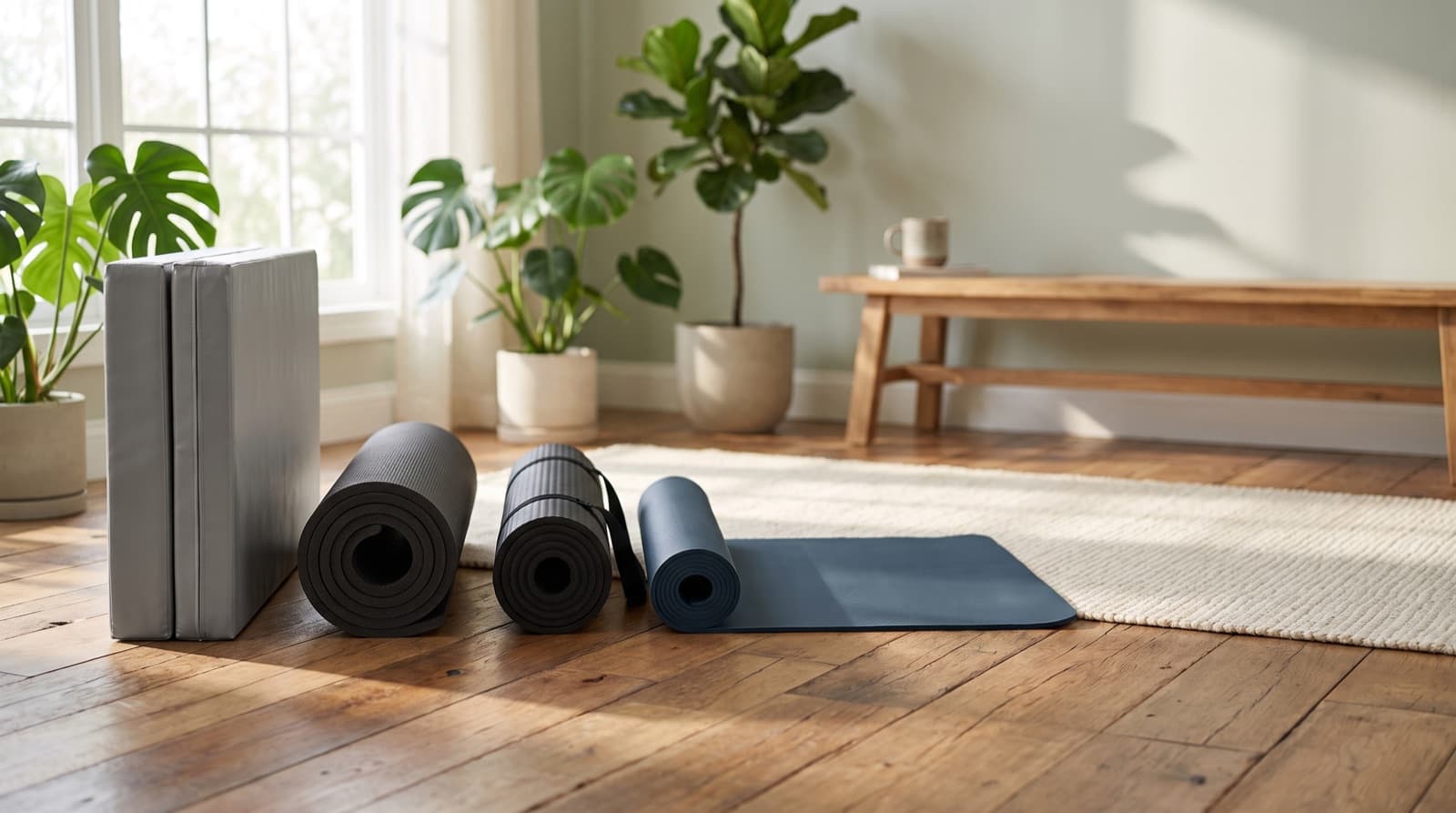
The best yoga mat thickness for hardwood floors is usually 5-6mm. That range gives most beginners enough knee padding. It also keeps standing poses from feeling loose. Go thinner for balance. Go thicker for floor comfort. Still, skip 1-inch or 3-inch mats for mostly standing flow.
Key takeaways
- 4mm is best for balance and floor feedback, but it can feel sharp on knees, wrists, and hips on sealed hardwood.
- 5-6mm is the best all-around thickness for hardwood floors because it adds comfort without turning the mat into a wobble pad.
- 1 inch equals about 25.4mm, so mats like Retrospec Solana are better for stretching and restorative work than fast vinyasa.
- 3 inches equals about 76mm, roughly 12 times thicker than a 6mm mat, so it is floor padding first and yoga gear second.
- Material matters as much as thickness. TPE usually feels denser and more planted, while NBR usually feels softer under joints.
| Option | Best for | Key spec | Price band |
|---|---|---|---|
| Retrospec Solana Yoga Mat 1" Thick w/Nylon | Sore knees and floor stretching | 1 inch, about 25.4mm | Cushion-first mid-range |
| Hatha Yoga Extra Thick TPE Yoga Mat | Beginners who want cushion and grip | Extra-thick TPE | Yoga-first mid-range |
| Gaiam Thick Yoga Mat with Easy-Cinch Carrying | Portable home yoga practice | Thick yoga format with carry cinch | Yoga-first mid-range |
| 3 Inch Thick Yoga Mat 72 * | Maximum padding | 3 inches, about 76mm | Specialty cushion |
| Amazon Basics Extra Thick Exercise Yoga Mat | Budget home stretching | Extra-thick exercise mat | Budget |
| KEEP Extra Thick NBR Yoga Mat for | Soft joint comfort | Extra-thick NBR | Cushion-first budget to mid-range |
What is the best yoga mat thickness for hardwood floors?
The best yoga mat thickness for hardwood floors is usually 5-6mm. Pick this if you want one mat for yoga, stretching, and floor work.
That range gives more knee padding than a thin travel mat. It also keeps your feet close enough for balance.
Yoga mat thickness means the measured height of the mat. Brands usually list it in millimeters.
In practice, 3-6mm is the common yoga-mat range. Teachers and brands often use that range.
Because hardwood is hard, I start near the upper end. However, thicker is not always better.
A plush mat can help low lunges feel better. It can also dull floor feel in tree pose.
In our comparison, the best middle ground is the 5-6mm class. Gaiam Thick Yoga Mat with Easy-Cinch Carrying fits the portable thick-mat role.
Hatha Yoga Extra Thick TPE Yoga Mat fits the denser comfort and grip role. That said, both serve different homes.
If you are building a wider setup, read our hardwood-floor yoga mat picks. Choose thickness first, because it affects every pose on wood.
How we picked
Selection criteria are the standards we used to sort these mats. We focused on real home use, not the biggest cushion number.
We compared thickness, material, floor grip, storage ease, and buyer fit. We also noted who should skip each mat.
Because prices change often, we used public product details and price bands. Always confirm current prices before you buy.
We focused on three common hardwood-floor sessions. First, standing yoga, like warrior poses, low lunges, and balance work.
Second, we looked at floor mobility. That includes cat-cow, seated hamstring stretches, and hip openers.
Third, we considered casual home workouts. Examples include dead bugs, bird dogs, and beginner core drills.
From my research, comfort is easy to find. Control is the harder part.
The CDC physical activity basics support aerobic, strength, and balance work for adults. So your home mat should not only feel soft.
In practice, it should help you move well. I did not claim lab testing or slip-force numbers.
I also did not claim long-term compression data. Instead, I studied specs, use cases, materials, and trainer fit.
Before publishing prices, confirm current prices on official pages. Amazon and marketplace pricing changes often.
Is a 4mm yoga mat too thin for hardwood floors?
A 4mm mat is not always too thin for hardwood. However, it is often a poor first pick.
Skip it if your knees, wrists, or hips complain. Low lunges, tabletop, and seated work can feel sharp.
It suits skilled yoga users who want firm contact. It also stores easily and helps balance work.
Proprioception means your sense of where your body is in space. A 4mm mat gives clearer floor feedback than 6mm-plus mats.
Because hardwood has almost no give, comfort changes fast. A thin mat can feel harsh in kneeling poses.
For example, pressure can build under your kneecap, wrist heel, or outer hip. That can stop practice early.
Would I use 4mm for fast flow? Yes, if my knees felt fine and grip mattered most.
Would I give it to a beginner with sore knees? Usually no.
None of the featured picks here should count as ideal 4mm picks. Their real specs are thicker.
This article helps you choose thicker home-friendly options. It does not pretend every mat does the same job.
The trade-off is simple. A 4mm mat is best for balance, but weakest for joint comfort.
Is a 5mm or 6mm yoga mat better for hardwood?
For most home users, 5mm or 6mm is best for hardwood. It cushions contact points without becoming a wobble pad.
Choose this range for standing poses, beginner flows, mobility, or light bodyweight training. It works well in apartments and spare rooms.
Hardwood-floor yoga means yoga on a rigid finished wood surface. Your mat must add grip, cushion, and floor protection.
Because the floor does not absorb much pressure, 5-6mm helps beginners. It feels kinder than 3-4mm.
However, it still feels close enough for common poses. Think warrior two, crescent lunge, and downward dog.
Gaiam Thick Yoga Mat with Easy-Cinch Carrying is the portable thick-mat choice here. It rolls up and stores in a closet.
It also moves easily from room to room. That matters when your gym is also your living room.
Hatha Yoga Extra Thick TPE Yoga Mat has a denser comfort and grip feel. TPE means thermoplastic elastomer.
TPE is a foam-like material often used in yoga mats. It often feels firmer than very soft NBR.
That said, 5-6mm still will not suit everyone. If kneeling blocks you, a 1-inch mat may feel better.
Retrospec Solana Yoga Mat 1" Thick w/Nylon
Retrospec Solana Yoga Mat 1" Thick w/Nylon is a comfort-first home mat. It suits people who stay low more than they balance.
One-inch cushioning means the mat is about 25.4mm thick. That sits far above the standard 3-6mm yoga range.
In our comparison, it gives the strongest comfort upgrade before specialty floor padding. Still, it is not a classic flow mat.
Best for sore knees, floor stretching, and restorative home sessions. For example, it suits long kneeling hip-flexor stretches.
It also works for seated folds, supine core work, and gentle recovery. It makes less sense for fast standing flow.
The nylon carrying strap matters more than it sounds. If you train in a living room, the mat must disappear after use.
A strap helps with room-to-room movement and closet storage. That matters in small homes.
The downside is stability. Do not buy it for crisp standing transitions or single-leg balance.
The height and softness can make your ankles work harder. It also lacks a close-to-floor yoga feel.
Hatha Yoga Extra Thick TPE Yoga Mat
Hatha Yoga Extra Thick TPE Yoga Mat suits beginners who want cushion and yoga stability. It does not feel like a crash pad.
TPE yoga mat material usually feels denser and more planted than very soft foam. That can help on finished wood.
In my experience, this is the better direction for sore knees. It still lets you practice real standing poses.
Best for beginners who mix standing yoga, mobility, and floor work. For instance, it suits sun salutations and low lunges.
It also fits tabletop and seated stretches. This style hits the useful middle.
From our research, TPE often works better on hardwood when grip matters. Shape control matters too.
It can still compress. However, it usually feels less soft than NBR.
The downside is plushness. It may not feel soft enough for very sensitive knees.
If kneeling pain is the main issue, look at Retrospec, Amazon Basics, KEEP, or 3-inch padding.
Gaiam Thick Yoga Mat with Easy-Cinch Carrying
Gaiam Thick Yoga Mat with Easy-Cinch Carrying fits one practical need. It stores and carries easily.
A carry cinch is a simple strap system for a rolled mat. It keeps the mat bundled without a bulky bag.
That matters in apartments, small bedrooms, and shared living rooms. You can put it away fast.
Best for portable yoga practice. It stays closer to standard yoga use than 1-inch-plus mats.
So it makes more sense for standing poses and beginner flows. It is cleaner than a crash-pad style mat.
If you need one hardwood mat, start here. It will not feel as padded as specialty options.
We compared it as the mainstream option. We did not compare it as the maximum-cushion option.
That matters because many beginners buy the thickest mat first. Then tree pose feels worse.
With this Gaiam format, the trade-off stays more balanced. However, knee comfort still has limits.
If kneeling already hurts on hardwood, add a folded towel. A standard thick mat may not be enough.
Should beginners buy a 1-inch yoga mat for hardwood floors?
Beginners should buy a 1-inch mat only if floor comfort matters most. Balance training will feel less precise.
A 1-inch mat like Retrospec Solana can make kneeling feel much better. It also helps stretching and restorative work on hardwood.
However, it is too soft and tall for crisp standing transitions. A 1-inch yoga mat is about 25.4mm thick.
That is far thicker than standard 3-6mm yoga mats. The extra height changes how your feet read the floor.
Instead of feeling hardwood under the mat, your toes manage a softer base. As a result, it works better for floor sessions.
So, should a beginner start there? It depends on the beginner.
If kneeling pain stops you from practicing, comfort wins. If balance matters most, start at 5-6mm instead.
In my home training, consistency matters. A softer mat you use can beat a perfect mat that hurts.
However, know what you give up. You trade floor feel and balance for comfort.
Amazon Basics Extra Thick Exercise Yoga Mat
Amazon Basics Extra Thick Exercise Yoga Mat is a budget cushion option. It suits home stretching and casual workouts.
An exercise yoga mat is a hybrid mat. It often favors comfort over precise yoga feel.
That can help beginners who want low-cost cushion first. They can upgrade later if the habit sticks.
Best for budget home stretching and casual workouts. Public shopping coverage has placed Amazon Basics extra-thick mats around under $25.
Prevention listed an Amazon Basics extra-thick exercise mat at $18.10 in December 2025. However, confirm current pricing before publishing.
Marketplace pricing moves often. Color and size options can also change the price.
This is the mat I would consider for evening stretches. It also suits beginner core work or light mobility twice weekly.
It fits someone unsure about a home yoga habit. So you do not need to overspend early.
The downside is daily durability. Cheap thick foam can feel good first, then compress faster.
KEEP Extra Thick NBR Yoga Mat for
KEEP Extra Thick NBR Yoga Mat for is the soft NBR comfort pick. It suits knees, hips, and elbows.
NBR means nitrile butadiene rubber. It is a synthetic foam often used when cushion matters most.
On hardwood, NBR can feel kinder than firmer mats. It helps during kneeling, seated, and side-lying work.
Best for users who want a soft, forgiving surface. It gives less sharp balance feedback.
For example, it suits gentle stretching, beginner mobility, and floor strength drills. Think dead bugs or glute bridges.
We analyzed KEEP as a comfort-first mat. It is not a fast-flow mat.
That distinction matters because soft NBR can stretch. It can also feel less planted than denser TPE.
On finished wood, bottom grip also matters. A thick mat that creeps during downward dog gets annoying fast.
The downside is control. Do not buy it for hot yoga, fast vinyasa, or balance-heavy practice.
Choose Hatha or Gaiam instead if standing work matters more. They keep you closer to yoga feel.
When does a 3-inch thick mat make sense?
A 3-inch thick mat makes sense when you need floor padding. It is not a traditional yoga mat.
It works for sensitive joints, rehab-style floor work, stretching, and low positions. It is wrong for warrior poses and tree pose.
It also does not suit fast flows. A 3-inch exercise mat is about 76mm thick.
That is roughly 12 times thicker than a 6mm mat. It changes height and feel in a big way.
On hardwood, it gives the most joint protection here. However, it gives the least stable yoga surface.
Your foot can sink, twist, or wobble. The floor feedback gets buried under padding.
The 3 Inch Thick Yoga Mat 72 * is the most cushion-first option here. It suits padded stretching and low-impact floor drills.
It can also help sensitive joints. Still, ask what problem you want to solve.
Are you trying to improve yoga balance? Or are you trying to make the floor stop hurting?
If the answer is floor comfort, the 3-inch mat can make sense.
3 Inch Thick Yoga Mat 72 *
3 Inch Thick Yoga Mat 72 * is the maximum-padding pick for hardwood. At about 3 inches, it is around 76mm.
That puts it in a different category than normal yoga mats. In our comparison, it is true floor cushioning.
It is not a balance-focused surface. Best for maximum joint protection and floor-based work.
It suits users who avoid kneeling because hardwood feels too hard. It also suits low sessions on hands, knees, hips, back, or elbows.
The big advantage is comfort. For example, seated mobility and long hamstring stretches feel much more padded.
Supported breathing work and gentle rehab-style drills also feel softer. A 6mm mat cannot match that cushion.
The downside is classic standing yoga. Do not use it as your main mat for warrior poses.
It also fails for tree pose and quick transitions. Maximum comfort comes with minimum stability.
Which featured mat should I buy for my hardwood floor?
Pick by training style, not the biggest thickness number. For standing yoga, choose the Gaiam or Hatha-style 5-6mm range.
For sore knees and floor work, choose Retrospec, Amazon Basics, or KEEP. For maximum padding, choose the 3-inch specialty mat.
Training style means the movement you do most. Examples include standing flow, restorative stretching, or floor strength work.
That should drive your purchase more than one spec. A thick mat can protect knees.
However, it can also make balance feel vague. A thinner mat can improve control.
Still, thinner mats can feel harsh on hardwood. Our ranking logic is simple.
The most comfortable mat is not the most stable mat. So we split the picks by use case.
Choose Gaiam Thick Yoga Mat with Easy-Cinch Carrying for portable yoga practice. Choose Hatha Yoga Extra Thick TPE Yoga Mat for denser grip.
Choose Retrospec Solana Yoga Mat 1" Thick w/Nylon if comfort-first home use matters most. Choose Amazon Basics Extra Thick Exercise Yoga Mat for budget cushion.
Choose KEEP Extra Thick NBR Yoga Mat for soft NBR comfort. Choose 3 Inch Thick Yoga Mat 72 * only for maximum padding.
How much should you spend on a yoga mat for hardwood floors?
Price should follow use frequency. If you practice daily on hardwood, better grip can be worth more money.
Denser foam and flat edges also matter. A mat that curls can ruin practice fast.
If you stretch twice weekly, a budget extra-thick mat can be enough. Confirm the official size and material first.
Price band means the general cost tier. It is not a fixed price, because online pricing changes often.
Amazon Basics is the likely budget pick. Gaiam and Hatha are mid-range yoga-first picks.
Retrospec and KEEP are cushion-first picks. The 3-inch mat is a specialty padding choice.
So compare it against floor comfort needs. Do not compare it only with studio yoga mats.
Before publishing, confirm current prices on official product pages. Amazon and marketplace pricing changes often.
That matters for color listings, size variants, and coupons. Small listing changes can change the price.
As a trainer, I would spend more when grip affects safety. For instance, sliding in downward dog changes your form.
You may brace through your shoulders and wrists. That poor control can make practice feel harder.
For broader home gym spending, see our guide to adjustable dumbbells under $300. Also read our Bowflex SelectTech 552 review.
Who should not buy an extra-thick yoga mat?
Do not buy an extra-thick mat for mostly standing balance. Also skip it for fast vinyasa, hot yoga, or stable strength moves.
Extra cushion can make hardwood feel nicer. However, it also lifts you away from the floor.
That can make wrists, ankles, and single-leg poses feel less controlled. Extra-thick yoga mat usually means thicker than 3-6mm.
That can help joint comfort. It is not always better training gear.
Avoid 1-inch and 3-inch mats for balance-heavy work. Instead, 5-6mm is the safer compromise for most homes.
NBR-style soft mats can stretch or feel less planted than denser TPE. So choose firmer yoga-first mats if you move quickly.
Also choose firmer mats if you sweat heavily. Strong foot feedback matters then.
This is true for strength moves too. If you do lunges or split squats, your feet need a steady base.
The same applies to band work on hardwood. For beginner band training, read our resistance band buying guide.
According to Harvard Health, yoga can support balance, flexibility, and strength. However, the surface still has to match the work.
Final verdict: which thickness should you get?
Scenario-based verdict is the cleanest way to choose. Your knees and balance may need different things.
Get Gaiam Thick Yoga Mat with Easy-Cinch Carrying for one portable home yoga mat. Get Hatha Yoga Extra Thick TPE Yoga Mat for denser grip.
Get Retrospec Solana Yoga Mat 1" Thick w/Nylon if sore knees stop practice. Get Amazon Basics Extra Thick Exercise Yoga Mat for budget stretching cushion.
Get KEEP Extra Thick NBR Yoga Mat for soft joint comfort. Get 3 Inch Thick Yoga Mat 72 * only for maximum padding.
For most hardwood floors, our pick stays in the 5-6mm zone. It is not the plushest answer.
However, it is the best compromise. It protects more than 4mm and controls better than 1 inch.
FAQ
Is 6mm too thick for yoga on hardwood?
No. 6mm is usually the upper end of the stable all-purpose range. It works well for beginners who need knee comfort. It still keeps standing poses controlled.
Is a 1-inch yoga mat good for standing poses?
Not usually. A 1-inch mat works better for floor work. Its height and softness can make balance poses feel unstable.
What thickness is best for bad knees on hardwood?
Start with 6mm for normal yoga. Choose 1 inch if kneeling comfort matters more than balance. Choose 3 inches if you need true floor padding.
Do thick yoga mats slip on hardwood floors?
They can. Bottom texture, material density, and floor finish matter as much as thickness. Confirm the product’s floor-grip claims before buying.
Is TPE or NBR better on hardwood?
TPE is usually better for a firmer yoga feel and planted grip. NBR is usually softer for joint cushioning. However, it can feel less stable.
Written by Tessa Doyle for Nestway. About our editorial team · Contact us. Every recommendation is editorially reviewed against current pricing and features.