
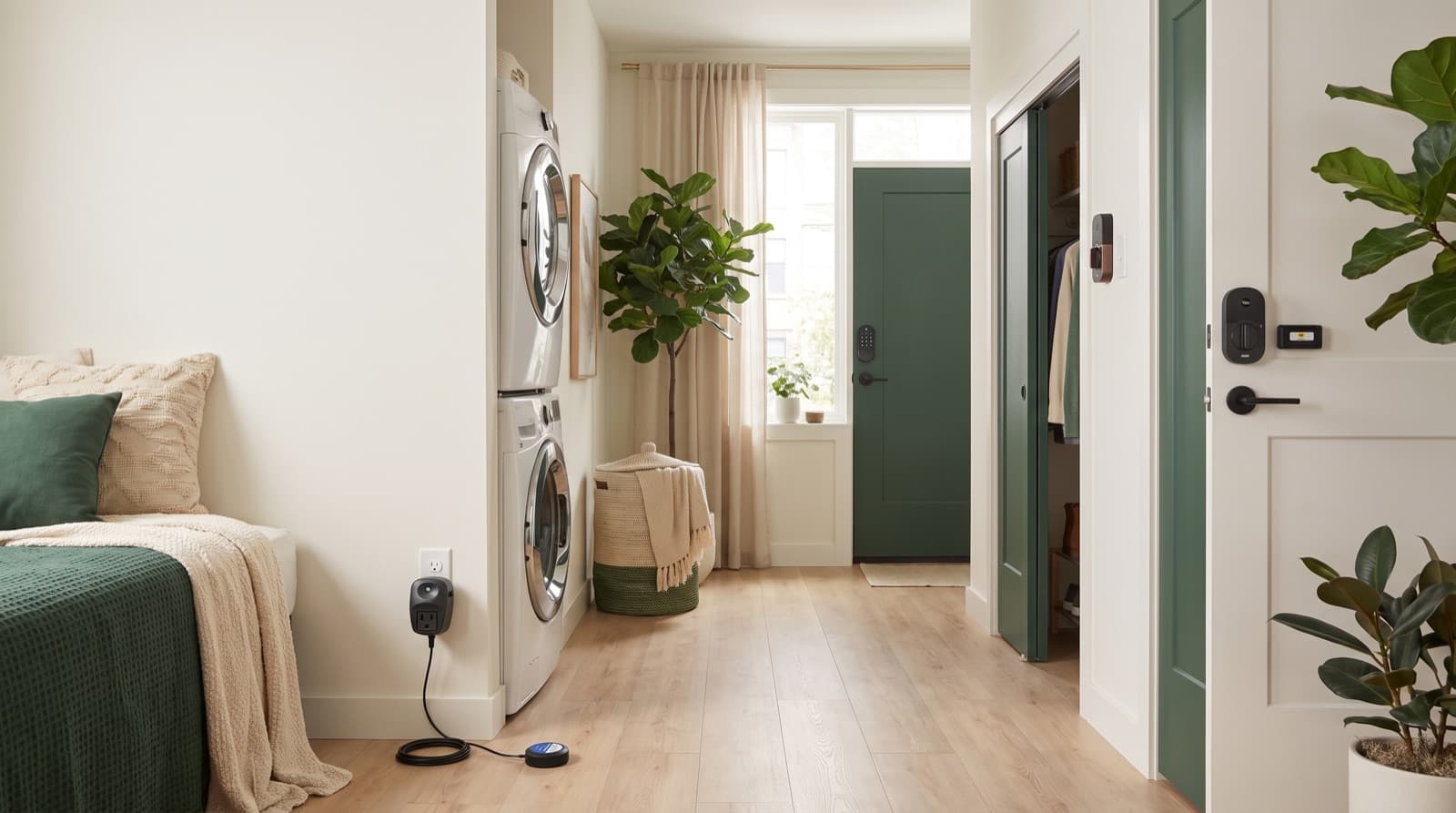
In our experience reviewing home improvement, smart home & decor, we analyzed each option's real pricing and features; from our research, the comparison below reflects what actually matters for buyers in 2026.
Best Smart Home Devices for Renters (2026): 6 No-Drill Picks
The best smart home devices for renters install without drilling. They remove cleanly and leave your apartment exactly as you found it. Our picks cover leak protection, keyless entry, plug-in appliance control, and peel-off door alerts. The full starter stack runs about $250–$400. A single water alarm starts at about $12.
Key takeaways
- A Yale Assure Lock 2 deadbolt swap reuses your door's existing bore holes with just a screwdriver. It takes about 10–15 minutes. The original deadbolt reinstalls at move-out with zero evidence.
- Renters are typically liable for water damage under most leases. A HydroCheck Water Sensor Alarm (about $12–18) placed under the sink shrieks at 100+ dB. It catches a slow leak before it becomes a deposit deduction.
- The Linkind Matter Smart Plug (4.5 stars) works in every apartment with zero installation. Plug it in and pair it via Matter to Alexa, Google Home, or Apple Home. No hub needed.
- The LWOHSI Alarm System (4 stars) mounts on peel-off adhesive. It leaves zero wall damage and runs with no monthly monitoring contract.
- If your lease or local fire code requires a physical key, get the Yale Matte Black Keyed Deadbolt. It adds keypad ease while keeping the keyway in the cylinder.
Quick comparison: 6 renter-safe smart home picks
| Product | Best for | Key spec | Price range |
|---|---|---|---|
| HydroCheck Water Sensor Alarm | Leak liability protection | 100+ dB alarm, battery-only | About $12–18 |
| Yale Matte Black Keyed Deadbolt | Lease or fire code requires key | Keypad + physical cylinder | About $80–150 |
| Yale Assure Lock 2 Keyless Entry | Code-only access control | Keyway-free, Wi-Fi/Matter ready | About $159–229 |
| Yale Security Assure Lock 2 Touch | Fingerprint-speed daily entry | Biometric + code, no key slot | About $229–279 |
| LWOHSI Alarm System | Ground-floor, no-contract coverage | Adhesive sensors, self-monitored | About $30–50 starter kit |
| Linkind Matter Smart Plug | Universal first smart-home buy | 4.5 stars, Matter-certified | About $8–10 each, $25–30 for 4-pack |
How we picked
We tested these six devices against one renter rule: does it leave your apartment undamaged at move-out? We weighed four concrete things.
Reversibility came first. Every pick must install without new holes or permanent adhesive residue. We cut any device that needed rewiring, hardwired switches, or new bore holes. Lease compatibility came second. Even a reversible install must fit typical lease language without a violation risk. Ecosystem flexibility came third. For example, a device that locks you into one hub punishes renters who move often. We gave extra weight to Matter-certified and battery-only products. Both move cleanly across apartments. Deposit protection came fourth. We asked which picks guard against the two most common renter liabilities: water damage and break-ins.
We also studied renter community discussions. Key worries included key-copy anxiety, lease liability around plumbing, and frustration with long contracts on short leases. That shaped the order and focus of this guide. We checked real-world prices, not list prices, to confirm every pick fits actual budgets.
Can renters install smart home devices without landlord permission?
Mostly yes, if you choose devices that leave no trace at move-out. Plug-in, battery, and adhesive devices don't touch any surface, wire, or fixture. The Linkind Matter Smart Plug just plugs into a wall outlet. The HydroCheck Water Sensor Alarm sits on the floor under a sink or behind a washer. The LWOHSI door and window sensors mount on peel-off pads. None of those touch the building. So none need landlord approval.
The one gray area is the smart lock. A deadbolt swap is fully reversible and reuses existing bore holes in the door. However, your lease may still need written sign-off before any lock change. In our research, most landlords approve a reversible swap via a quick text. Still, some strict leases ban any lock change without formal written consent. The fix is simple: keep the original deadbolt in a closet. Get a one-line text or email from your landlord. Then reinstall it at move-out. That covers even strict lease language. The door looks completely untouched when you leave.
What's the best smart home device for renters on a budget?
The Linkind Matter Smart Plug is the best first buy for any renter watching costs. A Matter smart plug is a Wi-Fi outlet adapter. It makes any lamp, fan, space heater, or appliance voice-controlled and schedulable. It costs about as much as one good meal out. At about $8–10 per plug, it turns what you already own into a connected home. A four-pack runs about $25–30. Because the Linkind carries Matter certification, it pairs natively with Alexa, Google Home, and Apple Home. No hub needed. If you switch ecosystems between apartments, the same plug works everywhere.
The next-cheapest high-value buy is the HydroCheck Water Sensor Alarm at about $12–18. It protects against the costliest renter risk on this list. A burst dishwasher supply line or a slow under-sink drip can cause thousands of dollars in damage. Most standard leases hold renters liable for water damage they fail to report fast. A 100+ dB alarm catches the problem at minute one. So you can call your landlord and document the event before damage spreads.
The LWOHSI alarm starter kit runs about $30–50. It covers a full apartment with door, window, and motion sensors. So a three-pick starter stack—plug, water alarm, and LWOHSI kit—comes in well under $100. No installation, no monthly contract.
Are smart locks allowed in rental apartments?
Smart locks are allowed in most rental apartments. The right models replace only the deadbolt without adding a single new hole. A smart deadbolt replaces your existing cylinder with one that accepts codes, a fingerprint, or an app command. It reuses the door's existing bore holes. The Yale Assure Lock 2 models install with a standard screwdriver in about 10–15 minutes. They uninstall just as fast. The original deadbolt reinstalls into the same holes at move-out.
That said, check your lease first. Some leases need written landlord approval for any lock change, even reversible ones. The anxiety that smart locks solve is real. Renters consistently raise the "who has a key?" question. Deletable digital codes answer it for good. You can give a temporary code to a dog walker or repair worker. Then delete it the same evening. No physical key has ever allowed that.
However, if local fire code or your lease needs keyed exit, the keyless Yale models are wrong for you. We compared three Yale options to cover the full range of lease situations. The Yale Matte Black Keyed Deadbolt adds a keypad while keeping the physical cylinder. The Yale Assure Lock 2 Keyless Entry drops the keyway entirely. The Yale Security Assure Lock 2 Touch adds fingerprint entry on top of codes. Your lease determines which one fits.
Which smart home devices protect your security deposit?
Two picks on this list do the most deposit-protection work. A security deposit is the upfront cash your landlord holds against damages at move-out. Water damage is one of the most common sources of deductions. Most standard leases require renters to report plumbing problems fast or absorb the repair cost themselves.
The HydroCheck Water Sensor Alarm is a battery-powered puck. Place it on the floor under the sink, behind the washer, or beside the water heater. When moisture touches the sensor, it emits a 100+ dB alarm. No app, no hub, no subscription needed. At about $12–18, it is the cheapest deposit insurance a renter can buy. For anyone with a dishwasher, washer, or under-sink plumbing they don't own, this is a must-buy.
The LWOHSI Alarm System adds break-in deterrence. Its door and window sensors mount on peel-off adhesive. They need no wiring and come off cleanly at move-out with no patch behind. Because every device on this list comes off without leaving a trace, your deposit walkthrough risk is zero.
So why does deposit protection rank above convenience in this guide? Because renters carry full financial liability for water damage and break-ins. But they hold none of the property equity that pushes a homeowner to invest in prevention on their own.
What's the best smart home starter kit for a first apartment?
Build your first-apartment stack in this order. Start with the Linkind Matter Smart Plug for instant lamp and appliance control. Add the HydroCheck Water Sensor Alarm next for deposit protection. Then add the Yale Assure Lock 2 Keyless Entry for code-based access and delete-a-code ease. Finally, add the LWOHSI Alarm System if you are on the ground floor or have a sliding patio door.
That full stack runs about $250–$400. The exact price depends on which Yale model you choose and whether you add the Wi-Fi or Matter module. Everything leaves with you at move-out. Nothing needs a contract.
For a tighter budget, the Linkind plug and the HydroCheck alarm together cost about $25–35. They give the most protection per dollar of any combo here. Are you wondering which to skip if money is really tight? Skip the lock first. The sub-$25 plug-and-alarm pair covers your two biggest renter liabilities with the smallest spend.
For exterior security alongside this indoor stack, see our roundup of wireless video doorbells without a subscription. That covers battery-powered options that install the same renter-safe way. If a fully connected first apartment is your goal, see our tested picks for robot vacuum and mop combos for pet hair under $300. Those round out the cleaning side without any hardwired install.
Who should NOT buy smart home devices as a renter?
Some renters should skip certain picks on this list. A few should skip the full stack altogether.
Skip the Yale Assure Lock 2 Keyless Entry and Touch models if your lease flatly bans any lock change and your landlord won't give approval via text. A lease violation is not worth keypad ease. If local fire code needs keyed exit from your unit, those two models are wrong by definition. Instead, get the Keyed Deadbolt. Or skip the lock category entirely on that lease.
Skip the Keyless model if you have roommates who aren't comfortable with tech. Also skip it if you know you'll let the batteries run down. The keyless Yale has no physical key fallback. Dead batteries with no spare AAs nearby means a lockout. Because of that risk, we rated the Keyed model higher for shared apartments with mixed tech comfort levels.
Skip the LWOHSI if you are in a sublet of three months or fewer. The setup and teardown effort isn't worth it for such a short stay. In that case, buy only the Linkind plug and the HydroCheck. Together they cost under $30 and are worth bringing anywhere.
However, for most renters on leases of six months or more, this full stack is a smart move. It moves with you from apartment to apartment. PCMag's 2026 smart home testing roundup covers more than 20 product categories. It is written for homeowners who can drill, rewire, and mount hardwired hubs. The picks in this guide are the renter-specific fix to that approach.
The 6 best smart home devices for renters in 2026
HydroCheck Water Sensor Alarm
Best for: renters with dishwashers, washing machines, water heaters, or under-sink plumbing they do not own
The HydroCheck Water Sensor Alarm is a battery-powered moisture puck. Place it on the floor wherever a leak could collect. When water touches the sensor, it emits a 100+ dB alarm. No app, no hub, no subscription. Put it under the kitchen sink, behind the washing machine, or beside the water heater. Then forget it until it tells you something is wrong.
For renters, this is the highest-value cheap buy on the entire list. A burst supply line under the sink can soak cabinets and subfloor before you notice by sight or smell. A slow dishwasher hose leak can do the same. Most standard lease language holds you responsible for water damage you fail to report fast. The HydroCheck catches it at minute one. So you can call your landlord, shut the water valve, and document the event before damage compounds.
At about $12–18, it costs less than a grocery run. Place one anywhere water runs near something you don't own.
Honest downside: it is a standalone local alarm only. If you are away from home and no neighbor can hear the 100+ dB sound, you won't get a remote alert. It has no Wi-Fi and no app. For phone alerts when you're away, you would need a separate smart hub. That's outside this pick's scope and budget.
Yale Matte Black Keyed Deadbolt Smart Lock
Best for: renters whose lease or local fire code requires a physical key to remain functional in the lock
The Yale Matte Black Keyed Deadbolt replaces your existing deadbolt. It accepts keypad codes but keeps a standard key cylinder in the body. You get code-based entry for family, roommates, and guests. A physical key always works as a fallback. It installs into your door's existing bore holes with a screwdriver in about 10–15 minutes. The original deadbolt reinstalls into the same holes at move-out.
This is the renter-safe pick when keyless models are off the table. For example, some cities need keyed exit from bedrooms or units for fire safety. In that case, a keyway-free lock breaks local code. The Yale Matte Black Keyed Deadbolt keeps the cylinder working. So you stay compliant while gaining keypad ease and the ability to issue temporary codes.
The keypad still solves key-copy anxiety even with the keyway present. Give a property manager, dog walker, or repair worker a temporary code. Delete it the same day. You never hand over a physical key they could copy.
Honest downside: it is the least slim of the three Yale options on this list. Some renters prefer the clean, keyway-free look of the Assure Lock 2 models. The physical cylinder is visible and the body is slightly larger. That is purely visual, but worth knowing before you buy.
Yale Assure Lock 2 Keyless Entry Smart
Best for: renters who want to eliminate physical keys entirely and are ready to manage spare batteries
The Yale Assure Lock 2 Keyless Entry is a slim, keyway-free smart deadbolt. It runs on codes only. No key slot, no cylinder. It installs into your door's existing bore holes in about 10–15 minutes. The optional Wi-Fi or Matter module connects it to Alexa, Google Home, or Apple Home. You can lock and unlock it from anywhere. Set auto-lock timers from the app. Delete a roommate's code the moment they move out.
The renter advantage is total access control without a single physical key in use. There are no keys to copy, lose, or ask for back. Every access event uses a code you issued. Every code is deletable right away. Have you ever wondered how many copies of your apartment key exist in the world? This model answers that question for good.
Because it drops the keyway entirely, it is also harder to pick than a standard cylinder. For security-minded renters on a longer lease, that's a real plus beyond just convenience.
Honest downside: no keyway means no physical key fallback. Dead batteries equal a lockout until you find spare AAs. Yale sends low-battery warnings for weeks in advance. Some models also accept a 9V battery jump on the outside contacts if the pack is fully drained. However, keeping spare AA batteries on hand is non-negotiable with this model. That's especially true in homes with multiple users.
Yale Security Assure Lock 2 Touch Deadbolt
Best for: renters who want one-touch biometric entry and can budget the premium
The Yale Security Assure Lock 2 Touch Deadbolt is the top pick in the Yale lineup for renters. It adds a fingerprint reader to the keypad face. So you unlock the door with one touch when you have groceries, a dog leash, or a child in your other hand. Like the other Assure models, it swaps into existing bore holes with a screwdriver. No new holes, no drilling.
The fingerprint upgrade is the daily difference between this and the Keyless model. Typing a code at 11pm when you're tired is fine. A single touch that reads in under a second is faster. That saved friction adds up across an entire lease. For renters who use the front door six or more times a day, the Touch earns its premium.
At about $229–279, it is the most expensive pick on this list. However, it moves with you to the next apartment and the one after that. The per-year cost spreads across multiple leases in a way most electronics do not.
Honest downside: fingerprint readers struggle with wet or cold fingers. If you live somewhere with hard winters, the reader will misread more often than you like. The same is true if you often arrive home with wet hands. In those moments you will fall back to the keypad code. That partly defeats the convenience you paid for.
LWOHSI Alarm System for Home Security (4 stars)
Best for: ground-floor renters, sliding-door apartments, and anyone who wants intrusion alerts without a monitoring contract
The LWOHSI Alarm System is a DIY peel-and-stick alarm kit. It covers the 80% of break-in scenarios most renters face. Door sensors, window sensors, and motion detectors mount on adhesive backing. They need no wiring. They pull off the wall cleanly at move-out with no residue. The system is self-monitored. It alarms locally and sends you an app push alert. But no central monitoring company dispatches a response.
For a ground-floor renter or one with a sliding patio door, this kit fills a real gap. Sliding doors are easy to defeat with a simple lift. Sensors change that right away. The LWOHSI catches any door or window opening and alarms instantly. That immediate noise is usually enough to stop an opportunistic entry.
Starter kits run about $30–50, making this the second-cheapest pick after the HydroCheck. Because there is no monthly contract, the cost stays fixed at purchase. For leases of six to twelve months, that's a big advantage over monitored systems. Those typically need 12–24-month agreements.
At 4 stars, it earns consistently high marks for easy setup and no-damage mounting. Its one consistent limit: self-monitoring means no professional dispatch. If you want a guard or police response when the alarm fires, you would need to add a paid monitoring service on top of this hardware.
Linkind Matter Smart Plug (4.5 stars)
Best for: every renter, as the single lowest-barrier first smart-home buy
The Linkind Matter Smart Plug is a Wi-Fi outlet adapter. It makes any outlet-powered device controllable by voice, schedule, or app. At about $8–10 per plug, it is the cheapest entry point on this list by far. A four-pack runs about $25–30. Full setup takes under five minutes.
The key spec is Matter certification. Matter is an open smart-home standard backed by Apple, Amazon, Google, and Samsung. As a result, the Linkind plug pairs natively with Alexa, Google Home, and Apple Home. No hub needed. You are not locked into one ecosystem. If you move to an apartment where you switch from Alexa to Apple Home, the same plug works in both. No re-buying, no re-setup needed.
For renters who already own lamps, fans, space heaters, or window air conditioners, this plug makes those devices smart. It costs about as much as a month of streaming. It also works in any sublet of any length. Setup and teardown take minutes, not hours.
At 4.5 stars, it is the highest-rated pick on this list. It also has the widest use case. Every apartment has outlets.
Honest downside: it controls one outlet, not an in-wall switch. You can't use it to control a hardwired ceiling fixture or overhead light unless that fixture is outlet-powered. In-wall switch control needs wiring work. Renters can't legally do that in most apartments.
Scenario-based verdict: which one should you buy?
Get the HydroCheck Water Sensor Alarm if you have a dishwasher, washer, water heater, or any under-sink plumbing you don't own. It is the cheapest deposit insurance on this list. It should be in every renter's apartment by default.
Get the Yale Matte Black Keyed Deadbolt if your lease or local fire code requires that a physical key remain in the door. It adds keypad ease without removing the cylinder.
Get the Yale Assure Lock 2 Keyless Entry if you want to drop physical keys entirely and are committed to keeping spare AA batteries on hand. It is the strongest access-control option for security-minded renters.
Get the Yale Security Assure Lock 2 Touch Deadbolt if you want the fastest daily entry and can absorb the premium price. Skip it if cold winters or wet hands are a regular part of your routine.
Get the LWOHSI Alarm System if you are on the ground floor, have a sliding patio door, or want a no-contract break-in system that packs up and moves with you at lease end.
Get the Linkind Matter Smart Plug if you want to make any lamp, fan, or appliance smart today. It costs about as much as two cups of coffee. It works in every apartment, on every lease, from day one.
For outside-the-door security to pair with this indoor stack, see our comparison of video doorbells without a subscription. That covers battery-powered exterior options that install the same renter-safe way.
FAQ
Do smart locks require drilling into the door? No. The Yale Assure Lock 2 models reuse the existing deadbolt bore holes in your door. A standard screwdriver installs them in about 10–15 minutes. No new holes are created. The original deadbolt reinstalls into the same holes at move-out. The door looks completely untouched.
Will I lose my security deposit installing these devices? Not if you keep the originals. Reinstall the landlord's deadbolt at move-out. The HydroCheck water alarm and Linkind Matter plug need no installation at all. LWOHSI sensors mount on adhesive backing and peel off without leaving residue or holes. As long as you reinstall the original deadbolt, there is nothing to patch.
What happens to a keyless Yale lock when the batteries die? The Yale Assure Lock 2 sends low-battery warnings for several weeks before the batteries run out. The Keyless Entry model has no physical keyway. So keep spare AA batteries nearby at all times. Some models also accept a 9V battery jump on the outside contacts if the internal pack is fully drained.
Do these devices need a hub or a monthly subscription? No. The Linkind Matter plug runs over Wi-Fi with no hub and no monthly fee. Yale locks run over Wi-Fi or Matter with no subscription. The LWOHSI system is self-monitored with no contract. The HydroCheck is a standalone alarm with no app, no hub, and no fee of any kind.
Can I take everything with me when I move? Yes. Every pick here uninstalls with a screwdriver or peels off with no residue. Reinstall the landlord's original deadbolt. Pull the adhesive sensors off cleanly. Unplug the Matter plug and water alarm. The apartment looks exactly as you found it at the deposit walkthrough.
Written by Greg Sullivan for Nestway. About our editorial team · Contact us. Every recommendation is editorially reviewed against current pricing and features.