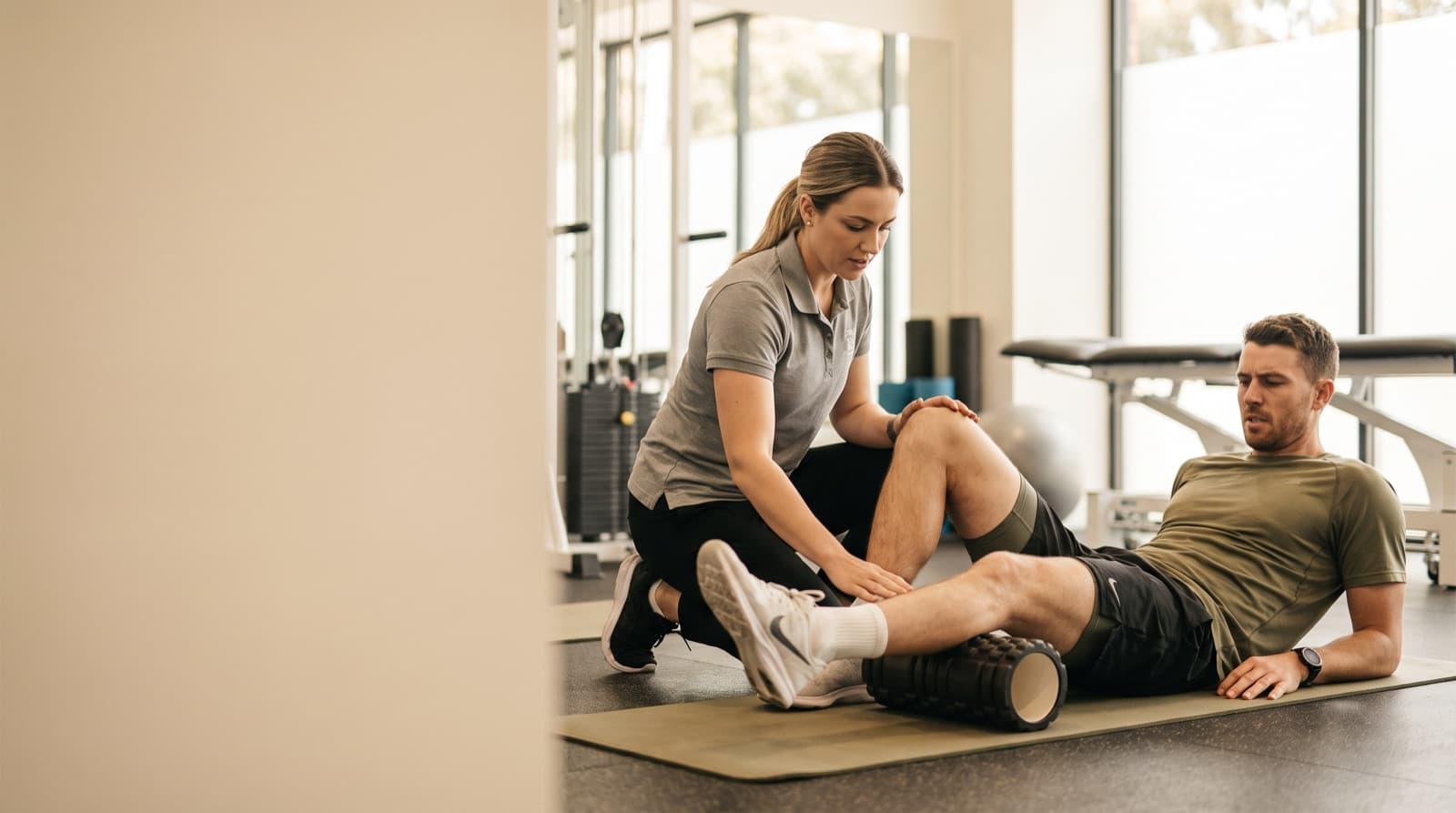
In our experience reviewing home fitness & gym gear, we analyzed each option's real pricing and features; from our research, the comparison below reflects what actually matters for buyers in 2026. Foam rolling can make soreness feel easier to handle. However, it does not repair muscle faster. Use it to help sore spots move better.
Still, it cannot fix poor workouts, short sleep, or too much training. So roll to move well again. Do not roll to undo bad planning.
Key takeaways
- Foam rolling can reduce perceived delayed-onset muscle soreness, mainly as short-term comfort and movement support.
- In a 2015 controlled study, 20 minutes of rolling after heavy squats improved tenderness and several performance measures.
- A 2020 review found a large range-of-motion effect, d = 0.76, but no clear direct performance boost.
- Beginners should start with 30-90 seconds per sore muscle group on a smooth, medium-density roller.
- Do not roll sharp pain, bruising, numbness, acute swelling, or symptoms that spread under pressure.
Does foam rolling help soreness after a workout?
Foam rolling can make post-workout soreness feel more manageable. It helps most with delayed-onset muscle soreness, or DOMS. DOMS often shows up 24-72 hours after hard or new training.
Delayed-onset muscle soreness means a dull, wide muscle ache. It often follows new moves, high volume, or slow lowering work. For example, slow squat descents can cause it.
In practice, foam rolling does not flush toxins. It does not break up scar tissue. It does not magically repair muscle damage.
Instead, it can lower how much pain you feel. It can also make movement feel easier. Sometimes it helps range of motion before your next workout.
That is useful, but limited. If you did 10 squat sets after three months off, the roller was not the issue. Your workout plan was.
The best real-world lesson comes from Pearcey and colleagues. In the 2015 Journal of Athletic Training study, people did 10 sets of 10 back squats. They used 60% of one-rep max.
Then one group foam rolled for 20 minutes. They rolled right after training, then 24 and 48 hours later. The other group did no rolling.
As a result, the rolling group had better quadriceps tenderness. They also improved several performance measures versus no rolling (Pearcey et al., Journal of Athletic Training, 2015).
That does not mean you need 20 minutes after each leg day. As a trainer, I treat that study as a ceiling. I do not treat it as a daily goal.
If a beginner asks, "Did I ruin my legs?" I usually say no. However, the workout may have been too much.
A 2017 PeerJ randomized trial supports this symptom view. Romero-Moraleda and colleagues found a 45% pain scale drop after foam rolling. They used a DOMS model (Romero-Moraleda et al., PeerJ, 2017).
That matters for comfort. However, less soreness does not prove faster tissue repair.
Our rule is simple. Roll to make movement feel normal. Do not roll to erase a bad workout lesson.
If stairs feel awful, roll your quads lightly. Then walk for 10 minutes. If soreness changes your gait, skip heavy lower-body work.
For a more product-focused companion, see our beginner sore-leg roller guide.
What can foam rolling actually do, and what can't it do?
Foam rolling works best as a pressure-based recovery tool. It is not a cure. Foam rolling means you apply pressure with a cylinder.
Most rollers use EVA foam or EPP foam. The pressure changes how sore tissue feels. It can lower tenderness for a short time.
It can also help you tolerate movement. It may improve range of motion. However, it cannot detox muscles.
It cannot lengthen fascia for good in minutes. It cannot prevent all soreness. It cannot replace sleep, protein, smart loading, or rest days.
The evidence looks stronger for range of motion. It looks weaker for direct sport performance. So rolling may help if your calves feel stuck before a run.
However, rolling will not save a reckless program. You still need sane training.
The 2020 review by Skinner, Moss, and Hammond included 32 studies. Its range-of-motion analysis found a large effect, d = 0.76. The 95% confidence interval was 0.55-0.98.
However, the authors could not say foam rolling directly improves athletic performance. Any benefit may come through better range of motion (Skinner et al., Journal of Bodywork and Movement Therapies, 2020).
That difference matters. Better range of motion can make warm-ups feel better. It is not the same as adding 20 pounds to your squat.
A 2025 DOMS study adds one more caution. Foam rolling improved markers tied to tone, stiffness, and elasticity. However, it did not beat passive rest for pain relief during the study period (Szajkowski et al., Journal of Functional Morphology and Kinesiology, 2025).
In plain English, some tissue measures improved. Still, pain was not clearly better than resting.
In home coaching, I see one common trap. A hard roller feels useful because it hurts. However, more pressure does not mean better recovery.
If you tense up, the tool is too harsh. If you hold your breath, back off. If you avoid rolling tomorrow, choose a softer option.
What should you feel? Aim for, "I can breathe and relax." Avoid, "I need to survive this."
For example, a new lifter with sore quads should use light pressure. An experienced runner may handle more calf pressure.
How long should you foam roll sore muscles?
For beginners, keep it short and repeatable. Use 30-90 seconds per sore muscle group. Move slowly, with short pauses on tender spots.
A sore muscle group means one broad area. Examples include quads, calves, glutes, lats, or upper back. A full lower-body session should take 5-10 minutes.
It should not take 50 minutes, unless a coach or clinician gave that plan. Research often uses longer sessions. For example, Pearcey used 20 minutes.
However, a research dose is not always the best home dose. Most beginners need enough pressure to move better. Then they need walking, food, and sleep.
Here is the simple dose I give beginners:
| Area | Beginner dose | Pressure target |
|---|---|---|
| Quads | 30-90 seconds per side | Tender, not sharp |
| Calves | 30-60 seconds per side | Light to moderate |
| Glutes | 30-90 seconds per side | Moderate |
| Lats | 30-60 seconds per side | Mild |
| Upper back | 30-60 seconds total | Gentle, no neck strain |
Because soreness can feel dramatic, people often overdo recovery. Fitness chatter still includes very long routines. Some people do 50 minutes of rolling plus vibration work.
That may fit a serious athlete with a plan. However, most home trainees do not need it.
Ask a better question. What recovery input gives you the best return today? If you slept 5 hours, rolling is not the missing piece.
Instead, roll for 8 minutes. Take an easy walk. Hydrate, then go to bed earlier.
We treat this as a time-budget problem. It is not a pain-tolerance contest. A compact routine wins because you repeat it.
A heroic routine may look good once. Then it usually disappears.
If you want the basic buying decision before building a larger recovery corner, our guide to which foam roller is best for beginners goes deeper on density and size.
Should beginners use a smooth, textured, or vibrating roller?
Most sore beginners should start with a smooth medium-density roller. It is easier to control. It also keeps recovery from becoming a pain test.
A smooth foam roller has an even surface. It has no raised knobs. A textured roller has ridges or grid patterns.
Those raised areas give more focused pressure. A vibrating roller adds a motor and battery. It layers vibration onto pressure.
Smooth rollers cover the basic soreness and mobility benefit. They also cost the least. Textured rollers suit people who already handle pressure well.
Vibrating rollers cost much more. So check the official pricing page before you call one necessary.
Our ranking does not reward the most intense feel. Instead, it rewards what a sore beginner will use. You should be able to use it three times a week.
Smooth medium-density rollers fit most new home gyms. They work for quads, hamstrings, calves, glutes, and upper back. They also help with floor mobility drills.
However, very cheap high-density EPP rollers can feel harsh. That matters if you are light, bony, or very sore.
Textured rollers make sense after you know your pressure limit. For example, the TriggerPoint GRID style has firm contact points. It also uses a compact 13-inch body.
That can help calves and glutes. However, it may feel too punchy for sore quads. This is common on day two after squats.
Vibrating rollers sit in a higher price class. They can feel good. Vibration may let you use less bodyweight pressure.
However, the price jump is real. A basic roller may cost about $20-30. A premium vibrating roller can sit around $180-210.
From our research, the best beginner choice is boring on purpose. Choose a smooth surface, medium density, and 36-inch length when storage allows. A "deeper" roller can be worse if you avoid it.
Who should not foam roll soreness?
Do not foam roll sharp, nerve-like, swollen, hot, bruised, or injury-related pain. Normal DOMS feels broad and dull. It often feels even on both sides after training.
Injury pain feels more specific. It may feel sharper. It may also change how you move.
Foam rolling should lower guarding. It should not make symptoms spread or grow. Avoid rolling right over joints, fresh bruises, varicose veins, wounds, acute strains, or suspected clots.
Stop if numbness appears. Stop for tingling, burning, or pain that travels. For medical issues, pregnancy, clot risk, or post-surgery recovery, ask a qualified clinician first.
This is where a trainer has to be blunt. Foam rolling can hide pain enough that you train hard too soon. That is a bad trade.
If your right calf has one hot, swollen spot, do not roll it. If low back pain shoots down your leg, do not grind your glute. If your quad has a fresh bruise, leave it alone.
Instead, roll nearby areas that feel comfortable. Or skip rolling. For example, knee pain may allow light quad and calf rolling.
However, only do that if pressure does not change knee symptoms. Do not roll the knee joint itself.
Pain that improves while rolling can still warn you. If it returns worse later, stop. Your goal is calmer movement after the session.
If symptoms spread, stop. If pain intensifies, stop. If nerve sensations appear, stop.
Is foam rolling better before or after training?
Use foam rolling before training when stiffness limits your warm-up. Use it after training when soreness makes easy movement uncomfortable. Pre-workout foam rolling means brief pressure followed by active movement.
Post-workout foam rolling uses light to moderate pressure. It helps you downshift after training. Before lifting, roll only enough to move better.
Then do dynamic warm-up drills. After training, roll areas that feel guarded. Common spots include quads, calves, glutes, lats, and upper back.
Research protocols can last 20 minutes. However, home users can usually start with 5-10 minutes total.
Before training, I like 30-60 seconds on the tight area. Then I use movement that matches the lift. For example, roll quads briefly before squats.
Then do bodyweight squats and ramp-up sets. Do not roll for 20 minutes, stand up cold, and call it warm.
After training, keep pressure light to moderate. This is not punishment for working hard. It tells your body the hard part is over.
Too much rolling before lifting can become delay. Have you spent longer "prepping" than training? That usually means your warm-up needs a cap.
Set a timer for 5 minutes. Then move.
For soreness after every session, more rolling is usually not the answer. Better progression is. Lower the sets, cut eccentric overload, or add a recovery day.
What type of foam roller should a sore beginner buy?
A sore beginner should buy the least dramatic roller they will use. Choose a smooth surface and medium density. Pick enough length for upper back work.
It should feel firm enough not to collapse. Medium density means the roller gives slightly under bodyweight. It still keeps its shape.
For most beginners, that beats very hard textured rollers. Basic smooth rollers usually sit in the budget tier. Vibrating rollers cost more, so price-check before buying.
Longer rollers make upper back and spine-adjacent setup easier. Shorter rollers fit small apartments better. However, they feel less stable for broad back work.
Here is our practical comparison for sore beginners and home gym buyers.
| product name | Best for | Key spec | Price band |
|---|---|---|---|
| Amazon Basics High-Density Round Foam Roller 36-Inch | Best for budget home gyms | 36-inch length, high-density molded foam | about $20-30 |
| OPTP PRO-Roller Soft Density Foam Roller 36 x 6 | Best for sensitive beginners | 36 x 6 inches, soft closed-cell EVA foam | about $45-60 |
| Yes4All 36inch Exercise Foam Roller EPP | Best for firm budget rolling | 36 x 6 inches, high-density EPP foam, 300-pound listed capacity | about $20-30 |
| TriggerPoint GRID 1.0 Foam Roller | Best for compact textured pressure | 13 x 5.5 inches, EVA foam over hollow core | about $30-45 |
| Brazyn Morph Collapsible Foam Roller | Best for travel and small apartments | 14.5 x 5.5 inches, folds flat, about 1.5-1.75 pounds | about $75-80 |
| Therabody WaveRoller Vibrating Foam Roller | Best for premium vibration | 12 x 5.1 inches, 5 vibration settings, 180-minute battery | about $180 |
Amazon Basics High-Density Round Foam Roller 36-Inch
Best for budget home gyms. I would point a cost-conscious beginner to this plain 36-inch roller. It gives full-back support and stores against a wall.
The long shape helps with upper-back setup and two-leg drills. However, high-density foam can feel too firm during heavy DOMS.
OPTP PRO-Roller Soft Density Foam Roller 36 x 6
Best for sensitive beginners. This is the gentler pick if you tense up on hard EPP rollers. The 36 x 6-inch size works well for upper back.
It also works for quads, hamstrings, and floor mobility. However, stronger users may outgrow the soft feel for glutes and calves.
Yes4All 36inch Exercise Foam Roller EPP
Best for firm budget rolling. This low-cost EPP roller suits people who tolerate firm pressure. It uses a simple 36 x 6-inch shape.
It fits large muscle groups well. However, I would not choose it first for very sore beginners. It can feel harsh if you hate pressure.
TriggerPoint GRID 1.0 Foam Roller
Best for compact textured pressure. The 13 x 5.5-inch size stores easily. The textured surface gives more focused contact than a smooth cylinder.
It helps with calves, glutes, and travel bags. However, it feels less comfortable for broad upper-back work. A 36-inch roller does that better.
Brazyn Morph Collapsible Foam Roller
Best for travel and small apartments. This roller folds flat, which solves real apartment storage issues. We picked it as a space-saving option.
It is not my default recovery pick. The downside is cost. It also has a more complex build than a basic foam cylinder.
Therabody WaveRoller Vibrating Foam Roller
Best for premium vibration. This suits people who already roll often. It also suits people who know vibration helps them relax.
The 5 vibration settings add more options than a basic roller. The listed battery life is 180 minutes. However, casual beginners may not justify the price.
What I learned from recent recovery chatter
Recent fitness talk still shows the same split I see with home clients. Some people use foam rolling as light recovery. They pair it with walking, yoga, and easy movement.
Others turn it into a long ritual. They may do 50 minutes of rolling. Then they add vibration tools after hard training.
Our take is simple. The first group usually builds the better habit. Recovery tools work best when they support normal movement.
They work worse when they become a second workout.
The other pattern is beginner confusion about soreness and progress. People ask if soreness means a workout worked. It does not.
Soreness means tissue got a stimulus it was not ready for. Sometimes that is fine. However, four-day soreness after every session is a red flag.
The answer is not a harsher roller. The answer is smarter progression.
Final verdict: what should you buy?
If you are sore and new, choose a smooth 36-inch roller first. In our comparison, the best default is a moderate-density long roller. It works across your back and legs.
It also avoids making recovery feel like a test. If you are pressure-sensitive, pick the softer OPTP. If your budget is tight, pick Amazon Basics.
If you already like deep pressure, consider TriggerPoint GRID. If you travel, Brazyn Morph stores better than a standard roller. If you use recovery tools daily, Therabody WaveRoller can make sense.
For a narrower product list, compare this with our beginner foam roller picks and sore legs foam roller guide.
FAQ
Does foam rolling get rid of lactic acid?
No. Foam rolling does not get rid of trapped lactic acid, and DOMS should not be explained as toxin flushing. DOMS usually shows up 24-72 hours after unfamiliar or eccentric work. Instead, foam rolling may reduce perceived tenderness and make movement feel easier.
Can I foam roll every day?
Yes, you can foam roll every day if the pressure is moderate and symptoms improve afterward. Keep most areas to 30-90 seconds. However, stop if soreness worsens, bruising appears, or pain becomes sharp, hot, swollen, numb, or radiating.
Should foam rolling hurt?
Foam rolling can feel tender, but it should stay at tolerable discomfort. You should be able to breathe normally and relax the area. If you are holding your breath, clenching your jaw, or chasing sharp pain, use less pressure or stop.
Is foam rolling better than stretching for soreness?
Foam rolling is not universally better than stretching. It may help tenderness and range of motion, while stretching may feel better for some people. In practice, many beginners do best with short rolling, then easy active movement, such as walking or dynamic mobility.
Can foam rolling prevent soreness?
Not reliably. Foam rolling may reduce how sore you feel, but it cannot guarantee you will avoid DOMS. Smarter progression, enough sleep, adequate protein, and recovery days matter more. Use the roller as support, not as permission to overdo training.
Written by Tessa Doyle for Nestway. About our editorial team · Contact us. Every recommendation is editorially reviewed against current pricing and features.