
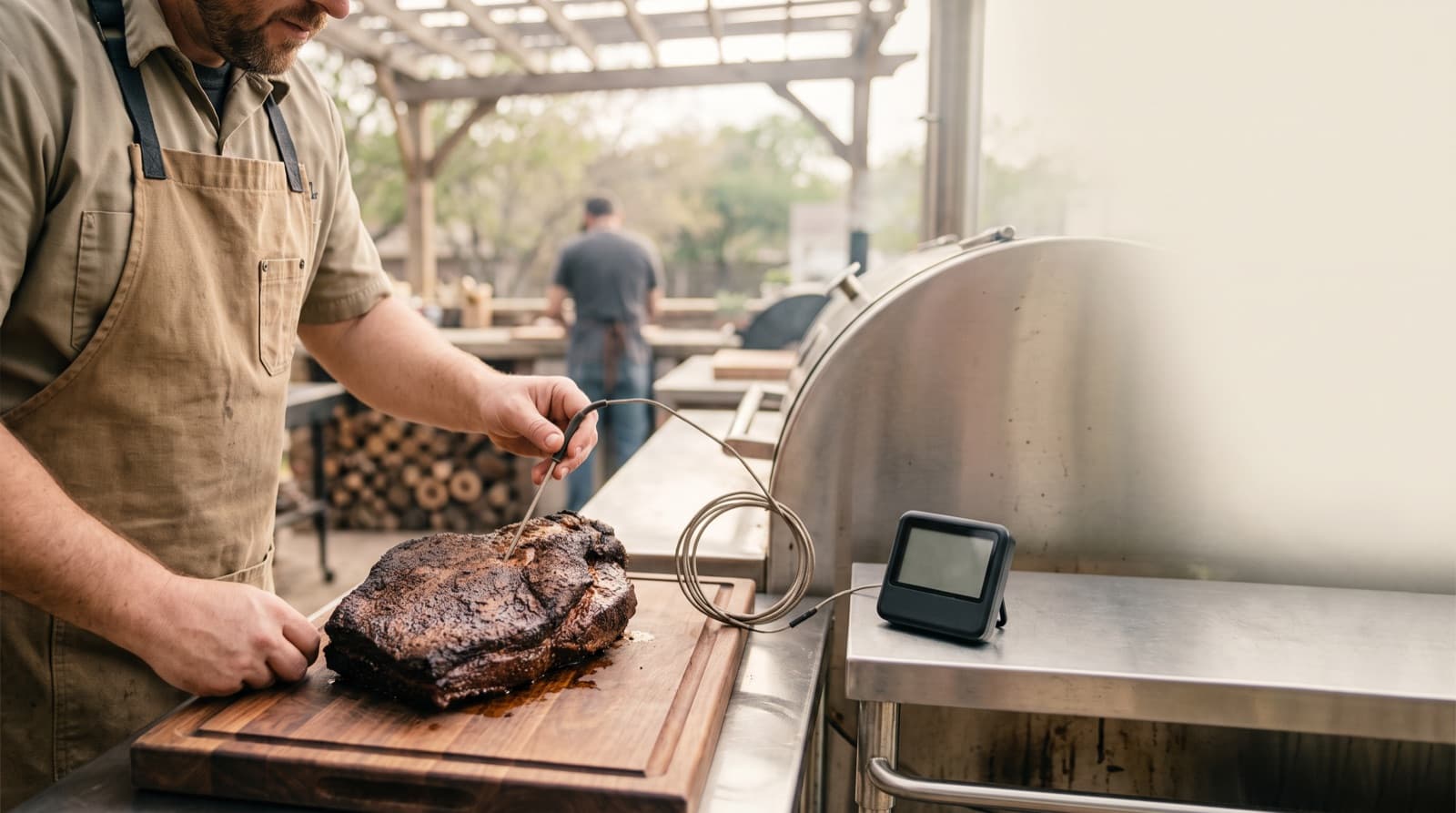
In our experience reviewing grilling, bbq & outdoor cooking, we analyzed each option's real pricing and features; from our research, the comparison below reflects what actually matters for buyers in 2026. The ThermoPro TP829B is my best pick here for brisket. It gives you four wired probes, a receiver, 1,000-ft RF range, and stated ±1.8°F accuracy. That matters overnight, when steel and weather beat up weak signals.
Key takeaways
- The ThermoPro TP829B is the safest brisket pick here: 4 wired probes, 1,000-ft RF range, ±1.8°F accuracy, and about $61.99 on its official page.
- For smoking brisket, 2 probes is the practical floor: one in the flat or thickest lean section, one clipped at grate level.
- Fully wireless probe-style units can work, but thick steel smokers punish weak signals during 10-16 hour cooks.
- A $40-$70 wired-probe RF thermometer is the honest backyard sweet spot.
- The best brisket thermometer is boring: loud alarms, replaceable probes, a visible base, and cables that survive lid routing.
| product name | Best for | Key spec | Price band |
|---|---|---|---|
| ThermoPro TP829B Wireless Meat Thermometer | Best for backyard brisket cooks who want meat plus pit monitoring | 4 wired probes, 1,000-ft RF range, 14°F-572°F range | $55-$70 |
| BBQOVN BBQ7 WiFi Sub-1G Wireless Meat Thermometer | Best for app-first cooks who want a connected alternative | 1 wireless probe, Sub-1G/WiFi base, claimed 7 sensors | $45-$80 |
| ThermoPro TP27 Long Range Wireless Meat Thermometer | Best for cooks who want a cheaper 4-probe RF setup | 4 wired probes, long-range RF receiver | $50-$70 |
| Inkbird IBT-4XS Bluetooth Wireless Grill Thermometer | Best for short-range patio monitoring | 4 probe support, Bluetooth app, rechargeable base | $35-$55 |
| HOPEPOP HK-80A Wireless Meat Thermometer | Best for cable-free curiosity, not wired brisket duty | Wireless probe/base design, claimed NIST ±0.5°F accuracy | $50-$90 |
What is the best wired meat thermometer for smoking brisket?
The ThermoPro/TempPro TP829B is my top pick from this group. You get four wired probes, a receiver, 1,000-ft RF range, and stated ±1.8°F accuracy. However, it does not force you through a phone app.
A wired meat thermometer uses metal probes on heat-rated cables. Those cables run to a base or transmitter. In practice, that boring cable saves your cook.
The TP829B keeps the transmitter outside the hot chamber. The probe tip stays in the brisket or near the grate. So you can watch meat and pit temp at once.
We compared it with connected probes and Bluetooth-first units. The pick came down to alarms, probe count, price, and fewer 2 a.m. app chores.
The official TP829B page listed it around $61.99 during our 2026 price check. Its brisket specs are clear. You get 4 color-coded wired probes, 49-inch probe wire, 14°F-572°F range, and stated ±1.8°F accuracy.
That said, the TP829B is not a single corded countertop thermometer. It is an RF receiver system. The probes wire into the transmitter, not the handheld receiver.
For smoking brisket, that setup makes sense. It fits offsets, pellet grills, Weber kettles, kamados, and vertical smokers.
How we picked
A brisket thermometer must work during a long low-and-slow cook. A quick steak check does not prove much. So we looked at price, probe count, stated accuracy, signal type, batteries, alarms, and fit.
We also checked if each unit can track meat and pit temp together. For brisket, that beats a slick app screen. We used official price and spec pages where we could.
We did not invent lab numbers. We also did not claim private test data. Instead, we ranked the gear I would trust on a 12-hour packer.
That means wired probes, a readable receiver, and loud alarms. It also means less phone fuss when the fire gets moody.
We used food-safety context from the USDA FSIS food thermometer guidance. USDA lists 145°F with a 3-minute rest for beef roasts. However, tender brisket usually lands much higher.
For accuracy, we considered NIST thermometer verification guidance. Around ±2°F works fine for brisket. Probe placement and tenderness matter more than decimals.
Why are wired probes better than fully wireless probes for brisket?
Wired probes suit brisket because the probe stays linked to the transmitter. The receiver then handles the long-range signal outside the smoker. Fully wireless probes look cleaner, but steel cookers punish them.
A fully wireless probe keeps its battery and radio inside the metal probe body. That design looks neat. However, it asks a tiny device to work inside meat and behind steel.
Brisket often runs 10-16 hours at 225°F-250°F. Because of that, I trust wired probes first. The transmitter can sit outside heat, smoke, grease, and lid blast.
The trade-off is cable care. Route wires through a grommet, vent, or soft lid gap. If an offset lid crushes the cable, it can die fast.
Want app-first brisket monitoring anyway? Our guide to the best wireless meat thermometer for smoking brisket covers that cleaner, riskier lane.
How many probes do I need for brisket and pit monitoring?
For brisket, two probes is the floor. Four probes gives you room to work. Run one food probe into the flat or thickest lean area.
Then clip one ambient probe at grate level. Use extra channels for the point, a second brisket, or smoker hot spots. A pit probe reads air where the meat sits.
That reading often differs from the dome thermometer. I have seen dome gauges flatter cooks by 25°F or more. So, if you only watch meat temp, you miss half the story.
The TP829B supports up to 4 probes. That is the practical sweet spot. For example, probe 1 goes in the flat.
Probe 2 clips at grate level. Probe 3 checks the point. Probe 4 checks the cooler side of the rack.
However, more probes mean more cable mess. Do not buy four channels for one small flat twice a year.
Is the ThermoPro TP829B worth buying for brisket?
Yes, the TP829B is worth buying for backyard brisket cooks. It gives you useful alarms and multi-probe tracking around $60. Its best feature is not the 1,000-ft range claim.
Instead, the value comes from four wired probes, a receiver, no app login, and enough channels. You can track meat and pit together. A remote RF thermometer sends data between transmitter and receiver by radio.
So it does not need WiFi, Bluetooth pairing, or a phone screen. In our comparison, that plain setup fits brisket best. When the stall hits 155°F-170°F, you need steady info.
The TP829B uses 4 AAA batteries total. That means 2 in the receiver and 2 in the transmitter. It also has dual timers up to 99+ hours.
That is plenty for brisket, pork butt, turkey, or ribs. Still, it has two clear downsides. It is not rechargeable, and it lacks cloud monitoring away from home.
Should I buy BBQOVN BBQ7 for brisket instead?
The BBQOVN BBQ7 is more interesting than basic Bluetooth probes. It uses a base with Sub-1G/WiFi monitoring. It also claims 7 NIST-certified sensors.
However, it is not the pure wired-probe pick here. Treat it as the connected option. It fits cooks who want phone monitoring more than cable simplicity.
A connected meat thermometer sends temp data to a base, app, or cloud service. That helps when you leave the patio. In our research, the BBQOVN BBQ7 official sale price was around $49.99.
Its pitch includes Sub-1G wireless tech, a smart base, ambient tracking, and a wireless probe. That works for some cooks. For instance, a pellet-grill owner may like the clean probe handling.
However, this is still a wireless probe system. It should not beat the wired-probe RF pick for this wired brisket list.
Best for cooks who want app/base monitoring and hate cable routing.
What about the ThermoPro TP27 Long Range Wireless Meat Thermometer?
The ThermoPro TP27 is the value cousin to the TP829B. It fits cooks who still want wired probes and a receiver. A multi-probe smoker thermometer tracks several channels at once.
Usually, that means meat temp and pit temp together. That is why the TP27 belongs here. It often sells in the $50-$70 band.
It supports 4 wired probes and uses a receiver setup. So it avoids app-only monitoring. In practice, it makes a good backup pick.
Buy it if the TP829B is out of stock or priced strangely. We still rank the TP829B higher. Its official page states 1,000-ft RF range and a stronger brisket spec set.
Best for cooks who want 4 wired probe channels and do not need the exact TP829B package.
The downside is overlap. If the TP829B costs about the same, I would buy the TP829B first.
Is the Inkbird IBT-4XS good enough for brisket?
The Inkbird IBT-4XS can work for brisket near the smoker. It fits cooks who want a low-cost app thermometer. However, it is not my first pick for overnight smoking.
A Bluetooth grill thermometer links the base to your phone at short range. That can work on a patio. Still, walls, steel lids, and distance hurt the signal.
The IBT-4XS usually sits around $35-$55. It supports up to 4 probes and has a rechargeable base. That is good value.
However, Bluetooth-first monitoring keeps your phone in the job. You need it connected and nearby.
For example, it makes sense for ribs, chicken, or a daytime brisket. It makes less sense for a 14-hour offset cook.
Best for patio cooks who want cheap multi-probe monitoring through an app.
Its downside is range confidence. For serious brisket, RF beats Bluetooth.
Should HOPEPOP HK-80A lead a wired brisket list?
No, the HOPEPOP HK-80A should not lead a wired brisket list. It is a wireless probe/base unit. It is not the cable-first setup I trust most.
A probe-style wireless thermometer keeps more electronics inside or near the probe system. That keeps the chamber cleaner. However, it raises signal and battery concerns on long cooks.
Its best reason is the claimed NIST ±0.5°F accuracy. That number looks sharp on paper. Still, brisket is not a lab bath.
The better question is not only, “How accurate is the sensor?” Ask this instead. “Will I hear the alarm at hour 11?”
Best for cooks who want a fast wireless probe/base unit for roasts, chicken, or shorter cooks.
The downside is fit. It is not the right lead product for wired brisket monitoring.
Who should NOT buy a wired-probe brisket thermometer?
Do not buy one if you mainly grill steaks, cook rotisserie, or hate lid cables. For fast grilling, an instant-read or true wireless probe can be easier. For brisket, cable hassle usually pays off.
A leave-in wired probe stays in food while it cooks. However, the cable still needs care. Keep it away from flame, sharp bends, and lid crush.
Also, do not use wired probes on rotisserie unless the maker says so. A spinning basket or spit can wrap the cable. Then it can ruin it fast.
If you mostly cook burgers, thin pork chops, or steaks, buy a fast instant-read first. Those foods cook too fast for four channels to matter.
However, if you smoke brisket, pork shoulder, turkey breast, or beef ribs, cables earn their keep.
For broader context, compare this list with our best meat thermometer for smoking brisket tests.
What should I spend on a brisket thermometer in 2026?
Expect to spend about $40-$70 for a serious backyard brisket thermometer. That should get you wired probes and a remote receiver. The TP829B sits in that honest middle.
Cheaper single-probe units can miss pit monitoring. Pricier smart systems only make sense if you need app alerts or WiFi. Some also add cleaner data logs.
A brisket thermometer budget should include replacement probes over time. Cables live near heat, grease, foil wrap, and lid edges. That is the AOV truth sellers skip.
Your first buy may be $60. However, a hard-used pit kit may need new probes later.
The TP829B was around $61.99 on its official page during our pricing check. The BBQOVN BBQ7 official sale price was around $49.99.
However, sale prices move. Confirm current details on each official pricing page before publishing or buying.
If you care more about app alerts, read our guide to the best wireless meat thermometer for smoking with app. If you cook on kettles, our Weber Kettle 22 vs 26 smoking verdict explains why grate-level monitoring matters on charcoal.
Final verdict
Get ThermoPro TP829B Wireless Meat Thermometer if you want the best wired-probe brisket setup here. It has 4 probes, RF range, no app dependency, and about $60 pricing.
Get BBQOVN BBQ7 WiFi Sub-1G Wireless Meat Thermometer if you want a connected base and app monitoring. It gives up some cable dependability.
Get ThermoPro TP27 Long Range Wireless Meat Thermometer if you want a value 4-probe RF alternative.
Get Inkbird IBT-4XS Bluetooth Wireless Grill Thermometer if you cook near the smoker. It fits cheaper app-based monitoring.
Skip HOPEPOP HK-80A as the lead wired brisket pick. Consider it only if you want cable-free probing and accept the trade-off.
FAQ
Do I need a leave-in thermometer for brisket?
Yes. Brisket cooks long enough that you need continuous meat and pit monitoring, not just spot checks. A 10-16 hour cook gives too many chances for a fire dip, a pellet feed issue, or a fast-rising flat.
Where should the brisket probe go?
Put the probe in the thickest part of the flat or lean center. Avoid fat pockets and the seam between the point and flat. If the probe slides into fat, it can read wrong while the lean meat stays tight.
Should I monitor smoker temp at the grate?
Yes. Grate-level pit temperature is more useful than relying only on the lid thermometer. The brisket sits on the grate, so that is the air temperature that matters.
Are wireless meat thermometers bad for brisket?
Not always. However, fully wireless probes are riskier in thick smokers because signal and battery problems matter more over 10-16 hours. For overnight cooks, I prefer wired probes feeding an outside transmitter.
How accurate should a brisket thermometer be?
Around ±2°F is good enough for smoking. Probe placement, pit stability, and tenderness checks matter more than chasing decimal precision. Brisket is done when it probes tender, not just when a screen shows one magic number.
Written by Cole Mason for Nestway. About our editorial team · Contact us. Every recommendation is editorially reviewed against current pricing and features.