
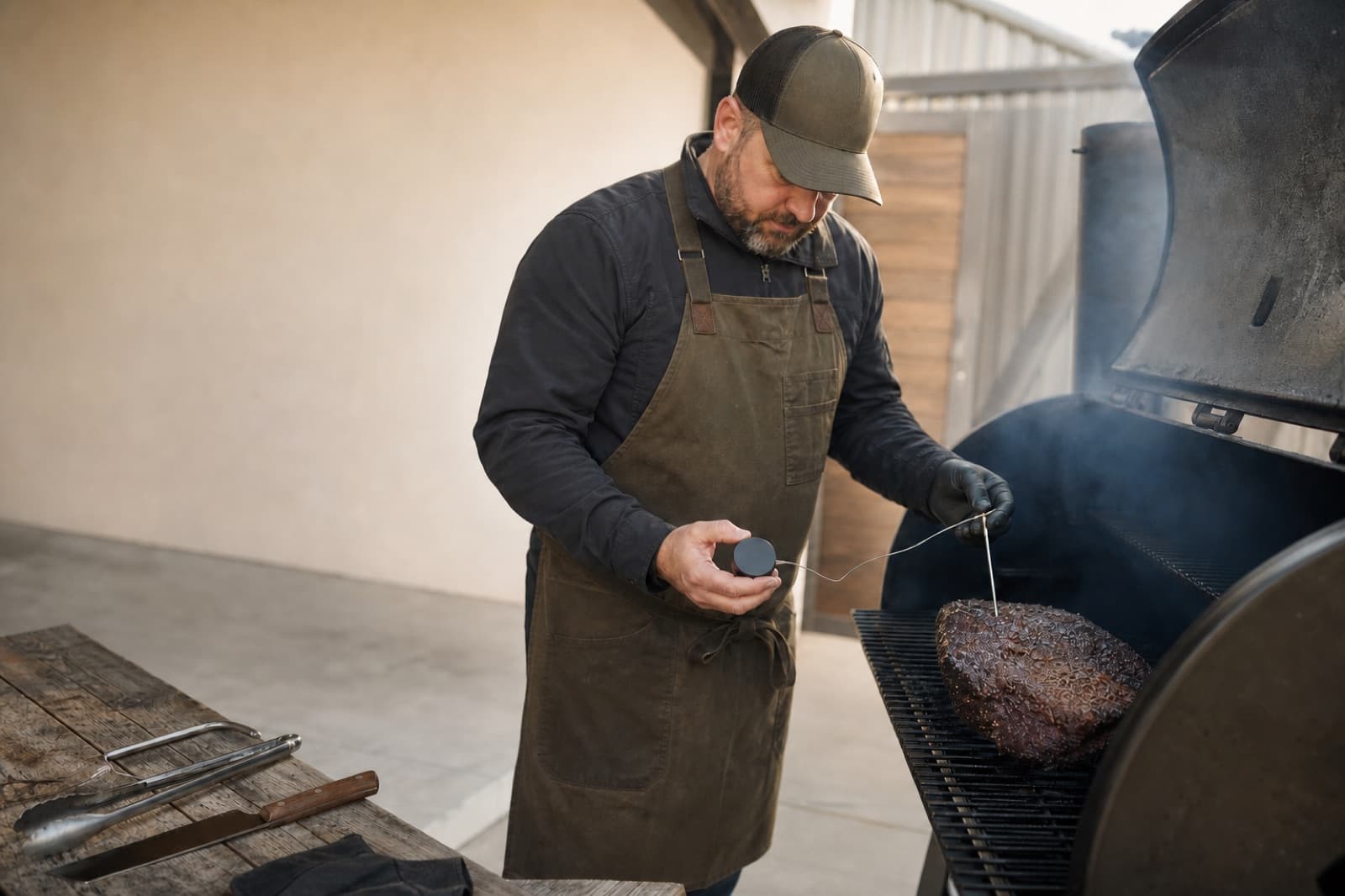
In our experience reviewing grilling, bbq & outdoor cooking, we analyzed each option's real pricing and features; from our research, the comparison below reflects what actually matters for buyers in 2026. The best wireless meat thermometer for smoking is the TempPro TP829B for most backyard cooks. It still uses probe cables. However, its 1,000-ft RF range, four probes, receiver, and about $71.99 price win. That setup fits brisket, ribs, and pork shoulder.
Key takeaways
- TempPro TP829B is our value pick for smoking: about $71.99, 1,000-ft RF range, four wired probes, no app, and claimed ±1.8°F accuracy.
- GoveeLife Bluetooth Wireless Meat Thermometer is the best budget app pick: about $59.99, Wi-Fi plus Bluetooth, 500-ft claimed range, and 48-hour probe runtime.
- ThermoMaven P1 has the best thinner-probe pitch, but its deep insertion need makes it better for brisket flats, butts, roasts, and birds than thin chops.
- BBQOVN BBQ7 is the wildcard: about $49.99, Sub-1G plus Wi-Fi, 7 sensor language, and backorder risk.
- For metal smokers, wired RF still wins often because steel, walls, and distance can beat Bluetooth claims.
| product name | Best for | Key spec | Price band |
|---|---|---|---|
| TempPro TP829B | Backyard smokers who want range without an app | 1,000-ft RF, 4 wired probes, 14°F to 572°F range | $70-75 |
| GoveeLife Bluetooth Wireless Meat Thermometer | Phone-first cooks on a budget | Wi-Fi plus Bluetooth, 500-ft claim, 48-hour runtime | $55-65 |
| ThermoMaven P1 | Thick roasts and wireless-probe buyers | 6 sensors, thinner probe design, IPX8 probe claim | $55-70 |
| BBQOVN BBQ7 WiFi Sub-1G Wireless Meat Thermometer | Spec hunters who accept stock risk | Sub-1G plus Wi-Fi, 7 sensor claim, smart base | $45-60 |
What is the best wireless meat thermometer for smoking in 2026?
The best wireless meat thermometer for smoking is TempPro TP829B for most backyard smokers. It solves range first. RF range means radio contact between a sender and receiver. You do not need your phone, router, or app account.
In our comparison, the TP829B had the best smoking mix. You get claimed 1,000-ft RF range and four color probes. You also get ±1.8°F accuracy and an about $71.99 price.
It is not truly wire-free. However, brisket, pork shoulder, ribs, and zone checks need steady alarms. Pretty probes matter less at hour nine. If you cook on steel, that trade-off matters.
TempPro TP829B is what I would hand a neighbor. Think first overnight pork butt. The receiver sits inside. The sender stays near the pit. Four probes track meat and grate zones.
No pairing dance. No greasy phone unlock. No app update before ribs.
The downside is cable mess. Wired probes run under lids and across grates. They also get in the way during foil wrap. So skip this setup for rotisserie baskets.
For brisket-specific buying advice, see our guide to the best wireless meat thermometer for smoking brisket.
Which wireless smoker thermometer has the most reliable backyard range?
For real backyard range, choose RF or Sub-1G over plain Bluetooth. Sub-1G means wireless signals below 1 GHz. These signals often handle distance and walls better than fast data.
TempPro claims 1,000 ft on 915 MHz RF. That claim applies in the United States and Canada. BBQOVN claims Sub-1G range 10-30 times longer than Bluetooth. It also adds Wi-Fi checks.
GoveeLife claims 500 ft with 2.4 GHz Wi-Fi plus Bluetooth. However, all these numbers are best-case claims. Steel smokers, foil, brick, rain, and distance cut signal.
Bluetooth uses the 2.4 GHz ISM band. Bluetooth SIG says walls, metal, glass, and concrete can hurt range. See the Bluetooth SIG range guide.
That is why I rank TempPro TP829B first for smoking. Yes, it has wires. In practice, reading meat temp is not the hard part. Keeping that reading alive is the hard part.
Do you want a clean probe that drops during the stall? I don’t. Instead, I want the receiver yelling at 225°F. I also want it yelling when pork hits my wrap target.
BBQOVN BBQ7 has the best range story on paper. It uses Sub-1G and Wi-Fi. It also claims 7 NIST-certified sensors. However, public reviews look thin.
The listing we checked also showed backorder language. I like the idea. I would not make it my only tool before feeding 15 people.
GoveeLife works better near your router. It also fits cooks who want phone alerts. For a deeper phone-first shortlist, see our wireless meat thermometer with app picks.
Which probe style is best for brisket, pork shoulder, ribs, and chicken?
For big cuts, cable-free probes feel easy. Still, insertion depth matters more than the box photo. Probe insertion depth means how far the probe must sit inside meat. You need that depth for a sound reading.
ThermoMaven P1 markets a 30% thinner wireless probe design. It also lists 6 sensors. BBQOVN markets 7 sensor coverage. That sounds useful for brisket flats and pork butts.
It also fits turkey breasts and whole birds. However, thick wireless probes can get awkward. Ribs, thin chicken, and small steaks give you less room.
ThermoMaven P1 feedback points to about 2.75 inches of needed insertion. That makes sense for roasts. It does not make sense for thin chops.
ThermoMaven P1 fits cooks who want a cleaner chamber. It also has a better probe-shape pitch. Best uses include brisket, pork shoulder, turkey, and roast beef.
You get a wireless probe and app control. You also get a base, IPX8 language, and a thinner probe story.
The downside is food fit. A wireless probe holds sensors, chips, and a battery. So even a thin one stays thicker than a wired probe.
For example, baby backs and chicken thighs leave less safe space. A wired probe usually looks worse. Still, it often fits better.
USDA says to place thermometers in the thickest part. Keep them away from bone, fat, or gristle. See USDA FSIS food thermometer guidance.
That is easy in a pork butt. It is harder in a flat wing. It is also harder in a skinny rib rack.
If brisket is your main cook, pair this section with our best meat thermometer for smoking brisket tests.
What should app reliability change about your buying decision?
App reliability should shape your choice. You either buy phone-first or receiver-first. App-first thermometer means the phone app handles graphs, alerts, presets, and remote checks.
GoveeLife makes sense near the house. You get graphs, alarms, and guided temps. Its app includes 28 temperature recommendations. It also offers Wi-Fi plus Bluetooth checks.
ThermoMaven also has app control and a standalone base. However, app features only help while the signal holds. If you hate pairing, buy TempPro TP829B.
TempPro needs no app. It needs no Wi-Fi. It also needs no setup. That matters when your hands smell like smoke and pork fat.
GoveeLife Bluetooth Wireless Meat Thermometer is the best budget app pick here. It fits phone-first cooks who want indoor alerts. You can prep sides or watch the game.
The direct price we checked was about $59.99. That is fair for Wi-Fi and Bluetooth. You also get live alerts and a 48-hour runtime claim.
The downside is dependence. Wi-Fi helps when you leave the patio. However, setup and app behavior must stay stable. Also, 2.4 GHz is crowded.
Bluetooth SIG says Bluetooth shares 2.4 GHz with Wi-Fi. Other devices can cause interference. See the Bluetooth SIG reliability guide.
For example, GoveeLife looks good near the kitchen wall. If your smoker sits behind a garage, choose a receiver. That answer sounds boring. It also saves dinner.
For more app-heavy options, see our best meat thermometer for smoking with app guide.
Which thermometer has the best battery life for overnight smoking?
GoveeLife has the clearest overnight battery claim here. It claims a 25-minute full charge. It also claims 48 hours of nonstop use. Battery runtime means cook time before power runs out.
For overnight smoking, I want a 14-hour brisket plus cushion. GoveeLife gives the cleanest margin. TempPro TP829B uses 2 AAA batteries in the receiver. It uses 2 more AAA batteries in the sender.
That sounds old-school. However, you can save it at 2 a.m. ThermoMaven and BBQOVN recharge. Confirm current runtime before buying. Rechargeable probe claims change by model and bundle.
Here is the pitmaster math. Rechargeable probes work when you dock them. However, AAA power is easier during a stalled brisket.
I can steal batteries from a TV remote. I cannot fast-charge a dead probe inside wrapped pork.
So, who wins? For clean battery specs, GoveeLife wins. For emergency recovery, TempPro wins. For weekend cooks, ThermoMaven is fine.
That said, charge your gear the night before. For high-stakes overnight cooks, keep an instant-read thermometer nearby.
How much should you spend on a wireless meat thermometer for smoking?
The honest 2026 price band here is about $49.99 to $71.99 direct. Price band means real street range from our comparison. It does not mean fake list price.
BBQOVN BBQ7 was about $49.99. GoveeLife Bluetooth Wireless Meat Thermometer was about $59.99. ThermoMaven P1 was about $59.99 in the briefed band. TempPro TP829B was about $71.99.
Spend more only for range, probes, app behavior, or probe shape. Cheapest is not best if stock looks risky. It also fails if signal cannot pass your smoker path.
In our research, we weighted signal path over slick apps. That is the main call here. Most lists overrate cable-free probes. They look better in photos.
However, I care about hour nine. The bark has set. The phone sits across the room. The alarm still needs to work.
If you smoke once a month, spend around $60-75. Then stop. If you cook for crowds, four probes matter more than style. If you grill steaks, buy a fast instant-read first.
Who should still buy a wired wireless thermometer?
Buy a wired wireless thermometer if you smoke several meats. Buy one if you cook for crowds. Also buy one if you hate apps. Wired wireless thermometer means cabled probes inside the cooker. The sender sends readings wirelessly to a receiver.
TempPro TP829B is the clearest fit. It tracks four probes. It avoids phone pairing. It also covers a 14°F to 572°F range.
The four-probe setup works for brisket plus grate temp. It also works for ribs plus chicken. You can track two butts on different shelves.
The trade-off is cable mess. Wires cross grates, lids, and wrap stages.
This is not the right tool for rotisserie cooks. It also may fail if your lid pinches cables. However, wired RF is still hard to beat per dollar.
That holds for Weber kettle snake setups. It also holds for pellet grill overnights. Offset brisket cooks benefit too.
For kettle owners choosing cooker size and airflow setup, our Weber Kettle 22 vs 26 smoking verdict pairs well with this decision.
Who should not buy a wireless meat thermometer for smoking?
Do not buy one for burgers, thin steaks, wings, or quick chicken. Wireless smoking thermometer means a leave-in tool for long remote checks. It is not a quick doneness tool.
USDA safe temps still matter. Poultry should reach 165°F. Ground meat should reach 160°F. Whole beef, pork, veal, and lamb need 145°F with a 3-minute rest.
See the USDA FSIS safe minimum chart. However, short cooks rarely need graphs or cloud alerts. You also do not need several probes.
You will get more value from an instant-read thermometer. Add a basic wired leave-in probe later.
For instance, burgers need spot checks. Patties cook at different speeds. Wings are too small for big wireless probes. Thin steaks read better from the side.
Wireless smoking thermometers earn their keep on long cooks. Think brisket stall tracking and pork shoulder wrap timing. Also think turkey breast carryover and pit temp alarms.
If your grill session lasts 12 minutes, skip this gear. It becomes expensive drawer clutter.
How we picked
We picked these thermometers for smoking use first. We did not chase kitchen novelty. Smoking use means long cooks and closed steel chambers. It also means low-and-slow temps and enough probes.
We compared direct pricing, claimed range, and connection type. We also checked probe count, probe shape, battery claims, and app dependence. Standalone control also mattered.
We looked at stock risk and review depth. We checked USDA FSIS safe-temp guidance. We also checked Bluetooth SIG range limits.
We did not claim lab accuracy testing. Instead, we ranked what fails first in backyards. That means signal, probe fit, power, and simplicity.
Our biggest judgment call was ranking wired probes above cable-free probes. That is not trendy. However, it matches how smokers behave. Steel cook chambers punish weak wireless signals.
So, for the best wireless meat thermometer for smoking, range and alarms beat a tidy grate photo.
Product verdicts
TempPro TP829B
TempPro TP829B fits backyard smokers who want long range without an app. It uses 1,000-ft RF. It includes four color-coded wired probes. It costs about $71.99.
Pick it for brisket, pork shoulder, ribs, and grate tracking. It fits app-averse cooks and crowd cooks. It also fits anyone who wants a receiver inside.
Do not buy it for a fully cable-free chamber. Also skip it if you need rotisserie clearance.
GoveeLife Bluetooth Wireless Meat Thermometer
GoveeLife Bluetooth Wireless Meat Thermometer fits phone-first cooks. You get Wi-Fi, Bluetooth, alerts, and budget pricing. Its strongest claim is 48 hours after a 25-minute full charge.
At about $59.99, it is the app pick I would try first. It works best near the house. It also fits cooks who like graphs.
Do not buy it if your smoker sits far from the router. Also skip it if you hate app setup.
ThermoMaven P1
ThermoMaven P1 fits thick roasts and wireless-probe buyers. It markets 30% thinner probes. It also lists 6 sensors, IPX8 language, app control, and base control.
That mix helps with brisket flats and pork shoulder. It also fits turkey and roast beef. It works for cooks who want fewer chamber wires.
Do not buy it mainly for ribs, thin chops, or wings. Insertion depth can get awkward.
BBQOVN BBQ7 WiFi Sub-1G Wireless Meat Thermometer
BBQOVN BBQ7 fits spec hunters who want Sub-1G plus Wi-Fi. At about $49.99, its sensor and range claims look strong. It lists 7 sensor language.
It is the most interesting value gamble here. Buy it only if you accept backorder risk. You also need to accept lighter public review history.
Do not buy it as your only thermometer before an important cook.
Final verdict: which one should you get?
Get TempPro TP829B if you smoke brisket, butts, ribs, or several meats. It gives the best backyard signal per dollar. Get GoveeLife if your smoker sits near the house. It gives app alerts on a budget.
Get ThermoMaven P1 if you want a cleaner wireless probe for thick cuts. Get BBQOVN BBQ7 only if you accept backorder and review-depth risk.
FAQ
Is Bluetooth enough for a smoker?
Sometimes, but Bluetooth is not my first choice for a steel smoker. Bluetooth uses 2.4 GHz, and Bluetooth SIG says obstacles such as walls, concrete, and metal can reduce range. For backyard smoking, RF or Sub-1G is safer when the cooker sits outside and the receiver sits inside.
Are wireless probes better than wired probes?
Wireless probes are cleaner inside the smoker, but wired probes are usually cheaper, thinner, and more reliable for multi-meat cooks. For example, TempPro TP829B gives you four probes at about $71.99. A single wireless probe can be nicer for rotisserie, but less flexible for ribs plus pit temp.
How many probes do I need for smoking?
Two probes are the minimum: one for meat and one for pit temperature. Four is better if you cook brisket plus ribs, two pork butts, chicken, or different grate zones. That is why the TempPro TP829B’s four-probe setup matters more than its less tidy wiring.
What temperature should smoked chicken reach?
Smoked chicken should reach 165°F internal temperature. USDA FSIS lists 165°F for all poultry, including whole birds, breasts, legs, thighs, wings, ground poultry, giblets, and stuffing. Use the thermometer in the thickest part, and avoid bone so the reading means something.
Should I trust app doneness presets?
Use app presets as alarms, not gospel. USDA safe minimums set the floor, but BBQ pull temps depend on the cut. Brisket might probe tender around the 195°F to 205°F zone, while chicken safety is 165°F. Instead, verify safe temps, then judge tenderness and carryover.
Written by Cole Mason for Nestway. About our editorial team · Contact us. Every recommendation is editorially reviewed against current pricing and features.