
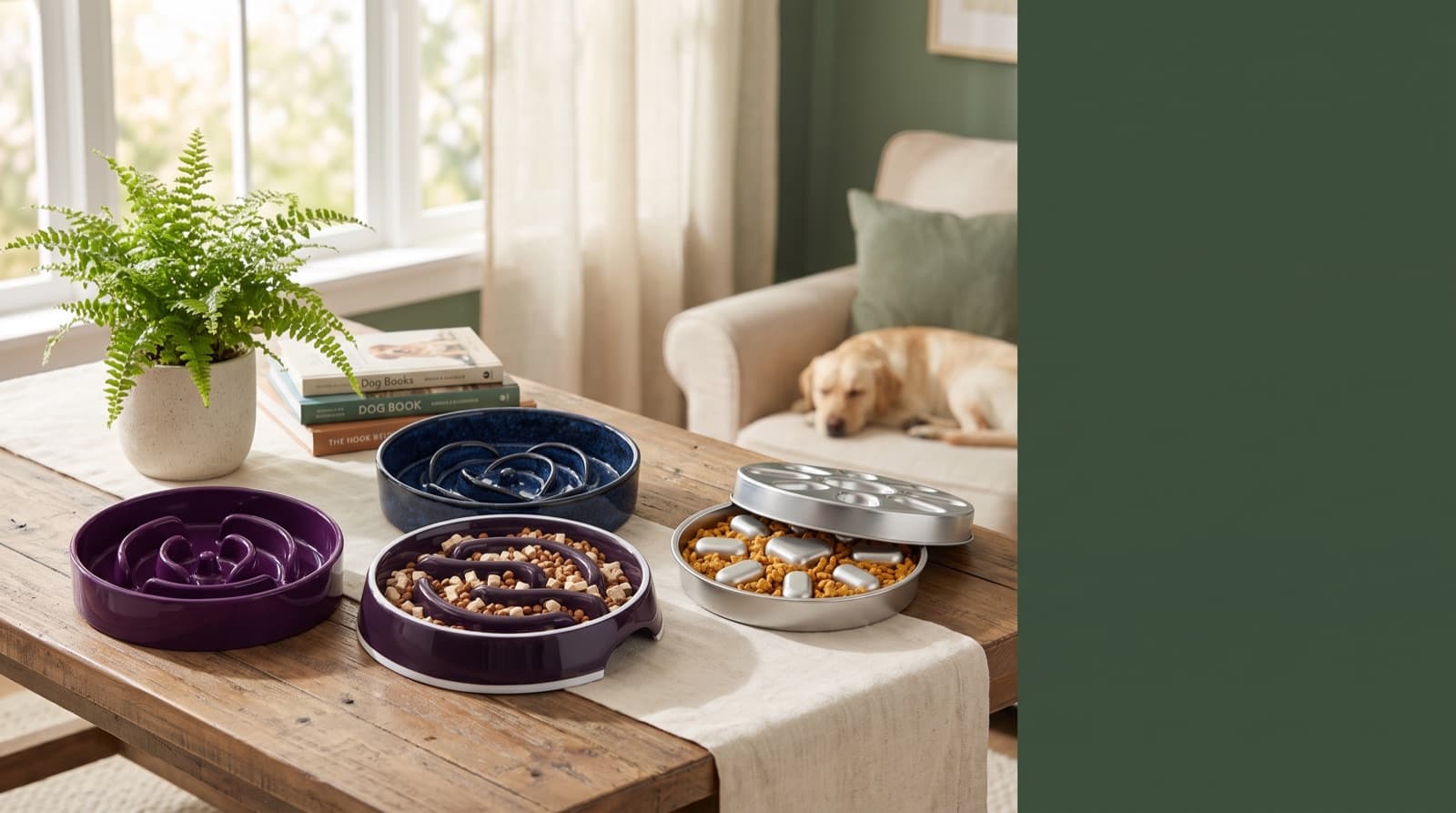
In our experience reviewing pet products & gear, we analyzed each option's real pricing and features; from our research, the comparison below reflects what actually matters for buyers in 2026. The hardest slow feeder dog bowl for most bowl-smart dogs is LE TAUCI. Its ceramic weight and deep channels add real work. However, LOOBANI 3.5 works better for larger meals. Your pick should slow eating without adding stress, mess, or snout trouble.
Key takeaways
- LE TAUCI is the best hard-mode upgrade for strong chewers because ceramic is heavy and chew-resistant, but it is a poor fit for flat-faced dogs.
- LOOBANI 3.5 is the capacity pick for medium and large dogs eating 2-3 cups per meal, because kibble stays down in the channels.
- Oiwliur is the practical non-slip pick for dogs who shove bowls across tile, laminate, or sealed wood.
- vancasso is the kitchen-friendly ceramic-style pick when cleanup and weight matter more than maximum puzzle difficulty.
- Retire any difficult bowl if your dog chews ridges, gives up, paws hard, or cannot reach food in a normal posture.
| Option | Best for | Key spec | Price band |
|---|---|---|---|
| LE TAUCI Ceramic Slow Feeder Dog Bowls | Bowl-smart chewers | Ceramic, heavy, chew-resistant | about $29-$31 |
| vancasso Slow Feeder Dog Bowl | Daily livability | Ceramic or stoneware-style feel | mid-price ceramic-style |
| LOOBANI Slow Feeder Dog Bowls - 3.5 | Bigger meals | 3.5-cup capacity | mid-price large bowl |
| Oiwliur Slow Feeder Dog Bowls with Non-Slip | Bowl pushers | Non-slip base | budget to mid-price |
| Slow Feeder Dog Bowls | First slow feeder trial | Basic maze channels | budget |
| TOBYTO Slow Feeder Dog Bowls Large Medium | Medium dogs | Large-medium sizing | budget to mid-price |
What is the most difficult slow feeder dog bowl for dogs who beat maze bowls?
The hardest slow feeder mixes deep ridges, heavy build, and enough room for kibble. Food should drop into the channels. It should not sit on top. For this list, LE TAUCI is the best hard ceramic pick. However, LOOBANI 3.5 is better for large meals.
Difficulty means slower eating plus harder food access. It does not just mean odd shapes. A bowl can look tricky and still fail. For example, kibble can ride above shallow ridges.
We weighed hard feeding against cleanup time. That matters after breakfast. In practice, the bowl you will wash every day usually wins. However, harder bowls can frustrate some dogs. Seniors, puppies, flat-faced breeds, and short-snouted dogs may need easier bowls.
Fast eating can matter. The American Kennel Club’s bloat guidance says eating speed can add risk for some dogs. This article covers gear, not medical care. Still, a slow feeder can help dogs who inhale meals.
If you want easier picks first, read our guide to slow feeder bowls for fast eating dogs. This guide is for dogs who already solved those.
How we picked
We compared difficulty, material, portion fit, cleanup, grip, and frustration risk. Selection criteria are the rules behind each pick. We wanted bowls that add real work. Still, they should not make sink cleanup miserable.
We checked listed capacity where we could. We also checked public price bands in July 2026. We reviewed material claims, non-slip features, and food fit. For example, some bowls suit dry kibble better than wet food.
We also weighed common owner complaints. These include sliding, chewing, stuck wet food, and dogs quitting. Because we did not run timed lab tests, we do not claim exact saved minutes. Instead, we matched public specs to real home use.
The FDA pet food handling guidance says to wash bowls and scoops after each use. Use soap and hot water. So, we treated cleanup as a core feature. A gross maze is useless if nobody wants to wash it.
We also considered slow feeder testing from The Spruce Pets. Its guide stresses material, chewing, cleaning, and breed anatomy.
Which slow feeder is best for dogs who chew plastic bowls?
For plastic chewers, LE TAUCI is the best pick here. Ceramic resists damage better than plastic or silicone ridges. It is also heavier, so dogs have less luck flipping it. However, you must check ceramic for chips after drops.
Ceramic slow feeders use fired clay with a hard glazed surface. In practice, that smooth glaze can rinse easier than tight plastic channels. That helps after dry kibble dust. LE TAUCI costs about $29-$31. That premium can make sense after your dog scars cheaper bowls.
However, this bowl is not for every home. Skip it if bowls often get dropped on tile. Also skip it for flat-faced dogs that cannot reach deep channels.
LE TAUCI Ceramic Slow Feeder Dog Bowls
LE TAUCI Ceramic Slow Feeder Dog Bowls is the best hard ceramic pick. It suits bowl-smart chewers. It is best for strong chewers who have damaged plastic ridges. The main value is heavy, chew-resistant build at about $29-$31.
What should you watch? Ceramic can chip if dropped on tile. Also, deep channels can be too hard for short snouts. If your dog bites ridges instead of working around them, stop using it.
Which slow feeder is easiest to live with every day?
vancasso is the daily pick when you care about weight, looks, and cleanup. It is not the meanest puzzle. Instead, it is a durable-feeling ceramic-style bowl for normal feeding.
Daily livability means the bowl slows your dog and stays put. It also rinses clean. It should not make your feeding corner look temporary. In practice, owners keep using gear that feels easy. A bowl that takes 8 minutes to scrub gets skipped.
So, vancasso makes sense if you want ceramic-style weight and easier wipe-downs. However, it is not the hardest bowl here. LE TAUCI is still the better hard-mode choice.
vancasso Slow Feeder Dog Bowl
vancasso Slow Feeder Dog Bowl is the kitchen-friendly ceramic-style pick. It suits owners who want weight and easier wipe-downs. It also feels less chewable than many plastic bowls. Use it for a fast eater that does not need maximum slowdown.
The downside is challenge. If your dog beats every feeder in two minutes, vancasso may be too easy. Instead, choose it when daily feeding must stay simple.
Which bowl is best for medium and large dogs eating bigger meals?
LOOBANI Slow Feeder Dog Bowls - 3.5 fits medium and large dogs best when meal size matters. A hard bowl fails when 2 cups mound over the ridges. So, the 3.5-cup capacity matters as much as the maze.
Capacity means how much food the bowl can hold while the channels still work. For example, 1 cup may sit well in a shallow maze. Add 2.5 cups, and it becomes a pile.
LOOBANI works better for dogs eating 2-3 cups per meal. It beats shallow small bowls for that use. However, the trade-off is sink space. Bigger bowls take more room. Wet food also gets more annoying in large grooves.
LOOBANI Slow Feeder Dog Bowls - 3.5
LOOBANI Slow Feeder Dog Bowls - 3.5 is the best large-meal puzzle pick. It suits medium and large dogs. It is best when normal dinner is too big for small maze bowls. The 3.5-cup capacity helps kibble sit down in channels.
Who should skip it? Owners feeding wet food daily may dislike the bulkier grooves. Also, small dogs with short snouts may struggle.
For medium-size meals, TOBYTO Slow Feeder Dog Bowls Large Medium is the alternate. However, LOOBANI is cleaner when meal volume drives the choice.
Which slow feeder is best for dogs who push bowls around?
Oiwliur Slow Feeder Dog Bowls with Non-Slip is for dogs who shove dinner around. Non-slip design matters most on tile, laminate, and sealed wood. Light bowls can slide too much there. As a result, the puzzle can become frustrating.
Non-slip means the base helps reduce sliding during normal eating. It does not mean flip-proof. In our comparison, Oiwliur stands out because grip is the main feature. It is not an afterthought.
This matters for eager pushers and pawers. However, you still need to test it at home. Use the real feeding surface and normal meal size. Wet floors, loose mats, and large dogs can change the result fast.
Oiwliur Slow Feeder Dog Bowls with Non-Slip
Oiwliur Slow Feeder Dog Bowls with Non-Slip is best for dogs who push bowls around. It suits slick kitchens and fast eaters. It also helps dogs who paw while solving the maze. Pick it when movement is the problem.
The downside is simple. Non-slip does not mean immovable. A strong large dog may still move it. That can happen if the dog hooks a paw under the edge.
Is the generic “Slow Feeder Dog Bowls” pick worth including?
The plain “Slow Feeder Dog Bowls” pick belongs here as the budget option. It suits owners moving beyond a basic bowl. However, it is not the top choice for ceramic weight or large meals.
Judge it by channel depth, grip, and kibble placement. Food should sit inside the maze. Budget slow feeders let you test slower eating with low risk. They are not the toughest bowls overall.
In practice, they can work well with dry kibble. The pieces need to fall into the channels. However, wet food changes things. Soft food smears into corners and dries fast. It often needs soaking.
If your dog chews gear, a lighter bowl can become poor value fast.
Slow Feeder Dog Bowls
Slow Feeder Dog Bowls is the best basic-budget step-up. It suits owners testing slow feeding before spending more. It makes sense for dry kibble, smaller portions, and dogs that do not chew bowls.
The honest downside is durability and grip. Strong dogs can shove lighter bowls. Chewers can damage ridges. If you already replaced a chewed bowl, skip this tier.
Who should buy TOBYTO Slow Feeder Dog Bowls Large Medium?
TOBYTO Slow Feeder Dog Bowls Large Medium is the sensible middle pick. It suits dogs that need more challenge than starter bowls. However, they may not need the heaviest ceramic option.
Recommend it for medium dogs first. Large dogs depend on portion size and snout access. Middle-ground slow feeders add more maze work than starter designs. Still, they stay easier to store and wash than large-capacity options.
TOBYTO fits that lane. We compared it with LOOBANI 3.5 mainly on meal size. If your dog eats a moderate large-dog meal, TOBYTO can make sense. However, overfilling stops the maze from working.
TOBYTO Slow Feeder Dog Bowls Large Medium
TOBYTO Slow Feeder Dog Bowls Large Medium is best for medium dogs and moderate large-dog meals. It suits owners who want more challenge than a starter bowl. It does not jump to the biggest-capacity option.
Who should not buy it? Power chewers need a tougher material choice. Flat-faced breeds also need close access checks before daily use.
Who should not buy a difficult slow feeder dog bowl?
Do not buy the hardest slow feeder for a dog who gets frantic. Also skip it if your dog quits, bites ridges, or cannot reach food. Age, dental comfort, and face shape matter. The right bowl slows eating without turning meals into fights.
Frustration risk means the feeder creates stress instead of steady problem-solving. Flat-faced dogs may struggle with deep grooves. Seniors may need easier access, even if they eat fast. Chewers should avoid damaged plastic or silicone ridges.
Broken edges can trap grime or come loose. So, watch the first few meals. Is your dog calmly working the channels? Or is dinner becoming a wrestling match?
A less difficult bowl used daily beats a hard bowl your dog hates. For example, an older dog with dental tenderness may need a shallow pattern. Smaller meals may help too. A young power chewer may need ceramic weight first. Puzzle depth can come second.
If chewing affects more gear, read our durability guides. Start with indestructible dog beds for heavy chewers. Also see chew proof dog beds for large breeds.
How should buyers judge price and value in 2026?
In 2026, value is simple. Pay more for ceramic weight, chew resistance, and easier daily cleaning. Pay less only if your dog is not a chewer. The bowl also needs to stay put.
LE TAUCI costs about $29-$31. That is fair if durability matters. Value is not the lowest shelf price. It is the cost of a bowl your dog can use safely. It is also a bowl you will keep washing.
LOOBANI 3.5 earns value through capacity for bigger meals. Slow Feeder Dog Bowls earns its place as a budget trial pick. However, cheap is not a bargain if your dog flips it. It also fails if your dog chews it or finishes too fast.
Ask yourself two questions. Does the food sit inside the maze? Or does it mound over the ridges? Also, will you clean this bowl after wet food on a workday morning?
For instance, a dog eating 2.5 cups of dry kibble needs capacity first. A dog eating 1 cup and chewing plastic needs stronger material first.
Verdict: which difficult slow feeder should you get?
Scenario verdict is the fastest way to match bowl to dog. Get LE TAUCI if your dog chews plastic. It is the hardest ceramic upgrade here. Get LOOBANI 3.5 if your medium or large dog eats 2-3 cups per meal.
Get Oiwliur if sliding across tile is the main problem. Get vancasso if you want ceramic-style weight with easier daily cleanup. Get Slow Feeder Dog Bowls if you want the lowest-commitment trial. Get TOBYTO if you have a medium dog that needs more challenge.
FAQ
What makes a slow feeder dog bowl difficult?
Deep channels, narrow access points, enough capacity, and stable weight make a bowl harder. However, your dog still needs normal eating posture. If your dog cannot reach food without biting or hard pawing, the bowl is too hard.
Are ceramic slow feeders better than plastic?
Ceramic is better for chew resistance and weight. It also has a smooth glazed surface. That can make rinsing easier. However, plastic is usually cheaper and less breakable. Check ceramic bowls for chips or cracks after any drop.
Can flat-faced dogs use difficult slow feeder bowls?
Many flat-faced dogs struggle with deep grooves. They need shallow access and close supervision. They also need a bowl that avoids face pressure. If your dog snorts, quits, or paws hard, choose an easier design.
Do slow feeders work with wet food?
Yes, slow feeders can work with wet food. However, wet food makes maze grooves much harder to clean. It often needs soaking, a small brush, or dishwasher-safe materials. The FDA also advises washing pet food bowls after each use.
When should I stop using a slow feeder?
Stop using a slow feeder if your dog chews it or seems stressed. Also stop if your dog cannot reach food. Retire any bowl with damaged ridges, chips, cracks, or spots that trap old food.
Written by Jordan Avery for Nestway. About our editorial team · Contact us. Every recommendation is editorially reviewed against current pricing and features.