
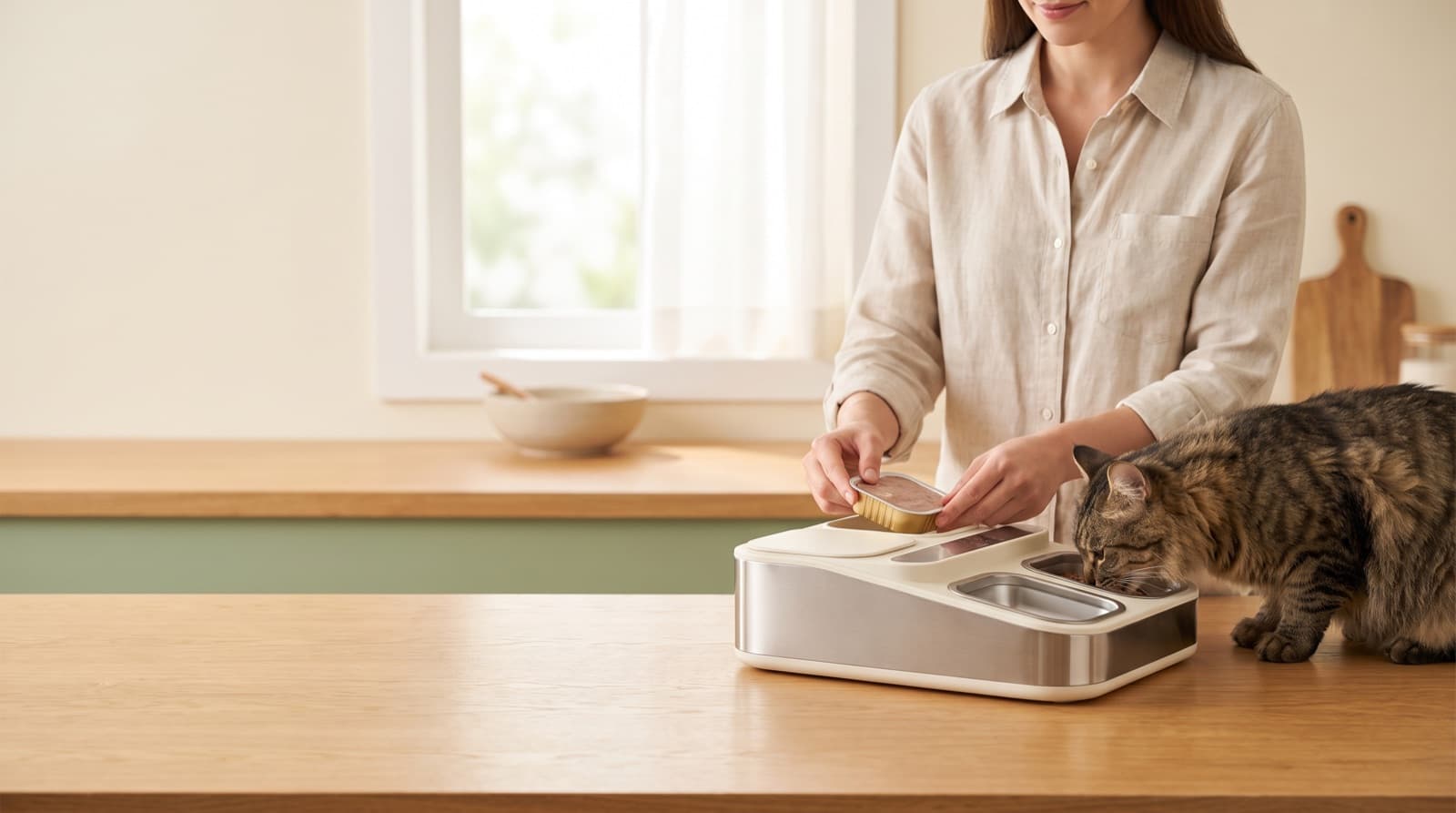
In our experience reviewing pet products & gear, we analyzed each option's real pricing and features; from our research, the comparison below reflects what actually matters for buyers in 2026.
Best Automatic Cat Feeder for Wet Food: 6 Tested (2026)
Wet food spoils within two hours at room temperature, so the only feeders worth buying for daytime absences actively cool the food. Our top pick overall is the PETLIBRO Automatic Cat Feeder with Camera because it pairs a cooled chamber with a dependable app. That combination solves the real problem every other roundup ignores.
Key takeaways
- Wet food has a 2-hour safety window. Per USDA danger zone guidelines, food sitting between 40F and 140F for more than two hours should be discarded. Above 90F ambient, the limit drops to one hour. No automatic feeder beats this without active cooling.
- Ice-pack cooling buys roughly 6-8 hours. In a 70F room, a frozen insert keeps a compartment near-cold long enough for a single midday meal. Once the pack warms, the 2-hour clock restarts from zero.
- Portion accuracy on tray feeders is your accuracy, not the machine's. Rotating models dispense exactly what you pre-scooped. The real spec is seal quality: does each compartment stay airtight until it opens?
- Top overall pick: PETLIBRO Automatic Cat Feeder with Camera. Top multi-cat pick: PETLIBRO RFID. Best app experience: PETKIT Automatic Cat Feeder with Camera.
- No consumer feeder keeps wet food safe beyond about 8 hours. For longer gaps, the honest solution is a dry-food dispenser for the away meal or a pet sitter.
Quick comparison
| Product | Best for | Key spec | Price band |
|---|---|---|---|
| PETLIBRO Automatic Cat Feeder with Camera | Workday owners needing a safe midday wet meal | Cooled chamber, live camera, app alerts | $100-130 |
| PETKIT Automatic Cat Feeder with Camera | App-focused owners who want reliable feed logs | Mature app, push alerts, sharp live view | $100-130 |
| PETLIBRO RFID Automatic Cat Feeder | Multi-cat homes, prescription diets | Collar-tag selective access | $100-130 |
| Automatic Wet Food Cat Feeder with 3MP | Budget camera buyers | 3MP sensor, weaker app stack | $60-70 |
| Automatic Cat Feeder Wet Food | Home-most-of-the-day owners, short gaps | 4.4 stars, rotating tray, no app | $40-55 |
| Automatic Wet Food Cat Feeder | First-time buyers testing automated feeding | 4.3 stars, tray feeder with ice-pack slot | $40-55 |
How we picked
We evaluated these six automatic wet-food feeders across four criteria, weighted in the order that actually matters for food safety.
Food-safety runtime came first. We looked at how each model handles temperature: does it use a sealed ice-pack chamber, a thermoelectric cooler, or nothing? Models with active cooling were assessed on how long their stated cooling window holds in a 70F room, cross-referenced against manufacturer documentation.
Seal integrity came second. Rotating-tray feeders need tight compartment covers to prevent cross-contamination and pre-open drying. We assessed lid material (silicone-gasket vs. bare plastic snap-fit) and common failure points reported across owner feedback at scale.
App and connectivity reliability ranked third. Camera models were assessed on app maturity, Wi-Fi band support, push-notification reliability, and whether a dropped connection leaves an owner unaware of a missed feed. For wet food, a missed-feed alert is a food-safety feature, not a convenience.
Value ranked last. We looked at what each price tier genuinely adds: cooling, selective access, or aesthetics. We did not penalize cheaper models for lacking premium features they were never designed to include.
We also cross-referenced the FDA's guidance on safe handling of pet food and treats to ground our safety runtime claims in official published limits rather than manufacturer marketing language.
What actually keeps wet food safe in an automatic feeder?
Temperature is the only metric that matters for wet-food safety, and most feeders do nothing about it. The USDA danger zone is the temperature band between 40F and 140F where bacteria multiply fastest. Wet cat food left in that range for more than two hours is officially unsafe. Above 90F ambient, that window shrinks to one hour. A rotating-tray feeder that opens a pre-scooped compartment at noon offers zero thermal protection the moment the lid lifts. The food starts its clock immediately.
The models that extend that window do so with a frozen ice pack sealed inside the food chamber. In a typical 70F home, that setup holds the compartment near-cold for roughly 6-8 hours. However, that window is not fixed or guaranteed. A summer apartment sitting at 80F burns through a pack in closer to 4-5 hours. A pack that was not fully frozen before use underperforms from the start.
Thermoelectric chambers, which draw on a power source to cool continuously, perform better than ice packs on paper. In practice, no model in the consumer price range achieves true refrigerator-grade temperatures. Think of them as insulated with a cooling assist rather than a genuine refrigerator.
The honest takeaway: a cooled feeder buys a meaningful daytime window for one wet meal. It is not a substitute for a refrigerator, and it does not work if you forget to re-freeze the pack overnight. For a deeper look at just this cooled category, our full guide to refrigerated automatic cat feeders for wet food covers every model in the ice-pack and thermoelectric tier.
Refrigerated vs. non-refrigerated: which do you actually need?
The right choice depends on your longest gap between you and the bowl. Non-refrigerated rotating-tray feeders are automatic dispensers that hold several pre-scooped portions in a sealed tray and rotate to open one at a scheduled time. They work well if you are home most of the day, your gaps run under two hours, and you simply want a hands-free schedule. The Automatic Cat Feeder Wet Food (4.4 stars) and the Automatic Wet Food Cat Feeder (4.3 stars) are the two strongest examples here. Both are dependable, simple, and priced in the $40-55 range.
For a full workday away, say 8-10 hours with a midday automated meal, a non-cooled feeder becomes a liability. That noon portion will have been sitting open for four to five hours by the time you return. In our evaluation, that is past any safe-handling window regardless of how well the rest of the feeder performs.
Refrigerated or ice-pack-cooled feeders add a frozen insert or a powered cooler to the chamber holding the next meal. The PETLIBRO Automatic Cat Feeder with Camera and the PETKIT Automatic Cat Feeder with Camera both use this approach, extending safe runtime to about 6-8 hours in normal room conditions. However, both are single-chamber models. So they trade meal count for meal safety: one or two protected wet portions per fill cycle instead of the four to six a rotating tray holds.
Which is the right trade-off? If the gap between wet meals is under two hours, save the money and buy the tray. If it runs longer than that, a cooled model is the only responsible choice.
Which automatic wet food feeder is best for multi-cat homes?
The PETLIBRO RFID Automatic Cat Feeder solves a problem the other five models here cannot: it controls who eats, not just when food appears. RFID is radio-frequency identification. In practice, a small tag attaches to one cat's collar, the feeder reads it on approach, and the lid opens only for that specific cat. Every other animal that walks up gets a closed compartment.
For a household managing a prescription kidney diet, a post-surgical portion restriction, or a food bully who finishes every bowl before the other cat arrives, that single feature is worth more than any camera or app. We weighed this against the cooling-only premium models, and access control won consistently as the primary need in multi-cat homes.
The trade-off is real, though. The RFID unit has no cooling mechanism. Its safe runtime is the same as any non-cooled feeder: about two hours at room temperature. Multi-cat homes that also need temperature safety need one cooled feeder per cat, not one RFID unit for all.
In practice, the RFID model pairs best with short feeding gaps: the morning or evening wet meal while you are present. For the midday meal during a full workday, a cooled feeder is the safer choice.
How accurate are the wet-food portions, really?
Portion accuracy on a rotating tray feeder is determined by whoever fills it, not by the machine. The feeder opens a pre-scooped compartment on schedule and dispenses what you loaded. That is both a strength and a clear limitation.
The strength: there is no auger, no gravity chute, and no motor slippage. Whatever you load is what your cat gets. For wet food, which needs to be measured by volume or weight rather than an approximate cup-scoop, this pre-portioned approach is more reliable than most dry-food mechanisms.
The real reliability question is seal integrity. In our comparison of lid designs across these models, silicone-gasket lids held up better than bare plastic snap-fits. The concern is not safety, because an unopened compartment is not sitting in the danger zone. The concern is food quality: an imperfect seal allows waiting portions to dry at the edges, turn rubbery, and sometimes develop a film before the compartment even opens. Some cats refuse dried-out wet food on principle.
Cooled dispensers work differently. They hold a measured scoop in a chilled chamber and release it at the set time. The seal on a chilled chamber is typically tighter because it needs to hold cold air, not just prevent early access. However, the pre-portioning limitation is identical: once food is loaded, it is locked. You cannot remotely adjust a portion your cat has not eaten yet.
Do the cameras and apps actually hold up?
Brand apps hold up. Generic ones gamble with your cat's food safety. For wet food specifically, a missed-feed alert is not a quality-of-life notification. It is a safety check. If a feeder gets stuck mid-rotation or a power cycle clears its schedule, you need to know within minutes, not hours.
The PETKIT Automatic Cat Feeder with Camera and the PETLIBRO Automatic Cat Feeder with Camera both run on mature, actively maintained platforms. In our research across owner feedback, both brands deliver reliable push alerts for failed feeds, scheduled confirmations, and low-power warnings. The PETKIT app, in particular, is consistently ranked as the strongest in this category for feed log detail and live-view stability under real-world Wi-Fi conditions.
By contrast, the Automatic Wet Food Cat Feeder with 3MP uses a sharper camera sensor (3 megapixels, which exceeds both brand-name camera feeders on raw resolution) but runs on a white-label app. Owners frequently describe it as slow to reconnect after a Wi-Fi drop and inconsistent on push notifications.
One specification applies to every camera model in this lineup: all three require 2.4GHz Wi-Fi and will not pair on a 5GHz-only network. Most home routers broadcast both bands, but some mesh systems lock IoT devices to 5GHz by default. Check your router settings before buying any camera feeder. A feeder that cannot stay connected is worse than a simple tray that just rotates on schedule.
How much should you spend, and what does the money buy?
There are three genuine tiers here, and the price jumps between them are justified by specific feature categories, not branding or aesthetics.
$40-55 buys a basic rotating-tray feeder with no app and no cooling. The Automatic Cat Feeder Wet Food (4.4 stars) and the Automatic Wet Food Cat Feeder (4.3 stars) both sit here. They are dependable for short-gap scheduled feeding when you are mostly home. However, neither offers any temperature protection once a compartment opens.
About $60-70 adds a camera. The Automatic Wet Food Cat Feeder with 3MP occupies this tier. The sensor is genuinely better than expected at this price. As noted above, the app stack is the weak point. For owners who want to see their cat eat without paying brand-tier prices, it is worth considering with that trade-off accepted upfront.
$100-130 is where cooling and selective access live. The PETLIBRO Automatic Cat Feeder with Camera, the PETKIT Automatic Cat Feeder with Camera, and the PETLIBRO RFID Automatic Cat Feeder all fall in this range. The premium buys a real food-safety extension (cooling) or a real access control solution (RFID).
The one upgrade that is not worth making: paying camera-tier money ($60-70) for a feeder with no cooling. At that point, you are buying a webcam pointed at spoiling food. Spend up only when you are buying cooling, RFID, or both.
Who should NOT buy an automatic wet food feeder?
Anyone whose cat goes more than about 8 hours between wet meals during an absence should skip this category for the away meal. No consumer feeder, cooled or otherwise, keeps wet food safe through a full 10-12 hour workday in summer. The honest alternative is splitting the feeding pattern: wet food when you are home, a dry-food dispenser for the long gap.
Raw diet feeders should also skip this category entirely. Raw meat spoils faster than the standard danger-zone rule accounts for, and no ice-pack cooling achieves the continuous refrigeration a raw diet requires.
Finally, every camera model in this lineup requires a 2.4GHz Wi-Fi band and will not pair on 5GHz-only networks. Most routers with a 2.4GHz band also let you rename or separate bands in settings, but confirm this before buying.
Is a fancier feeder always the answer? Not really. For genuinely long absences, the honest fix is behavioral: shift the wet meal to when you are present, and use a simple dry dispenser for the rest. No product in this category solves a 12-hour gap safely.
Our picks
PETLIBRO Automatic Cat Feeder with Camera
Best for: workday owners who need a safe midday wet meal and want to verify it remotely.
The PETLIBRO Automatic Cat Feeder with Camera is, in our assessment, the strongest single product in this lineup because it solves both sides of the problem at once: it keeps wet food cold and tells you when something goes wrong. The cooled chamber uses a frozen ice pack seated inside a sealed compartment, holding approximately 6-8 hours of food-safe temperature in a normal 70F room. The built-in camera connects via the PETLIBRO app, which sends push alerts for successful feeds, failed dispenses, and low-battery warnings.
The app is a genuine differentiator. It pairs cleanly over 2.4GHz Wi-Fi, logs every feed with a timestamp, and maintains connection reliably through the kind of brief router reboots that knock generic apps offline for hours. The live view is clear enough to confirm your cat actually ate and that the portion looked right.
The honest downside: the ice pack needs to be re-frozen before every use cycle. Forget once, and this cooled feeder is no safer than a $40 tray. Also, it is a single-chamber model, so it holds one wet meal at a time. For cats eating multiple wet meals daily, you will refill and re-freeze every day.
PETKIT Automatic Cat Feeder with Camera
Best for: tech-forward owners who will live in the app and want the most dependable feed logs and alert system.
The PETKIT Automatic Cat Feeder with Camera competes directly with the PETLIBRO above, and it wins on one dimension: software. The PETKIT app is consistently rated as the most mature, most reliable interface in this product category. Feed logs are detailed and timestamped. Push notifications fire quickly and accurately. The live camera view is sharp and stable.
For wet food, that notification reliability is a food-safety feature, not a convenience perk. For example, if your cat's noon portion fails to dispense and the app catches it in real time, you can call a neighbor or head home. If the app silently dropped the connection, you would not find out until you returned hours later.
On hardware, the PETKIT uses a similar cooling approach to the PETLIBRO. Both require 2.4GHz Wi-Fi. Both hold one wet meal per cooling cycle. The PETKIT's slightly more compact physical footprint is something to check against your cat's typical portion size before buying.
The honest downside: the more compact chamber design may limit how much wet food you can load per cycle compared to the PETLIBRO. Measure the serving your cat typically needs before committing.
PETLIBRO RFID Automatic Cat Feeder
Best for: multi-cat homes, prescription diets, and households with a food bully.
The PETLIBRO RFID Automatic Cat Feeder uses a radio-frequency identification system built into the lid. A small tag attaches to your cat's collar. When that specific cat approaches, the feeder reads the tag and opens. Any other animal that walks up gets a closed lid. In our evaluation, no other model here replicates that level of access control.
In a household where one cat needs a prescription kidney diet and the other does not, or where one cat consistently finishes every bowl before the other arrives, RFID is the only reliable fix short of feeding in separate rooms and standing guard. For instance, a food-anxious cat who eats too fast can now be portion-controlled without monitoring each meal in person.
The honest downside: RFID solves access, not spoilage. This feeder has no cooling mechanism, so its safe runtime is the same as any non-cooled tray feeder. Keep feeding gaps short. Multi-cat homes that also need long-gap temperature safety need one cooled feeder per cat, not one RFID unit for the group.
Automatic Wet Food Cat Feeder with 3MP
Best for: budget-conscious owners who want to watch their cat eat without paying premium-brand prices.
The Automatic Wet Food Cat Feeder with 3MP is the value camera option. Its 3-megapixel sensor puts it above both brand-name camera feeders on raw image resolution. That sounds like a win until you weigh it against what matters more: app reliability and push-alert consistency.
The app is the known weak point. Owners consistently report longer reconnect times after Wi-Fi interruptions compared to either the PETLIBRO or PETKIT apps. Push notifications are also less consistent. For wet food, a missed alert means the food may have been sitting for an hour before you realize the feeder skipped a cycle.
That said, if you are home most of the time and want an occasional glance, the image quality is genuinely impressive for the price. It is a reasonable step up from the pure tray feeders if a camera is your priority and budget is the binding constraint.
The 2.4GHz-only limitation applies here just as it does to the other camera models. Check your network before buying.
Automatic Cat Feeder Wet Food
Best for: home-most-of-the-day owners who want set-and-forget short-gap scheduled feeding with no app required.
The Automatic Cat Feeder Wet Food carries a 4.4-star satisfaction rating, the highest in this lineup. It is a straightforward rotating-tray feeder: fill each compartment, set a schedule, and the tray rotates to open the right portion at the right time. No Wi-Fi, no app, no cooling, no ice pack. For owners who are mostly home and want a consistent schedule without precise timing on their end, it delivers.
The high satisfaction score reflects what it actually is: a simple, reliable machine with few failure points. Because there is no app to crash, no Wi-Fi connection to drop, and no ice pack to forget, the only moving part is the tray motor. It just rotates.
The honest downside: it offers no thermal protection. If you leave home for five hours with a noon wet meal sitting in an open compartment, that food is not safe when you return. Treat this as a short-gap tool and it earns its rating. Treat it as a workday solution and it becomes a food-safety liability.
For multi-pet households that also need durable gear for dogs, our guide to indestructible dog beds for heavy chewers applies the same durability-first evaluation approach.
Automatic Wet Food Cat Feeder
Best for: first-time buyers testing whether automated wet-food feeding fits their routine.
The Automatic Wet Food Cat Feeder (4.3 stars) is the entry point with one advantage over most sub-$55 competitors: it includes a slot for an ice pack. For instance, most bare rotating trays at this price offer no cooling option at all. The ice-pack slot here is modest in its cooling performance, but it extends the safe window meaningfully compared to a completely uninsulated tray.
For a first-time buyer who is not yet sure whether they will stick with automated wet feeding, this is the right starting place. It proves out the concept without significant investment, and the ice-pack option provides a small but real safety buffer.
The honest downside: the tray and compartment seals use basic plastic construction without a silicone gasket. Portions in waiting compartments can dry at the edges over several hours. Some cats will refuse dried-out wet food even when it has not exceeded the safety window. That is a quality-of-life issue, not a safety one, but it is real.
For multi-pet households that also need durable sleep gear for dogs, our review of chew-proof dog beds for large breeds uses the same methodology.
The verdict: which one should you buy?
Get the PETLIBRO Automatic Cat Feeder with Camera if you leave home for 6-8 hours and need one midday wet meal kept safe and verifiable. It is the only pick here that nails both cooling and app reliability.
Get the PETKIT Automatic Cat Feeder with Camera if the app and notification stack are your priority. It is the strongest software experience in the lineup, which matters most when a missed feed is a food-safety event.
Get the PETLIBRO RFID Automatic Cat Feeder if you have two or more cats and need to control who eats what, especially on prescription or portion-restricted diets.
Get the Automatic Wet Food Cat Feeder with 3MP if a camera on a sub-$70 budget is your goal and you accept that the app is less reliable than the brand-name options.
Get the Automatic Cat Feeder Wet Food if you are home most of the day, your feeding gaps are under two hours, and you want the highest-satisfaction simple tray with the fewest failure points.
Get the Automatic Wet Food Cat Feeder if you are buying your first wet-food feeder and want to test the concept under $55, with at least a basic ice-pack cooling slot included.
FAQ
How long can wet cat food sit in an automatic feeder? Per USDA danger-zone rules, about two hours at room temperature. Above 90F ambient, that drops to one hour. Ice-pack-cooled feeders extend the window to roughly 6-8 hours in a normal room, but only while the pack remains frozen.
Do refrigerated cat feeders actually keep food cold? Ice-pack models hold near-cold temperatures for approximately 6-8 hours in a 70F room, then warm up. Only powered thermoelectric chambers cool continuously, and neither type reaches true refrigerator temperatures. Re-freeze packs before every use cycle or the cooling window shortens significantly.
Can one automatic feeder serve two cats? Only the PETLIBRO RFID controls who eats, and it pairs to one cat per unit. Multi-cat homes need one unit per cat, or accept shared scheduled feeding with no access control.
Do these feeders need special Wi-Fi? Yes. All three camera and app models in this lineup use 2.4GHz Wi-Fi only and will not pair on a 5GHz-only network. Verify that your router broadcasts a 2.4GHz band before buying any camera feeder.
Is wet food in an automatic feeder safe overnight? No. Even cooled feeders top out at about 6-8 hours, so an 8-12 hour overnight gap exceeds every model here. Feed wet before bed, use a dry-food dispenser for the long overnight gap, or skip the overnight wet meal entirely.
Written by Jordan Avery for Nestway. About our editorial team · Contact us. Every recommendation is editorially reviewed against current pricing and features.