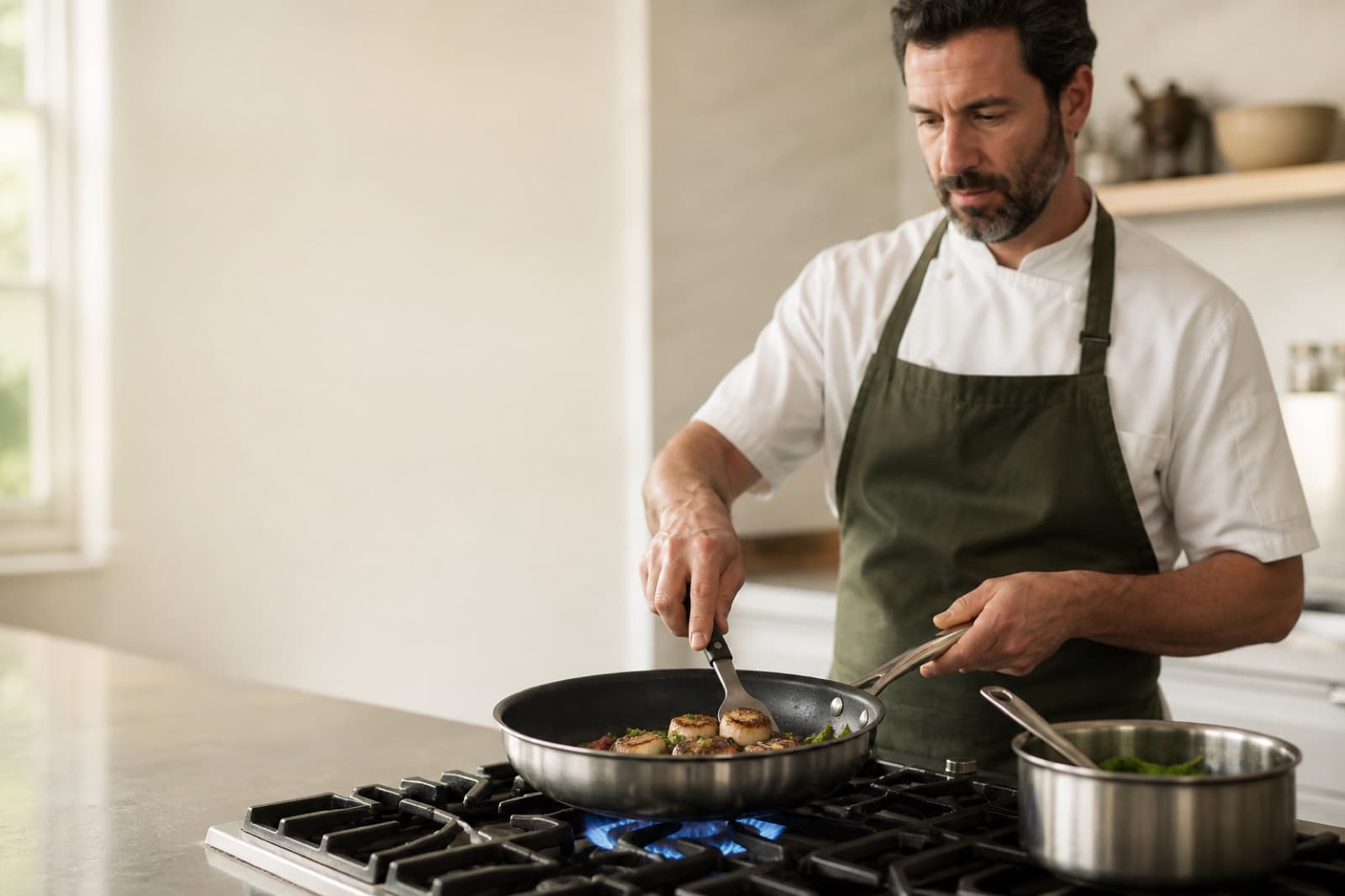
In our experience reviewing kitchen & cooking gear, we analyzed each option's real pricing and features; from our research, the comparison below reflects what actually matters for buyers in 2026. Stainless steel is the better main pan for gas. It takes flame, high preheat, browning, and deglazing.
However, nonstick is still the cheap helper. Use it for eggs, crepes, and fragile fish.
Most homes should buy one clad stainless skillet first. Then add one replaceable nonstick pan.
Key takeaways
- Stainless steel wins gas-stove searing because it tolerates high heat, fond, and pan sauce work.
- Nonstick wins eggs and delicate foods, but treat it as a 2- to 5-year pan.
- The best gas setup is one 10- or 12-inch clad stainless skillet plus one 8- or 10-inch nonstick.
- A $40 nonstick replaced every 3 years costs about $200 over 15 years.
- On gas, side flames shorten nonstick life faster than most normal washing mistakes.
| product name | Best for | Key spec | Price band |
|---|---|---|---|
| Tramontina Tri-Ply Clad Stainless Steel 10-Inch Fry Pan | Budget stainless starter | 10-inch, tri-ply clad stainless, oven safe to 500°F | $30-$60 |
| Cuisinart MultiClad Pro Stainless 12-Inch Skillet | Family dinners | 12-inch, tri-ply stainless, helper handle | $60-$100 |
| All-Clad D3 Stainless Steel 12-Inch Fry Pan | Long-term searing pan | 12-inch, tri-ply stainless, oven and broiler safe to 600°F | $130-$180 |
| Tramontina Professional Aluminum Nonstick Restaurant Fry Pan 10-Inch | Cheap egg pan | 10-inch, heavy-gauge aluminum, removable silicone grip | $25-$45 |
| OXO Good Grips Pro 10-Inch Frying Pan Skillet | Comfortable nonstick | 10-inch, hard-anodized aluminum, oven safe to 430°F | $35-$80 |
| T-fal Ultimate Hard Anodized Nonstick Fry Pan 10.25-Inch | Beginner breakfasts | 10.25-inch, hard-anodized aluminum, Thermo-Spot indicator | $25-$45 |
How we picked
We judged this as a gas-stove buying choice. We did not judge it as a matched-set problem.
Because gas changes pan behavior, we checked material, size, heat limits, and edge heat. We also checked 2026 street prices and replacement cost.
We compared public price bands from major sellers and price trackers. Then we weighed those prices against real service life.
We focused on 10- and 12-inch skillets. Those are the useful sizes.
An 8-inch nonstick works for one egg. However, it feels tight for pancakes or fish.
A 10-inch stainless skillet works for two people. A 12-inch skillet gives food room to brown.
We did not recommend full nonstick sets. In my kitchen, the egg pan wears out first.
So the real choice is simple. Buy stainless for heat, then buy nonstick for release.
Which cookware is better for a gas stove?
Stainless steel is better as your main gas-stove pan. It handles flame, hard preheat, browning, and deglazing.
Clad stainless steel means bonded metal layers. Most pans wrap stainless steel around an aluminum core.
That build spreads heat across the base. It also carries heat up the sidewall.
Nonstick works better as your second pan. Use it for eggs, pancakes, crepes, and fragile fish.
Nonstick cookware has a release coating. It helps food let go, but needs lower heat.
Gas burners create hot edge zones. Flames can wrap around the pan.
So buy stainless first. Use nonstick only where release matters.
The trade-off is skill. Stainless sticks when you rush it.
However, it rewards patience with real browning. Nonstick makes 7 a.m. eggs easier.
Still, the coating wears. Which problem matters more to you?
Do you want steak crust? Or do you want easy egg cleanup?
For broader set shopping, our gas-stove cookware set guide covers pots and saucepans. This article stays with skillets.
Tramontina Tri-Ply Clad Stainless Steel 10-Inch Fry Pan
Tramontina Tri-Ply Clad Stainless Steel 10-Inch Fry Pan is the value stainless pick. It suits daily cooks on a budget.
Because it uses tri-ply clad stainless, it feels like a real skillet. It is not a thin stainless shell.
The honest downside is size. A 10-inch pan crowds four chicken thighs.
So family cooks may want 12 inches.
Cuisinart MultiClad Pro Stainless 12-Inch Skillet
Cuisinart MultiClad Pro Stainless 12-Inch Skillet is the practical family stainless pick. It gives dinner more room.
Use it for onions, pork chops, and weeknight browning. The 12-inch size matters on gas.
Because crowded food steams, extra floor space helps. The downside is weight and storage.
I do not reach for it to scramble two eggs.
All-Clad D3 Stainless Steel 12-Inch Fry Pan
All-Clad D3 Stainless Steel 12-Inch Fry Pan is the premium long-term pick. It suits frequent gas-stove cooks.
It handles high heat, oven finishes, and metal utensils. Its 600°F oven and broiler rating adds headroom.
However, the price is real. Buy it only if you will use it often.
Which one sears better on gas, stainless steel or nonstick?
Stainless steel sears much better on gas. You can preheat it hard enough for real browning.
That heat drives off surface moisture. It also builds fond.
Fond is browned food residue left after searing. It looks stuck, but it tastes good.
Add wine, stock, lemon juice, or water. Then the fond turns into pan sauce.
Nonstick can brown some foods. For example, it can handle turkey burgers or zucchini.
However, you should not push nonstick like stainless. On gas, open flame heats sidewalls fast.
For steaks, chops, chicken thighs, mushrooms, and hard-seared vegetables, stainless wins.
The method is simple. Preheat the stainless pan, add oil, then add dry food.
The water drop test can help. Cooks often call it the Leidenfrost test.
A water drop should bead and skate. It should not sit flat and hiss away.
Then wipe it out, oil the pan, and cook.
In practice, this is why stainless earns the main-pan spot. It takes your best heat.
A nonstick skillet may release salmon more gently. But it cannot give you the same crust.
Which one is better for eggs, fish, and sticky foods?
Nonstick is better for eggs, crepes, tender fish, tofu, and low-fat cooking. Release matters most there.
Food release means food separates from the pan without tearing. Stainless can cook eggs, but it asks more.
You must preheat well, use enough fat, and wait. Still, weekday breakfast should not feel like class.
A good 8- or 10-inch nonstick makes eggs and pancakes easier. Keep the flame under the base.
Use silicone or wood tools. Skip high burner heat.
That convenience is real. I keep nonstick for eggs because I cook daily.
However, coating wear is also real. Replace it when flakes, warping, or sticking show up.
Tramontina Professional Aluminum Nonstick Restaurant Fry Pan 10-Inch
Tramontina Professional Aluminum Nonstick Restaurant Fry Pan 10-Inch is the cheap workhorse egg pan. It suits practical cooks.
Because it uses heavy-gauge aluminum, it heats quickly. The removable silicone grip helps on gas.
The downside is no induction support. The outside can also stain over flame.
OXO Good Grips Pro 10-Inch Frying Pan Skillet
OXO Good Grips Pro 10-Inch Frying Pan Skillet is the comfortable nonstick pick. It feels more finished.
Its handle feels nicer than restaurant-supply pans. The hard-anodized aluminum body is useful.
The 430°F oven-safe rating helps with gentle stovetop-to-oven jobs. However, the price can hurt.
Once it nears $80, replacement math gets worse.
T-fal Ultimate Hard Anodized Nonstick Fry Pan 10.25-Inch
T-fal Ultimate Hard Anodized Nonstick Fry Pan 10.25-Inch is the beginner breakfast pan. It suits renters and students.
It also helps low-oil egg cooks. The Thermo-Spot indicator gives a visual heat cue.
However, it is still nonstick. Do not use it for steak searing.
Skip broiler heat and metal utensil scraping too.
Which lasts longer and costs less over time?
Stainless steel usually costs more upfront. However, it lasts longer.
Nonstick usually costs less upfront. Still, you should treat it as replaceable.
A good clad stainless fry pan costs about $60-$130 in 2026. Budget tri-ply can dip under $60.
A real nonstick fry pan costs about $25-$60. Some nicer models cost more.
Here is the useful math. A $40 nonstick replaced every 3 years costs about $200 over 15 years.
One $100 stainless skillet can last 15 years. That costs about $6.67 per year.
So stainless wins value only if you cook on it.
That last line matters. Stainless does not save money if it sends you to takeout.
So buy the size you will lift and clean.
For example, a two-person home should start with 10-inch clad stainless. Add a 10-inch nonstick.
A family cooking four cutlets should start with 12-inch stainless. Surface area matters.
For fuller cookware planning, the Reddit-tested gas cookware set guide is useful when you want pot sizes too.
Is nonstick cookware safe on a gas stove?
Nonstick cookware can work on a gas stove. Use low to medium heat.
Center the pan over the burner. Retire damaged pans.
The FDA says some approved PFAS coatings are polymerized and tightly bound. It says normal use allows negligible food migration.
You can read that in its Questions and Answers on PFAS in Food. The agency separates cookware from grease-proof paper packaging concerns.
In 2024 and 2025, FDA actions focused on paper and paperboard. They did not ban normal nonstick pans.
That does not make nonstick durable. It also does not make it right for searing.
Avoid empty-pan high-heat preheating, especially on gas. Light aluminum nonstick can get hot fast.
Flames can also creep up the walls.
The FDA’s authorized PFAS food-contact page notes a different paper grease-proofer concern. In practice, my rule stays simple.
Use nonstick gently. Replace it when damaged.
Do not ask it to act like stainless.
Who should buy stainless steel instead of nonstick?
Buy stainless steel first if you cook on gas often. It suits searing, browning, and pan sauces.
Choose it if you use metal utensils. Choose it if you hate replacing pans.
Fully clad cookware means the heat-spreading core runs through the pan body. It is not only a bottom disc.
That matters on gas. Flame heats the lower sidewall and the base.
A 10-inch stainless skillet suits two people. A 12-inch skillet suits family cooking and meal prep.
Stainless also moves from burner to oven well. You avoid coating limits.
However, stainless is not ideal for mostly eggs. It also dislikes lazy preheating.
Stainless rewards timing. Nonstick forgives more.
The stainless buyer is often a daily cook. Meat eaters and sauce makers benefit most.
For instance, sear chicken thighs, remove them, then deglaze with stock and mustard. Stainless is right there.
If dinner is mostly scrambled eggs and tortillas, do not force this upgrade first.
Who should buy nonstick instead of stainless steel?
Buy nonstick if eggs sticking bothers you most. Do not buy it for steak browning.
Nonstick suits renters, occasional cooks, and low-oil breakfasts. It also suits fast cleanup.
Hard-anodized aluminum is treated aluminum. The process makes the outside harder and more wear-resistant.
Many nonstick skillets use it. It heats quickly and keeps weight low.
An 8- or 10-inch nonstick skillet is the useful size. Replace it when release fails.
Also replace it when deep scratches expose the base. Replace it when coating flakes or the pan warps.
Instead, skip the 10-piece nonstick set. Only one egg skillet usually sees daily wear.
Why replace three coated pans? A $35 breakfast pan can be smart.
A $200 set that ages together becomes clutter.
Nonstick is not for high-heat searing. It is not for broilers or metal utensils.
It is also not for buy-it-for-life shoppers. That said, it has a place.
Recent chatter around ceramic coatings and stainless “nonstick hacks” says the same thing. Cooks want easy release.
However, they are tired of fragile coatings.
What is the best gas-stove cookware setup for most homes?
The best gas-stove setup is a two-pan system. Buy one 10- or 12-inch clad stainless skillet.
Use that pan for heat, browning, and dinner. Add one 8- or 10-inch nonstick skillet.
Use the nonstick for eggs and fragile foods. That pair beats most 10-piece sets.
It also keeps replacement costs contained. In 2026, this setup costs about $90-$190.
Pair a $50 stainless pan with a $35 nonstick. You land near the low end.
Pair All-Clad with OXO. You land higher.
Add cast iron or carbon steel only if you want maintenance and weight. I like both.
Still, neither replaces nonstick for soft scrambled eggs. They also do not replace stainless for quick pan sauces.
The setup looks less matched than a boxed set. However, it works better.
A kitchen should serve dinner. It does not need to match the cabinet photo.
If you cook outdoors too, the same heat logic applies. Our gas grill smoker box tests cover thin metal over flame.
The lesson is similar. Flame control beats pretty packaging.
Scenario verdict: stainless steel vs nonstick cookware for gas stove
Get stainless steel if you cook dinner on gas. Choose it for meat, vegetables, sauces, and long life.
Get nonstick if eggs, crepes, tofu, or fish cause your main pain. Get both if you cook daily.
Because each pan solves a different problem, both earn space.
Get Tramontina Tri-Ply Clad Stainless Steel 10-Inch Fry Pan if you want the lowest sensible stainless entry point.
Get Cuisinart MultiClad Pro Stainless 12-Inch Skillet if you cook family meals and need more surface area.
Get All-Clad D3 Stainless Steel 12-Inch Fry Pan if you want the long-term premium stainless choice.
Get Tramontina Professional Aluminum Nonstick Restaurant Fry Pan 10-Inch if you want a cheap, replaceable egg pan.
Get OXO Good Grips Pro 10-Inch Frying Pan Skillet if comfort matters more than the lowest price.
Get T-fal Ultimate Hard Anodized Nonstick Fry Pan 10.25-Inch if you want a simple beginner breakfast pan.
FAQ
Can you use stainless steel cookware on a gas stove?
Yes. Fully clad stainless steel fits gas well.
It tolerates flame, high heat, preheating, and deglazing. A 10-inch pan suits two people.
However, a 12-inch pan gives family meals more browning space.
Can you use nonstick cookware on a gas stove?
Yes, but use low to medium heat. Center the pan over the flame.
Avoid empty high-heat preheating. The FDA separates polymerized nonstick coatings from the paper-packaging PFAS phase-out.
Still, heat abuse shortens coating life.
Why does food stick to stainless steel?
Food usually sticks when the pan is too cold. It can also stick when too dry.
Food sticks if you move it too soon. Preheat the pan, add oil, and dry the food.
Then wait for browning to release it. This matters for chicken skin, fish, and eggs.
Should I buy a stainless steel or nonstick set?
Most home cooks should skip full sets. Buy one clad stainless skillet for heat.
Then buy one nonstick skillet for eggs. That two-pan setup usually costs about $90-$190.
It works better than replacing a whole coated set later.
When should I replace a nonstick pan?
Replace a nonstick pan when the coating flakes. Replace it when deep scratches expose the base.
Also replace it when the pan warps. Replace it when eggs stop releasing with normal fat.
Use medium-low heat for that test. For many homes, replacement comes every 2-5 years.
Written by Nora Kellerman for Nestway. About our editorial team · Contact us. Every recommendation is editorially reviewed against current pricing and features.