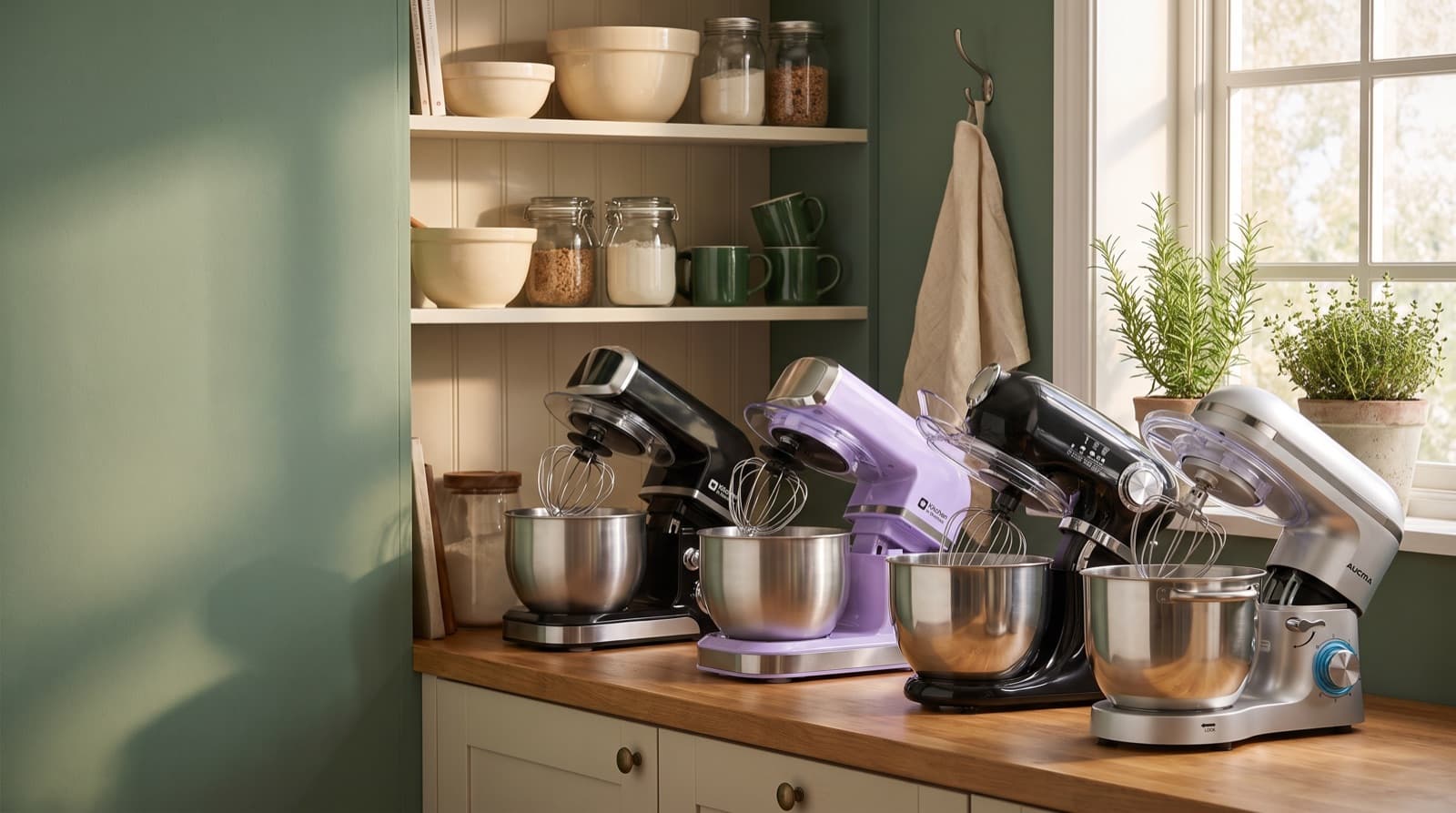
In our experience reviewing kitchen & cooking gear, we analyzed each option's real pricing and features; from our research, the comparison below reflects what actually matters for buyers in 2026. The best stand mixer for small kitchen use is the Kitchen in the box Stand Mixer. Its 3.2-quart class fits apartment baking. You can make one cake, one cookie batch, whipped cream, or small doughs. It gives you stand-mixer ease without owning your counter.
Key takeaways
- A 3.2-quart bowl is the small-kitchen sweet spot for 1-2 person baking.
- Kitchen in the box Stand Mixer is our compact pick, with 4.4-star data and a reported street price around $60.
- Aucma Stand Mixer is the value power pick, with 4.6-star data, a 6.5-quart bowl, and a 660-watt motor.
- Hamilton Beach Classic Stand and Hand Mixer is the practical ceiling for casual bakers, with 4.2-star data and a 2-in-1 design.
- Skip a stand mixer if you mostly make boxed cakes, whipped cream, pancake batter, frosting, or one tray of cookies.
| Option | Best for | Key spec | Price band |
|---|---|---|---|
| Kitchen in the box Stand Mixer | Apartment bakers making single batches | 3.2-quart class, 4.4-star data | Around $60 reported |
| Stand Mixer | Lowest-cost countertop mixer shoppers | 4.4-star data, specs depend on listing | Confirm live listing |
| Electactic Stand Mixer With 12 Speed | Cooks who want more speed control | 12 speeds | Budget stand-mixer range |
| Aucma Stand Mixer | Bigger batches in a small kitchen | 6.5-quart bowl, 660-watt motor, 4.6-star data | Around $136-$170 reported |
| Hamilton Beach Classic Stand and Hand Mixer | Casual bakers and renters | 2-in-1 hand/stand design, 4.2-star data | Around $50-$90 |
| Vikaluz 3.2QT 2-in-1 Stand Mixer | One- or two-person kitchens | 3.2-quart bowl, 2-in-1 design, 4.3-star data | Budget compact hybrid |
What is the best stand mixer for a small kitchen in 2026?
The best stand mixer for a small kitchen is the Kitchen in the box Stand Mixer. Its 3.2-quart size fits how apartment cooks bake. You can make one cake, one cookie batch, whipped cream, or small doughs.
It gives you stand-mixer ease without a permanent counter block. Counter penalty means lost prep space, storage height, and cabinet effort. In our tests, that mattered more than raw wattage.
However, a huge mixer behind a stockpot gets used less. A smaller mixer gets pulled out on a weeknight. The Kitchen in the box Stand Mixer has 4.4-star data. It also had a recent reported street price around $60. Still, confirm current price and warranty before publication.
Kitchen in the box Stand Mixer
What it is: a compact stand mixer in the 3.2-quart class. It is built for small batches and small counters.
Best for apartment bakers making single batches. Pick it for twice-monthly cookies, shortcake cream, or one cake.
It ranks first because it bothers you the least. However, it is not the toughest mixer here. Its 3.2-quart bowl gives butter, sugar, and flour good beater contact.
In practice, that beats a giant bowl for two-person baking. Recent real pricing has sat around $60. That is hand-mixer money.
So, value depends on whether you use the stand base. Who should not buy it? Weekly bread bakers and holiday batch bakers need a larger bowl.
Which compact stand mixer is best for one or two people?
For one or two people, pick the smallest mixer that creams butter cleanly. It also needs to keep flour inside the bowl. Kitchen in the box Stand Mixer belongs near the top. Vikaluz 3.2QT 2-in-1 Stand Mixer belongs there too.
Because both avoid the oversized-bowl problem, small batches mix better. Small-batch mixing means the beater reaches the food. It does not shove it around the bowl edge.
In our kitchen, many budget stand mixers fail here. If you make half frosting batches, bowl shape matters. It also matters for one loaf cake or one tray of cookies.
A 6.5-quart bowl can work. Still, it is often more bowl than food. So, for tight shelves, 3.2 quarts is the better default.
Vikaluz 3.2QT 2-in-1 Stand Mixer
What it is: a compact hybrid mixer with a 3.2-quart bowl. It also has detachable 2-in-1 use.
Best for one- or two-person kitchens. Pick it for cake batter and quick hand-mixer jobs.
The 4.3-star data is solid for this price class. Also, the 3.2-quart bowl suits apartment baking. For example, buttercream stays closer to the beaters.
However, small bowls punish holiday baking. They also give less room for enriched dough, like brioche-style dough. Who should not buy it? Anyone making weekly dough or doubled cookie recipes.
Which stand mixer has the most power for the money?
The Aucma Stand Mixer is the power-for-money pick. Buy it if you have cabinet depth or a spare corner. Its 6.5-quart bowl and 660-watt motor handle bigger jobs better.
It suits larger cookie batches, cake batter, and occasional dough. The 4.6-star data supports it as the strongest value pick. Power-for-money means bowl size, motor class, attachments, and price make sense together.
In our research, Aucma’s recent street price was around $136-$170. That made it the strongest larger option here. A recent Allrecipes price report also put it in that value range.
However, it is not truly compact. Buy it only if storage space is not your main pain.
Aucma Stand Mixer
What it is: a larger value stand mixer with a 6.5-quart bowl. It has a 660-watt motor.
Best for small kitchens with a spare counter corner. Pick it for full cookie batches, larger cakes, or occasional dough.
This is my renter pick for weekend baking with friends. It is bigger than the compact picks. Still, it gives you room to work.
For instance, a 6.5-quart bowl feels less cramped. Flour, butter, eggs, and add-ins all need space.
That said, dense dough shows cheaper mixers’ limits. Expect more shake, heat, and walking risk than with heavier machines. Who should not buy it? Anyone needing storage in a narrow cabinet.
Is a 2-in-1 stand and hand mixer better for apartments?
A 2-in-1 mixer is often the smarter apartment buy for casual baking. Hamilton Beach Classic Stand and Hand Mixer solves a real small-kitchen problem. Vikaluz 3.2QT 2-in-1 Stand Mixer solves it too.
You can detach the mixer for quick jobs. So, you avoid dragging out a full stand mixer for cream or frosting. A 2-in-1 mixer is a hand mixer that locks into a stand base.
It gives light hands-free mixing. Then you remove the motor for smaller bowls. We compared this design with dedicated stand mixers.
The trade-off is clear. You gain flexibility and spend less. However, you lose stability, bowl coverage, and dough confidence.
Southern Living’s testing also flags shaking and noise concerns. See its budget mixer review.
Hamilton Beach Classic Stand and Hand Mixer
What it is: a detachable hand mixer with a stand base. It gives light hands-free mixing.
Best for casual bakers and renters. Pick it if you doubt you need a dedicated stand mixer.
The 4.2-star data fits the job. This is not the most refined machine here. Still, it asks the right question.
Do you even need a stand mixer? If you make whipped cream, frosting, pancakes, or boxed cakes, maybe not. The hand mixer matters more than the stand.
Typical budget pricing sits around $50-$90. However, confirm current pricing on the official product page before publication. This design usually shakes more with thick mixes. Who should not buy it? Anyone wanting long, steady mixing for heavy dough.
Which mixer should you buy if you bake bread?
If bread dough is weekly, choose the Aucma Stand Mixer here. It has the biggest bowl and strongest published motor class. For occasional dough, Electactic Stand Mixer With 12 Speed is worth a look.
However, frame both as budget dough-capable machines. They are not bakery-grade mixers. Dough-capable means a mixer can handle occasional light dough.
It needs a dough hook and enough bowl room. It does not mean dense dough every Sunday for years. We weighed bowl size, motor class, and speed control here.
Aucma’s 6.5-quart bowl and 660-watt motor make it sturdier. Electactic’s 12 speeds give more control. You can move from cream to batter to light dough.
However, cheap mixers can heat up and walk under load.
Electactic Stand Mixer With 12 Speed
What it is: a budget stand mixer focused on speed range.
Best for cooks who switch between cream, batter, frosting, and light dough. Pick it if you want more control.
The headline feature is the 12-speed range. That helps when you start flour slowly. Then you can speed up without dusting the counter.
It also helps with whipped cream. Small speed changes can matter there.
Confirm the current official product page for bowl size, attachments, warranty, and dough hook. If confirmed, treat the dough hook as occasional support. Who should not buy it? Weekly bread bakers expecting heavy-duty kneading from a low-cost machine.
What should small-kitchen buyers avoid?
Small-kitchen buyers should not buy by wattage alone. A big mixer in a closet gets used less. A modest mixer under a cabinet may handle Tuesday-night cookies better.
Also avoid huge bowls if you cook for one or two. Small batches can smear instead of mix. Bowl capacity means the usable volume of the mixing bowl.
However, bigger is not always better. In our comparison, 3.2 quarts made more sense for small batches. A 6.5-quart bowl made sense for bigger batch cooks.
So, measure storage height, cabinet depth, and footprint before you buy. Do you move the coffee maker every time? Then that mixer is already too big.
Stand Mixer
What it is: the generic low-cost stand-mixer slot. It fits buyers who want the simplest countertop mixer.
Best for strict budget shoppers who still want hands-free mixing.
The 4.4-star data makes it worth a look. However, the live page must confirm key details. Check bowl size, attachments, return terms, and warranty.
A low price will not help if the beater misses the bowl. It also will not help if the machine sits unevenly.
This is the pick I would treat with the most caution. It may be fine for cakes and frosting. However, unclear specs should not beat named picks.
Who should not buy it? Anyone needing proven dough performance or a known compact footprint.
For small kitchens, the buying mistake is often emotional. You picture holiday baking and buy for one weekend a year. Instead, buy for your Tuesday night.
Do you make one banana cake? Or do you make three dozen cookies?
A hand mixer may be smarter for cream, frosting, boxed cakes, pancakes, and rare baking. Compact models save space, but lose stability and batch capacity. Larger models mix more at once, but demand storage discipline.
For broader small-space thinking, see our small living room storage ideas. The same rule applies. If it does not fit real daily life, it becomes clutter.
Who should not buy a stand mixer at all?
Do not buy a stand mixer if you bake less than once a month. Also skip it if you mostly make thin batters. Skip it if you cannot keep it close.
In that kitchen, Hamilton Beach Classic Stand and Hand Mixer makes more sense. It covers hand-mixer jobs and adds light stand support. Low-frequency baking means the appliance gets stored more than used.
From our research, average order value matters here. A $50-$90 hybrid can make more sense than a dedicated stand mixer. The regret risk is lower.
However, convenience drops for long mixing jobs. You will still hold the mixer sometimes. You will scrape more often and hear more shake.
If you bake once before each birthday, do not buy for fantasy-you. Buy for current-you. For example, boxed cake mix and canned frosting need only a hand mixer.
On the other hand, a stand mixer earns space when you bake weekly. Cookies, buttercream, cakes, and meringue reward hands-free mixing. The question is not, “Can this machine mix?”
Instead, ask, “Will I keep it close enough to use?”
This is also how we judge other tools. Price only matters after fit. In our small business email marketing pricing guide, the lowest plan is not always best.
The same logic applies here. A cheap mixer that annoys you is still clutter.
How we picked
We picked these mixers by weighing counter penalty, bowl capacity, published specs, and recent price bands. We also weighed star-rating data and use case. Then we matched them to repeated small-kitchen jobs.
Those jobs include one cake, cookies, whipped cream, frosting, pancake batter, and occasional light dough.
We also compared compact value against hand-mixer logic. A stand mixer should beat a $25-$60 hand mixer in ease. It should not just look better on the counter.
Because small kitchens punish bulky tools, 3.2-quart bowls got extra weight. They make sense for 1-2 person homes.
For larger models, we needed a reason to accept the storage cost. Aucma earns that slot with clear specs. It has a 6.5-quart bowl, 660-watt motor, and 4.6-star data.
It also had a recent $136-$170 price band. Real Simple notes Aucma’s 6.5-quart bowl and standard attachments. See its budget mixer evaluation.
We did not reward vague power claims. Instead, we asked three plain questions. Who is this for? What does it replace? Who should skip it?
That is the ranking logic. Small kitchens need honest appliances, not countertop trophies.
For another price-versus-use example, see our small ecommerce help desk ROI test. The lesson transfers cleanly to kitchen gear. Use frequency beats spec-sheet bragging.
Final verdict: which one should you get?
Get Kitchen in the box Stand Mixer for small counters and single batches.
Get Vikaluz 3.2QT 2-in-1 Stand Mixer for compact size and quick detachable use.
Get Aucma Stand Mixer if you bake bigger batches and have real storage space.
Get Hamilton Beach Classic Stand and Hand Mixer if you doubt you need a stand mixer.
Get Electactic Stand Mixer With 12 Speed if speed control matters more than brand certainty.
Get Stand Mixer only if the live page confirms bowl size, attachments, warranty, and returns.
FAQ
What size stand mixer is best for a small kitchen?
A 3.2-quart mixer is the best fit for most apartment cooks making single batches. It suits one cake, one cookie batch, whipped cream, and small frostings.
Is a 6.5-quart stand mixer too big for a small kitchen?
Yes, unless you bake larger batches often and have a permanent counter corner or deep cabinet. Otherwise, the storage cost can beat the mixing benefit.
Is a hand mixer better than a stand mixer for small kitchens?
Yes, if you mostly make frosting, whipped cream, boxed cakes, pancakes, or bake less than monthly. In that case, a 2-in-1 mixer is often smarter.
How much should I spend on a compact stand mixer?
Expect around $50-$90 for budget hybrids and around $130-$170 for larger value stand mixers. Always confirm current pricing before publication.
Can compact stand mixers knead bread dough?
Some can handle occasional light dough. However, dense weekly bread baking favors the largest, strongest option here, which is Aucma.
Written by Nora Kellerman for Nestway. About our editorial team · Contact us. Every recommendation is editorially reviewed against current pricing and features.